Movies of my Yesterdays: The Iron Giant

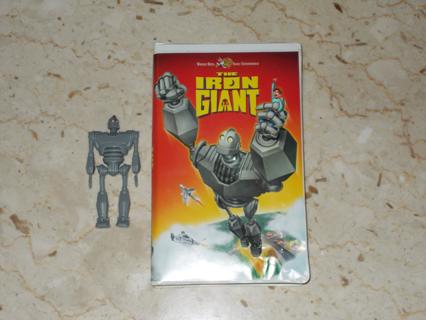
I dimly remember actually seeing this movie in the theater, but for whatever reason, what sticks with me more is getting it for Christmas, in a set with a toy figure (example photo, not mine) that was both exciting and yet I don’t think I ever actually played with. I seem to associate the story with winter scenes as well, even though I know there are summer scenes. I guess it takes place over a longer period of time than I thought.

I do recall that seeing the movie in the theater was at least one of the first times I allowed myself to cry at a movie (in a dark theater). The emotion that this movie draws out of celluloid is one of the main reasons that it’s endured as a modern classic and stands out against the more bland landscape of contemporaries that, unlike the perennial vintage cinema, we can still remember. In the nine(!) years I’ve been writing this blog, I’ve covered many movies from that year. Only a few of them come close to the legacy The Iron Giant immediately cemented.
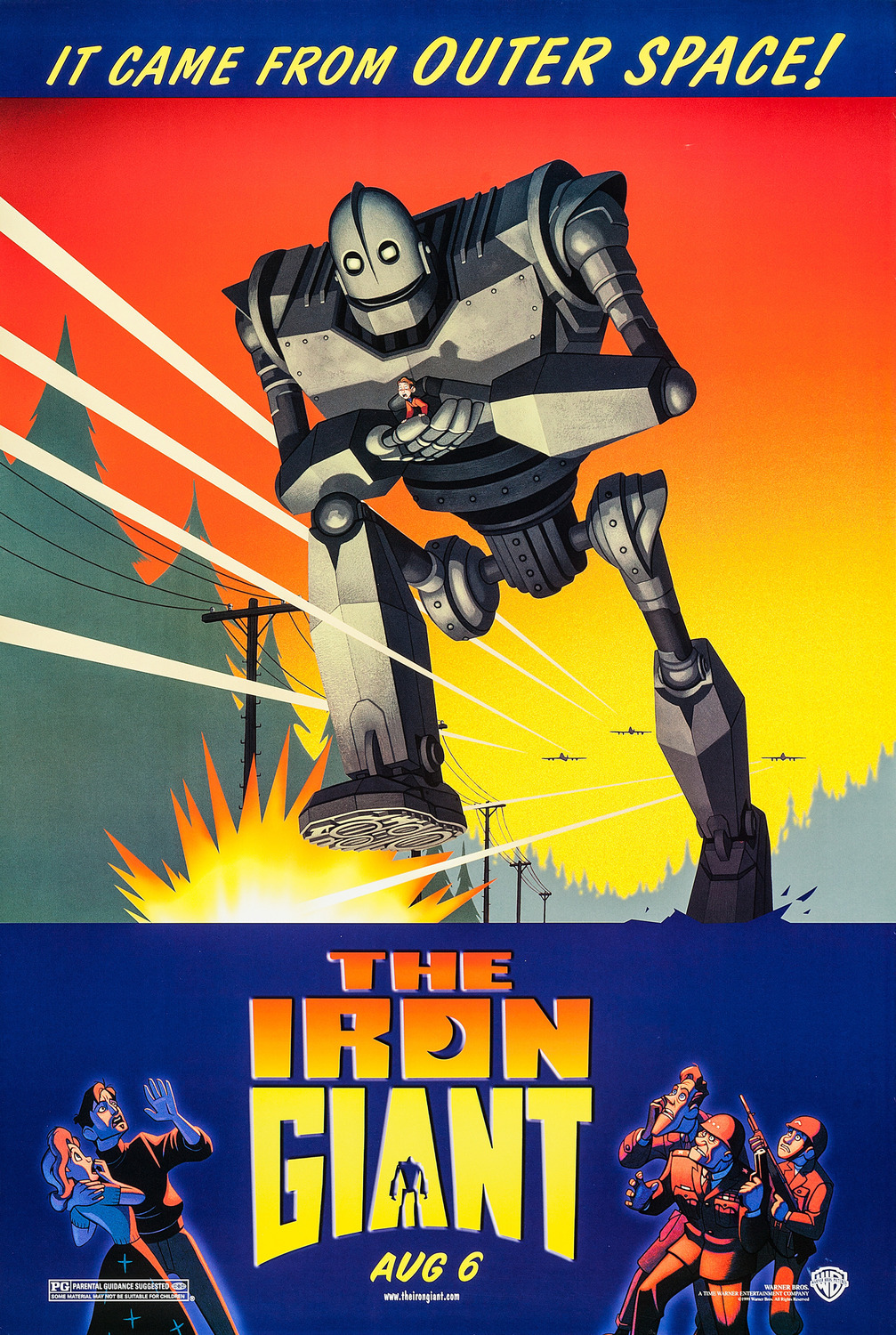
The Iron Giant. Warner Bros. 1999.

Hogarth, a boy in advanced classes with an excitable imagination outside of small town Rockwell, Maine, goes investigating his missing TV antenna and comes across a 50-foot tall robot from space! The giant robot, which eats metal, tries to eat a power station transformer, and gets tangled up in power lines, and Hogarth rescues him by pulling the shutoff switch. As Hogarth investigates, the giant befriends him, and they quickly form a secret partnership with junkyard artist Dean for the use of his scrap metal so the giant won’t go hungry. But the reports of strange sightings draw government agent Kent Mansley, a cold war G-man who sees Soviet threats in anything he doesn’t understand. Kent quickly susses out that Hogarth isn’t telling all he knows, and if he can get proof that there’s a dangerous weapon in Rockwell, he’ll finally get the respect he thinks he deserves.

This might not be the first time I’ve watched the movie since that VHS, but it’s the first time I’ve really noticed how much care was put into the art for this movie. I’m not sure I’ve seen better cel-shaded CGI before, but the Giant, Sputnik, and the missile are CG renders blended in so well it’s easy to forget they’re technically a different medium, and if they used it for other things, I couldn’t even tell or it wasn’t major enough to remember. However, the CGI was something I was aware of years ago. This time, I was also looking at the traditional animation, and especially the lovingly-created backgrounds. I think I’ve seen this movie called a love letter to traditional animated movies in an era where everyone wanted to make the next Toy Story, and I got it then, but I see it for myself now. As well, the music is quite evocative of cartoon features of a different age, and sometimes comes very close to evoking Looney Tunes incidental music.

My first instinct was to say that the messages of the movie are what makes it resonate, but there’ve been a lot of bad and forgettable movies with messages of “friendship is good, guns are bad, be yourself, help others, your past doesn’t define you”. What makes it effective is the execution. This story is not just character driven, but the characters express real emotion and profound thoughts that manage to all align to create a package of concentrated Feelings. It’s no wonder Pixar incorporated Brad Bird into their inner circle of creatives after this.

As the 1950s setting evokes a kind of nostalgia for a lost age of childhood, the movie is itself nostalgia for a generation, as it now approaches 20 years since its release. I’m sure that there are professional animators now who were inspired by this opus, and hopefully many of them are actually getting to do something close enough to that to satisfy them, as the market has moved away from traditional animation with any real budget for artistic flair. Being an inspiration is probably the highest honor a work of art can aspire to, and this is certainly one that has inspired careers as well as daily lives.
Blade

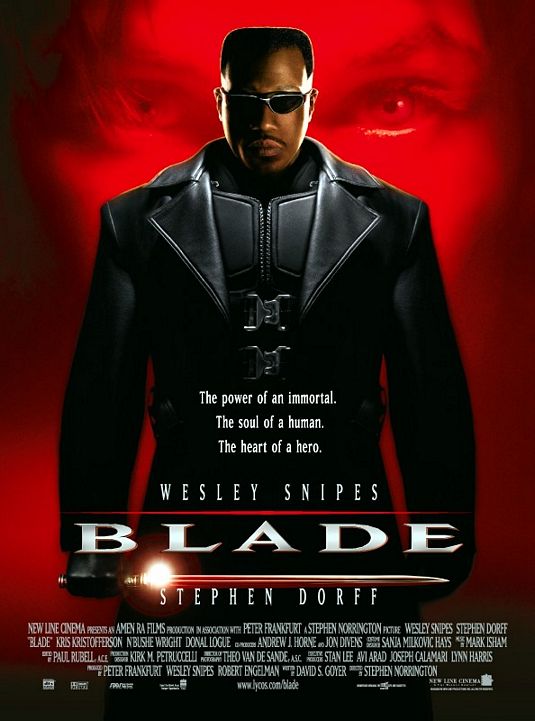
Blade. New Line Cinema 1998.

Before watching the movie:

I have no familiarity with the Marvel comics this is based on. For all I know, this movie was made because New Line had bought a package of cheap comics properties to turn a fast profit on. I don’t like to be so dismissive, but Blade is one of the most prominent notably black superheroes I can think of who aren’t carrying a legacy mantle, and I wouldn’t know that the book exists without this movie that exemplifies an era of moviemaking where “based on a comic book” was something to hide.

Lacking any of the brand recognition and shared continuity that makes comic book stories enticing now, this is essentially sold on the strength of Wesley Snipes slaying vampires with martial arts for two hours. Which is exciting enough if you’re into that sort of thing.

After watching the movie:

Thirty years ago, a baby was born to a woman dying of a vampire bite. Now, Blade is a Daywalker, a being without the vulnerabilities of vampires, but with many of the advantages, including super strength and speed and decreased aging. Blade and his partner Whistler save Dr. Karen Jenson from a vampire that eluded Blade’s assault on a vampire-owned rave, and they introduce Karen to the secret war to free human society from the elite order of vampires that secretly rule. As Blade fights vampire activity, a vampire named Frost manages to translate one of the ancient texts of the vampires, unlocking plans for a ceremony to bring about the age of the Blood Gods.

In the time this was made, comic book movies were often trying to be mature and serious while at the same time providing spectacular violence shows. This created a lot of movies that seem afraid to have fun, even as the stunt sequences the plots excuse are really fun and cartoonish. This has some really fun fight scenes, and the plot is pretty cartoonish, but the story and the fights often seem to belong to different movies because of how different they are in tone.

Most of the effects are highly effective. There’s a lot of work with prosthetics and practical creature effects that create convincing looks, and probably a lot of background CG that’s not noticeable. The disintegration of silver-stabbed vampires is really good for the time. The only time I was really taken out of the scene by bad effects was in the finale, with the demonic vampire souls flying around. That might have been partially caused by a frame rate mismatch, like how jarring the ED-209 was in RoboCop.

Even though there have been over 20 more years of superhero movies and Hero’s Journey plots further wearing out their cliches since Blade, the tropes this plot leans on seem particularly lazy. Developments in act one set up developments in act three with a megaphone. At least this movie introduces the character already established and just recaps the origin story, which is a rare approach. 

I have to respect that this was one of the vanguards of the modern rebirth of superhero movies, but it’s not a part of it. The success of movies like Blade and Spawn demonstrated that the market was safe for comic book movies again, but they didn’t do it by revolutionizing or commenting upon the genre, just by playing it straight. Often too straight, but I have to keep in mind how early this was. This is still a fun movie that doesn’t need too much of an excuse to explode some vampires, and that’s really all it had to be.

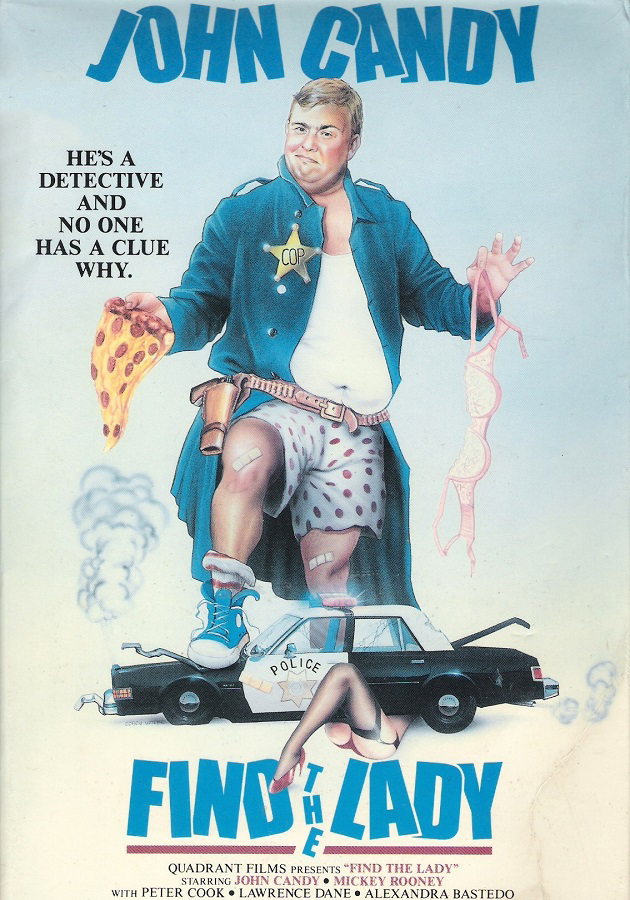
Find the Lady

Find the Lady.  Quadrant Films 1976.

Before watching the movie:

This is an old and (perhaps deservedly) forgotten movie from the early days of John Candy’s career. I’ve seen two wildly different posters for it, it was released under different titles, and his character has a partner the promotional material doesn’t care about because the partner didn’t become as famous as Candy.

So, my time would probably be better spent watching SCTV sketches, but here we are.

After watching the movie:

With the police force stretched thin, the chief wants to resolve the kidnapping of prominent businessman Lewenhak’s daughter Victoria quickly, and puts seasoned officer Broom on the case. Inexplicably, the otherwise competent Broom is the only one on the force who likes young oaf Kopek, and requests him as his partner. As it happens, Lewenhak planned the kidnapping with mafia thugs so he could use money from Victoria’s inheritance as “ransom” to pay off his own gambling debts. Only the thugs grabbed the wrong girl. And Victoria has run off with her boyfriend. And then gotten kidnapped by someone else. Now Lewenhak is trying to coordinate his business with the mobsters while allowing Broom and Kopek to tap his phone.

This seems like it’s mostly moving from one slapstick setup to another, yet it doesn’t actually have many showstopping slapstick gags. The plot is farcical, Kopek is a clumsy idiot, and Mickey Rooney is a goon frustrated that he doesn’t get to kill anybody, and nothing really comes together the way it seems like it should. Little makes sense beyond “this is supposed to be funny”. Sometimes it is funny. Sometimes I can just see what they were trying for.

One of the subplots is that Victoria is supposed to be an opera singer, but wants to be a cabaret performer, and is good at neither, and through that, a burlesque troupe gets involved. The comedy of mixing Broom and Kopek with them seems to be meant to come from how uncomfortable Broom is about everything. Even though the choreographer is a gay-coded man who refuses to stop dressing in drag once he starts, unless the punchline is simply “man in a dress, rimshot”, and given the quality of the writing and the time it was made, it’s entirely possible that’s what was meant, I think the jokes are mainly on Broom.

John Candy’s retroactive star power puts too much focus on the police investigators, but even so, they seem to be meant as stronger leads than they end up being. I was most interested in Lewenhak’s compounding problems, and I would’ve preferred a version where he was a proper Villain Protagonist, because he’s the most central character to the bumbling kidnappers plot that drives the story. And also because it would give Peter Cook more to do.

This movie was simply a waste of potential. It needed a few more rewrites before going into production. It fails at being a vehicle for the lead characters that were apparently established in a previous movie. It fails at holding interest. It often fails at being funny. The concept could’ve been a hoot, but it needed a lot of punching up.

The Survivors

The Survivors. Rastar Films 1983.

Before watching the movie:

It’s almost certainly just the snow and the 80s design aesthetic, but the poster makes me think of Spies Like Us a lot more than I should be.

Basically, these two New Yorkers lose their jobs the same week and their personality clash as they keep running into each other escalates to absurdity. Matthau and Williams may not seem compatible, but the central conceit is that they’re not compatible, so this could be a peanut butter and chocolate kind of combination.

Continue reading

Holiday leftovers

Put together a refrigerator turkey sandwich with some Yesterday’s Movies seasonal favorites.

Regular reviews resume next week.

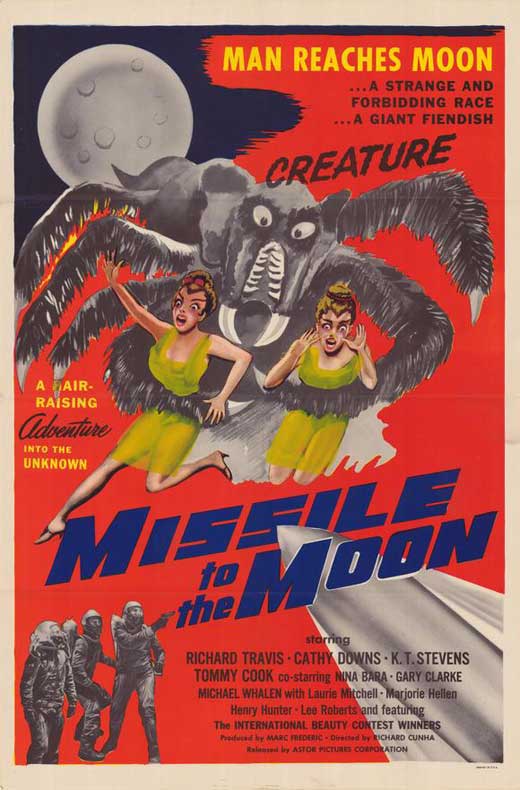
Missile to the Moon

Missile to the Moon. Layton Film Productions 1958.

Before watching the movie:

This looks like a typical B-movie sci-fi horror shocker. The all-women moon society might be interesting, and I’m looking forward to seeing how good or bad the monster is, but the most interesting angle is the fact that the ship is stolen in the first place. So that element probably won’t go anywhere.

Continue reading

The Third Man

The Third Man. London Film 1949

Before watching the movie

Apparently, this movie has appeared in the number two spot on a list of best British movies, and I only hear about it in discussion of lesser-known great Orson Welles movies. Welles is playing the (supposedly?) dead man, so, while even in the late 40s, you don’t cast Orson Welles as a corpse, his presence might be inflated by the fact that he’s the only recognizable name in the cast.

Continue reading

Miracle

Miracle. Walt Disney Pictures 2004.
Before watching the movie: I’ve heard many references to the “Miracle on Ice”, but only ever the broad strokes, that the US men’s hockey team in the 1980 winter olympics was not expected to beat the Soviet team, but they did. Those broad strokes leave out why anyone would still care about what happened then, and the closest I’ve seen to any explanation past the cold war rivalry has been “it’s an underdog story. The Russians were known for fielding dominant teams.” So here’s an underdog movie. Continue reading

Ed and his Dead Mother

Ed and his Dead Mother. ITC Entertainment 1993.

Before watching the movie:

This was not well-released, not well-received, and perhaps not well made. But it looks fun enough, unless they managed to choke the fun out of it in the poor execution.

Steve Buscemi seems to be intended to be the most normal character in the story, which is a strange concept to me. He’s long been leaning into the eccentric roles his features attract, but I think he might be the straight man here.

Continue reading

Attack of the Killer Tomatoes

Attack of the Killer Tomatoes. Four Square Productions 1978.

Before watching the movie:

I always knew that this was a horror spoof, but I didn’t realize it was a musical. It’s already under 90 minutes, and there are songs in it, so the plot will probably be very thin. But how much plot can be gotten out of running from murderous fruiting vines? Three sequels and a cartoon series, apparently.

Continue reading