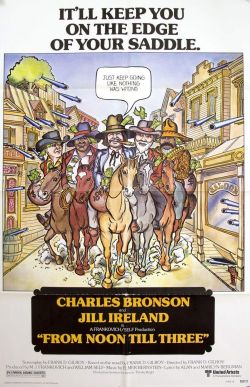
I’ve probably seen Charles Bronson in things before, but I don’t really recall him, and I don’t seem to have a tag for him. He is playing very against type in this movie, but I don’t really have a bearing on what that is other than “macho”.
I’m also not really clear on what this is about, since every summary I’ve seen seems to pick a different thread to focus on. There’s a bank robber who leaves his gang, there’s a widow whose story becomes a famous book, and it all starts with a life-changing three hours they spend together, and this is in some way a comedy. I hope I can keep my synopsis coherent.
I recall being disinterested in this movie when it came out, and not really seeing anything to change my mind. I’ve since had my fill of the Blue Collar Comedy guys in general, and I seem to recall seeing this have a poor reputation.
So why am I watching it now? I’ve come around to morbid curiosity. Tropic Thunder is probably a better movie, but most people agree on that. Now I want to see how badly Delta Force missed the mark.
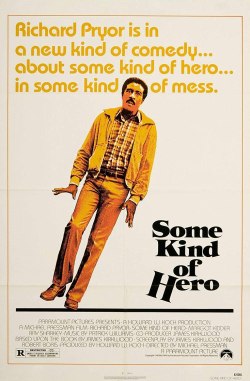
The first brief summations I read for this just say that the character is a veteran having a hard time coming home and getting into “trouble”. Which also describes First Blood. A slightly more involved summary mentioned that he ends up in a criminal heist for the mob, which I can certainly see being played for laughs or drama, and in fact, the book this is based on was a serious drama, but this is a dramedy because the studio insisted that Richard Pryor do comedic scenes. I think it will be interesting to see Pryor do as much drama as the suits will allow him to.
Despite having gone through a phase in my early teens when I got obsessed with and went through the filmographies of many actors including Christopher Lloyd, it seems I can still be surprised. I don’t recall knowing about this movie’s existence until immediately before deciding to review it. I was trying to find something weightier since it’s been a while since I’ve done good drama, but as soon as I saw Christopher Lloyd, my decision was made.
It seems this concerns a no-rules retreat camp created by teens who don’t want to be sent away to the camps chosen by their parents. I’m not sure how much my impression that the poster wants me to think it’s “Animal House, but with teens” comes entirely from the fact that Lloyd’s character is wearing a toga. Also the girl in the swimsuit seems a bit shoehorned in I guess.
One thing I recall about the circumstances of the George of the Jungle release was that it seemed to come out at about the same time as Disney’s Tarzan, but apparently this actually predates it by two years. Given what I know about animation production schedules, Tarzan was probably already in the works when they started on this, but just came out later. I now recall that it wasn’t until the direct to video sequel that they were able to reference Tarzan.
However, this was definitely part of a wave of Jay Ward cartoon adaptations made in the late 90s. As much as I like 2000’s The Adventures of Rocky and Bullwinkle (so much so that I did a redub of a sequence for college mainly because I thought there was a bad music decision that I wanted to fix. How did it go? Okay enough.) and Dudley Do-Right, I think this was the best of the bunch. Though it’s possible that’s just because I never saw any of the George of the Jungle cartoon, so I don’t know how badly it was changed. That didn’t stop me from loving the Inspector Gadget movie though.
George of the Jungle. Mandeville Films 1997.
Fabulously wealthy San Francisco heiress Ursula Stanhope has come to Burundi to explore the jungle, but is surprised when her equally rich but pompous fiance Lyle Van De Groot tracks her down and joins her expedition, insisting they should return home as soon as possible for the wedding. Lyle has been accompanied by two poachers who are after the White Ape, a legend of the Burundi jungle that could get them a fortune. In reality, the White Ape is actually George, a human who was lost in the jungle as a baby and raised by apes, and now is the King of the Jungle. When Lyle and Ursula are attacked by a lion, Lyle tries to abandon Ursula and run away, and George swings in to save her, bringing her back to his treehouse to help her recover from the shock. When Lyle and the poachers find Ursula and George’s treehouse, there’s an altercation that leads to Lyle accidentally shooting George, leading Ursula to bring him back to San Francisco for medical care. Having seen Lyle for the selfish coward that he is, next to the humble and gorgeous hero George, Ursula now finds herself with questions about her future, much to her status-obsessed parents’ chagrin.
Maybe this is again because I’m not familiar with the source material, but it still feels like this movie more naturally adapted to modern styles than the other cartoon movies I named above. It’s a cartoonish slapstick farce with a lot of self-aware commentary, sometimes even not delivered through the narrator, but it meshes with the 90s writing aesthetic somehow. George is a timeless klutzy hero, but Dudley is a relic of a different era, and Rocky and Bullwinkle spend their entire movie commenting on how they’re 30 years behind. The narration is really the only anachronism I can find in this movie, and the Narrator is a comic character in his own right.
There were things I was expecting in this movie that I guess I was remembering from the sequel. This is entirely in the jungle and in San Francisco (because the Americans won’t be interested if we don’t take the hero to America), except for a tag with Ape in Las Vegas, and I think I was remembering more scenes in other locations that are probably from the plot of that movie.
I still like this movie as much as I did then. The naked product placement was more noticeable now, but it didn’t bother me because it was often the joke. This is my favorite Brendan Fraser movie, and he did some great work in the 90s and 00s. George of the Jungle is a friend to you and me.
The premise as I’ve seen it summarized sounds like it could be just a framing device. A recently deceased prankster’s final wish on the afterlife’s doorstep is to watch his three poker buddies’ reactions to receiving letters from him stating that he’s had an affair with all three of their wives. They can’t even be sure if it’s the truth or one last prank. It sounds like the prankster could set the scene for us and then drop out, or mainly appear in flashbacks, but mostly this seems to be a bowl of jealously-fueled comedy arguing.
From how hard the movie is trying to be sold as a wacky comedy, I would expect that the change that Avalon’s undergoes in space would be really wacky, like he comes back really loopy, or having switched minds with his simian copilot. At the very least, “Deadhead” suggests to me an “idiot comes turns smart” story, which isn’t necessarily funny. But the summary I read says that he returns with a more “aggressive” personality. That doesn’t necessarily sound funny. Maybe it’s funny because he’s aggressive like a chihuahua, overconfident in his abilities.
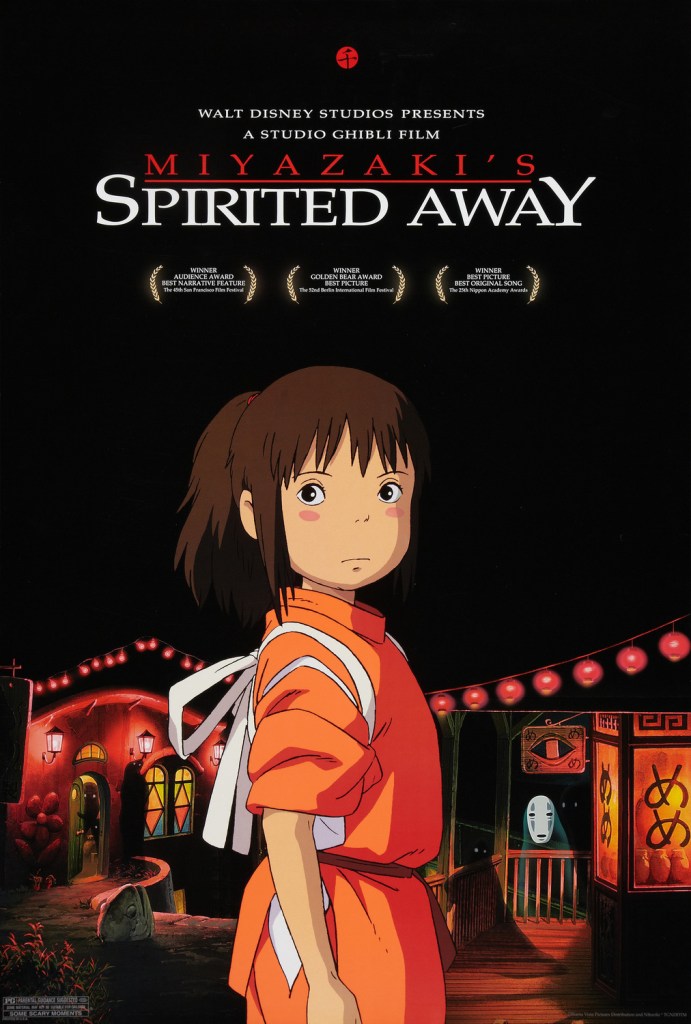
Spirited Away (Sen to Chihiro no Kamikakushi).Studio Ghibli 2001.
Before watching the movie:
I don’t know anything about this movie except that it seems to pretty consistently be considered the best Studio Ghibli movie. And I recall the title refers to something about the character being stuck in a place of spirits. I’ve seen most of Kiki’s Delivery Service, but that’s all of Ghibli I’ve seen despite having several friends and former roommates who have extensive collections.
I rarely go into movies as cold as this. Usually I have descriptions from boxes or streaming platforms, but with this one, I just decided “we’re going to watch this movie everyone loves”.
I don’t know what I would’ve been there to see, but I’m pretty sure I saw a trailer for this movie in the theater. I don’t think I got from the trailer that he was a comic, but they might as well make it thoroughly a Chris Rock vehicle by giving him a stand up career.
I’m interested to find out what reason the movie comes up with for why Lance can come back but not as himself.





 Yesterday's Movies