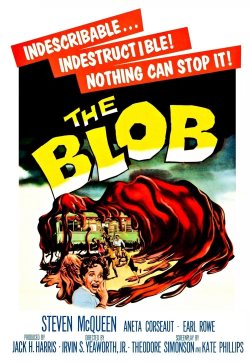
This is one of the most iconic 50s sci-fi monster movies, from what I understand. Alien jelly from space lands on a meteorite and threatens to eat a small town. It’s both a very typical 50s b-movie plot and also has the unique element of the monster being completely unlike any animal entity we’re familiar with, more of a force of nature than anything we usually have to reckon with in this genre.
I think I first heard about this movie about a decade ago, somewhere on the internet. I don’t really know much about it other than that Christian Bale plays a serial killer business executive and it’s somehow really popular. There was a parody of a murder scene where Huey Lewis kills Weird Al for doing a middling parody of one of his songs. It lives in my mind next to American Beauty which I don’t think is much related at all, but I expect it to be more like Fatal Attraction.
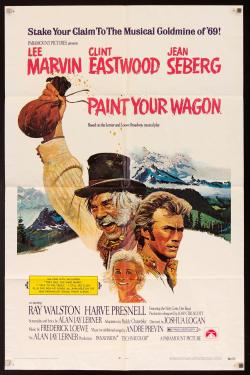
I didn’t mean to put two westerns back to back, but I couldn’t finish a month of musicals without Paint Your Wagon and I didn’t realize this was a short month.
I know precious little about this movie other than that it has Western movie stars not known for singing bafflingly cast in a musical. And I also know about the Simpsons taking the mickey out of it, but it’s so ridiculous that it has to be completely unrelated to the actual movie, no matter how ridiculous the movie itself is.
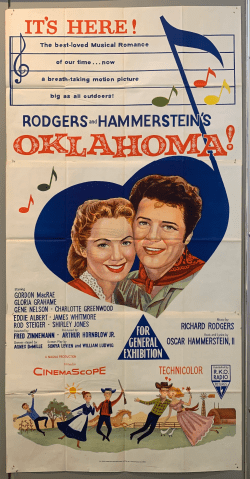
I have no idea what this is about, other than that it’s set in Oklahoma in the 19th century and has a lot of songs that have become standards with lives of their own, maybe more than any other.
I guess it’s a love story on the prairie? I have nothing to go on but those famous songs. It’s almost certainly going to have a lot of scenes outside for the purpose of taking advantage of being a movie and no longer a stage play, but how much will that actually matter?
After watching the movie:
Cowboy Curly McLain has a prickly relationship with Laurey Williams, farm heiress. They both take quite a lot of sport out of knocking each other down a peg, and while neither of them would admit affection for each other, they are both secretly fond of one another, something that Laurey’s Aunt Eller, the widowed owner of their farm, can plainly see. Everyone in the region is excited about a box social being held in the evening, and Curly comes to suggest that Laurey go with him in a fancy wagon he will be renting, but Laurey already accepted the invitation from her hired hand Jud. Jud is a simple, brutish kind of man, but when Laurey starts to think about breaking off with him to go with Curley, Jud’s response suggests it would be dangerous to disappoint him. Meanwhile, Will Parker, another cowboy, has just returned from the fair in Kansas City and, having won a roping contest, now has the $50 his girlfriend Ado Annie’s father said he wouldn’t be allowed to marry her without. But while Will was away, Annie, a fun loving, variety seeking girl, has been taking up with the traveling peddler Ali Hakim, a man who is clearly in a habit of leading on girls with promises of marriage he doesn’t intend to keep. Annie’s father, especially keen to keep Will from marrying his daughter, pressures Ali to marry her instead, and Ali starts searching for any way out, like helping Will press his agreement with Annie’s father while trying to also keep his intentions from Annie, though Will has his reservations about marrying so flighty a girl. As Jud and Laurey drive to the box social, Jud tries to force a kiss on her, and she wrestles him away, whips the horses into a bolt, and takes off for the dance alone, with Jud swearing not to let her be rid of him so easily.
Early in the movie, I felt like none of the songs were really doing much to build the plot, but somehow I didn’t care as much about that as usual. Maybe it’s because the stakes were relatively low and the songs were familiar, but for a long stretch of the movie I was happy to let the story take a back seat to yet another song painting a picture of romanticized, whitewashed rural life in the Oklahoma territory. I only particularly felt they should be getting on with it during a couple of incredibly lengthy dance numbers. By the time we get to the box social the plot has finally fully engaged, and I was fully engaged with it. However it’s weird the lengths the movie went to to make sure everyone knows within Code decency how violent and perverted Jud is and then treat him as so minor a complication to Curly and Laurey’s romance that the fight that finishes him for good is pretty much over the minute it begins, and Curly has no figurative blood on his hands whatsoever.
I have tags for some of these actors so I must have seen them in other things (I particularly remember the name Gordon MacRae but I couldn’t tell you what I’ve seen him in). The one exception is that I knew the Persian peddler Ali instantly as Oliver Douglas of Green Acres, Eddie Albert. His accent is all over the place and I’m not sure it has any resemblance to a Persian accent, but then neither is his appearance, and that’s par for the course with productions from this era. But knowing him from a kooky TV sitcom made it especially weird to see him playing such a rake, even if a bit of a bumbling one.
At least three songs have gone on beyond this musical. Everyone knows “Oh What a Beautiful Morning”, which is a beautiful song about not very much, and “Surrey with the Fringe On Top” is just as much a chestnut (though I was surprised that the original lyric was “Isinglass curtains” and not “clear glass curtains”. I had to look up Isinglass, but it makes infinitely more sense to call that substance “curtains”), and I was surprised how late the title song, perhaps most famous in my generation for the Sesame Street skit where the muppet keeps getting the wrong opening vowel, comes in. It’s not nearly as prominent a song as the other two, which are major recurring themes.
The story is a bit unusual, but somehow I’ve never been more okay with letting the plot slide while the show takes more interest in its musical numbers. Almost all of them are worth the time, even if they aren’t about much of anything but a mood. I’m not sure what it means to romanticize a past where just about everyone is excited about impending modernization, but on the other hand, I miss being excited about the future too, so maybe I do understand it. This is just a portrait of an idyllic day in an idyllic time, and it’s nice to be in that space for a little while.
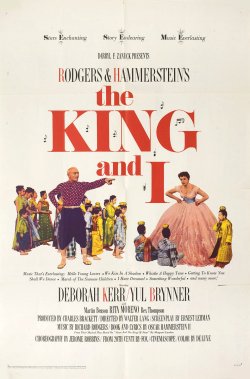
This is one of the most enduring musicals of classic Hollywood (an era I’m sure some would argue I’m stretching). I always had the sense it was something of a modern fairy tale, a common woman swept into the royal court and falling in love. It didn’t seem that interesting except for how popular it is. I think I’ve come across before that she’s there to teach the king’s children, but I keep forgetting it. I also don’t always remember that the king is Siamese until I remember that another title in its orbit is “Anna and the King of Siam”, which explains why his fashion doesn’t look much like the Western perception of kings.
I may have encountered this in some dusty streaming back catalogs or cheap collection of classic movies, but it didn’t appeal much to me on the face of it. Much more recently, I learned that it’s the source of the tongue-twister scene I think I saw in an AFI special about “the pellet with the poison is in the vessel with the pestle”, which I always wanted to find. The climactic swordfight is also highly praised by fight choreographers, I believe coming behind few other than the famous Princess Bride duel.
I’ve seen a few other Danny Kaye movies, but I only just now realized I might have been confusing him with Dennis Day occasionally. Kaye seems to be someone who used to be much more appreciated, but has been forgotten since the New Hollywood revolution.
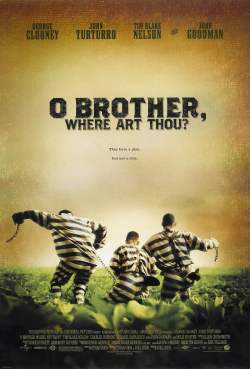
While I first watched this movie in high school, I think 9th grade English, it also has significance to me as the reason, or at least the excuse, to get Netflix. I had an assignment in a media class to analyze a scene and my group got O Brother Where Art Thou? and I used a free trial to get us a copy of the movie faster than the library could get it to us. That subscription back in the day made catching up on all the movies I’d never gotten around to possible, and while I was doing that and having opinions on them, I was looking for a creative project to put on the internet because I was also really getting into the heyday of webcomics. I didn’t think I was up to drawing a regular strip or making videos on a sustained basis at the time, but I could watch movies, have opinions, and share those opinions.
I’m glad to be able to say that in almost fifteen years, I’ve had something online every week, and I think I can still count on one hand the number that were just apologies for not even having old posts to recommend. I had a review online every week during a month where I had a full load of classes, a part time job, an assignment to write a novel in a month, and a weekly video series for my sketch comedy group’s blog. I got something up in weeks when I was moving all by myself and didn’t have internet service set up yet. I don’t remember what it was but I got something up the week I got married. I wanted to prove to myself I could stick to a posting schedule and it’s only in the last few months that I’ve had to evolve from staying up late on Thursday night to have something for Friday to writing over the weekend to have something by Monday. I’ve seen great movies I might not have gotten to without this push, and I’ve had a good excuse to rewatch movies I already loved and share why I love them.
Ulysses Everett McGill, a man with the gift of gab, leads his fellow convicts Pete and Delmar in an escape from their chain gang with the story of loot from a heist that he buried back home in a place that will be flooded to build a dam in just a few days. They go to Pete’s cousin for help, who immediately turns them in to Sheriff Cooley for the bounty, barely escaping the barn Cooley’s men try to burn them out of. Picking up hitchhiker Tommy Johnson, who says he sold his soul to the devil for guitar talent, they stop at a radio station where “a man will pay you to sing into a can” and record a song for some cash under the name “Soggy Bottom Boys”, then part ways with Tommy again. The gang is separated when some women at a river washing clothes drug them and when they wake up, they find Pete’s clothes laid out with nothing but a frog inside, and assume that they turned him into a frog, when really he’s been turned in for bounty, and confesses the location of the treasure under torture. Meanwhile, Everett and Pete arrive in Everett’s hometown and Everett meets up with the real reason he escaped from prison: his ex-wife is remarrying. All the while, the governor’s race is coming up, with the reform candidate Homer Stokes running a much more popular campaign than the incumbent, flour mill owner, and radio show host Pappy O’Daniel, and the people can’t get enough of that Soggy Bottom Boys record.
Even on this viewing, I can’t really tell how much was directly pulled from The Odyssey. There are the most obvious allusions, but they seem fairly superficial. Most of the misadventures along the way don’t seem to map to specific challenges faced by Odysseus, aside from the Sirens and the Cyclops, but especially the Cyclops is very surface level. It’s much easier to read the movie as a sketch of rural life in the Great Depression that draws some references from mythology to heighten the sense of being the little people in a world ruled by titans.
I’m surprised to learn that the central song of the piece, “Man of Constant Sorrow”, pre-existed the movie just as much as the other bluegrass and gospel music that is a persistent presence through the movie. I’d thought that it was written for the movie to specifically fit the mood they wanted for such a popular song and because “the man of constant sorrow” was one of Homer’s epithets for Odysseus. I see that the epithets include “much-enduring” and “man of pain”, but it seems that while “constant sorrow” could fit as other translations of those, it doesn’t seem to have been used in a popular enough translation to be significant. Regardless, it’s undeniable that the song was perfected for the movie.
I was always a bit confused as to the intended race of the characters. They’re played by three white men, but people keep calling them “Colored” or “miscegenated”, and while they do occasionally partner with Tommy Johnson, a Black man, they also have visibly darkened skin tones. For a while I thought that was some kind of aesthetic choice where they constantly have dirty faces because they’re working class in the Great Depression, but the thought crossed my mind this time around that they were meant to be mixed race, which would be a really bad look for a movie where a popular character gets run out on a rail the minute he outs himself as a white supremacist (a very 1990s moment). I’ve only come to realize now that they’re heavily tanned from working in the sun on the chain gang and the comments specifically from people who can see them are just about how they work with Tommy.
If anything, I’m more certain now that this movie is more about playing with historical and mythological elements more than taking them seriously. And that’s okay, remaking the old ideas in new ways is an important part of mythology and of storytelling. The story doesn’t feel as epic or meaningful as the way in which it’s presented seems to want it to be, but that just makes it more dreamlike, giving it the feeling of fantasy in a setting where everything has a natural explanation if you want it, but it’s not always the most compelling one.
I’m not entirely sure what the full context was when I saw this movie. I have a clear memory of watching it in a classroom, but I don’t think it was for the Science and Ethics class. I’m not really sure what scientific or ethical discussion could be had from this story. I think it was a “it’s the last week of classes and nobody’s getting any work done” kind of presentation. The main thing I remember is how deeply disturbed I was by it.
A man wakes up in a hotel bathroom with no memory of who his is or where he is. The phone rings, and the man on the other side, Dr. Schreber, tells him that people will be coming for him and he needs to get out. The man in the hotel room finds a murdered woman and a bloody knife in the bedroom and runs. This is John Murdoch, or that’s what all the evidence says, anyway. When the trenchcoated Strangers catch up to Murdoch, he discovers he has the ability to bend reality with his mind, which the Strangers recognize as “Tuning”. Inspector Bumstead gets assigned to the case of the serial killer who kills and decorates prostitutes when the previous detective on the case has a mental breakdown, and now they have enough clues to identify a suspect: John Murdoch, who left his wife Emma three weeks ago when he learned she was having an affair and must have snapped. But the night he woke with no memories, John went up to a call girl’s room and found he didn’t have it in him to do anything. At midnight every night, everyone except John falls asleep and the city rearranges itself according to the Strangers’ design, while Dr. Schreber injects new memories into those they have selected to place in different lives as part of their experiment. John has dim memories of growing up in a place outside the city called Shell Beach, which everyone has heard of and nobody can quite explain how to get to. With new plans in mind for John, the Strangers plan to track him down by injecting one of their own with the memories he was supposed to receive.
This movie has the least light I have ever seen in a movie. People are complaining now about how it’s impossible to see anything in modern movies and TV, but this might be even darker than what we get now. That’s definitely meant to echo how the sun never rises in the city, but as all of the frustrated audiences are saying now, there’s a limit. I definitely was hindered by watching in a brightly lit room, but I don’t know how much better it would have been in a darkened theater.
The Strangers’ experiment is supposed to be about understanding what changing memories does to the human soul, but I don’t think the point was made successfully. Aside from people slowly starting to notice that the world doesn’t make sense, I don’t really see very strong demonstrations of people staying the same in different lives. We only really see two people on either side of an imprinting, and one is basically the same guy but in a very similar setting, and the other one falls asleep telling one side of a story about a work dispute, and wakes up telling the other side of it. There’s altogether some very interesting ideas presented, but the mystery builds so slowly that I’m not sure much is really done with it. Even the climactic final battle is kind of a silly obligation. John gets slipped a syringe full of everything he needs to know (an actually impressive sequence, but not a heroic moment for John) and proceeds to have the goofiest special effects fight where he and the leader of the Strangers glare intensely at each other for a couple of minutes while the environment around them falls apart.
John is so much of an everyman type that I completely forgot about him in the years since I first saw this movie. Schreber, the creepy doctor who works for the Strangers under duress so you’re never fully sure if you can trust him, was incredibly memorable. I realized a little later that that was Keifer Sutherland, best known as the lead on 24, which is an incredibly different role. I’m never going to forget how disturbing Schreber was played, and I don’t necessarily see a reason for that take.
I really thought I’d missed something from the plot the first time around, but it really is just the puzzle box. By the time we understand everything, the movie is over. You’re left with the striking, if dim, visuals and some questions about identity that I think there was an attempt to make a statement on. This is a popcorn movie trying to philosophize, and it’s disappointing it isn’t all it wants to be.
This is a movie I was shown in high school as part of a discussion on genetics. It was a non-standard interdisciplinary class in literature and science that used sci-fi as a jumping off point to discuss scientific concepts and ethical dilemmas, and one of my favorite classes even before factoring it that it was taught by a teacher I already knew and liked well.
In a future where genetic engineering and sequencing are commonplace, few are conceived naturally, without the opportunity to screen candidate embryos for genetic diseases and make enhancements for superior abilities. Vincent Freeman was conceived the old fashioned way, and his genes mark him as an incredibly fragile and deficient “in-valid”, projected to die of a heart defect in about 30 years. Ubiquitous genetic testing and identification means that he’ll never be allowed to pursue his dream of going to space on his own identity, but a black market dealer in “borrowed ladders” connects him with Jerome Morrow, an English swimming champion now paralyzed from the waist down, who looks similar enough that, with help from daily samples of bodily fluids and studious replacement of any of Vincent’s own dropped hair and skin cells with Jerome’s, Vincent is able to fake his way into Gattaca as a mission navigator for an upcoming flight to Titan. Then, a week before launch, an administrator is murdered in the offices and the police find a hair on the scene that identifies as belonging to Vincent, an In-Valid unauthorized to be there, leading the police to start combing the facilities for an impostor among the Gattaca elite.
What stayed with me the most the first time around was how mundane the space travel was. These astronaut candidates are working at a desk in suit and tie jockeying in the bureaucracy until the launch day. I don’t really understand how Gattaca works as a business either, as it’s not clear why they do what they do. They just send rocket after rocket every few hours and I don’t think it’s ever explained. The focus is meant to be on the total genetic surveillance, but as a certified Space Kid, I just had questions about the space program, and I still do.
What struck me this time is how all of the Valids are always wearing immaculate suits, except for when doing the physical training for missions. I suppose this is meant to visually signal class, since most In-Valids we see are in coveralls even when not working, but it seems a bit silly to me that we never see the real Jerome wearing anything other than a perfect three-piece suit even though there’s only one scene where he’s left the house. By all means, his attire is justified when Vincent takes him to the speakeasy for people involved in black market genetics, but most of the time he’s just collecting samples of himself and generally living as much of a leisurely life as he can from a wheelchair, hiding from the world because he’s renting his identity to someone else and ashamed of his lost potential.
It is altogether very striking now, the retro design of the movie. The clothes lend a Film Noir feel, even though the cars are more based on midcentury models, with electric motors dubbed over. The detectives pursuing their hunt for the impostor at Gattaca is even more Noir.
However, I also have much more perspective on the discrimination shown. The warnings of a divide between the technological haves and have-nots I encountered in the 90s and early 2000s seemed academic at the time, but the realities are becoming clearer as we become more connected and more aware of what we’ve given away to big companies, in the technology sector and otherwise. I see that a lot of the criticism directed at the movie by geneticists is that Gattaca has a right to screen astronauts for perfect health, and that’s fair. It’s even reasonable for Gattaca to use genetic samples to identify who is and isn’t authorized to be in certain areas (this surveillance seems omnipresent, but I think that’s because we only see Gattaca and the police). But it’s missing that the only jobs that people without flawless genes can get are unskilled, low-paying labor because every single company wants to use genetic screening to deny jobs for the slightest flaw, and will flout privacy laws by quietly stealing samples from licked envelopes, doorknobs, handshakes, anything they can get.
It doesn’t matter if geneticists say that markers of likelihood for abnormalities are not guarantees, it matters that the employers and insurance companies believe in genetic determinism, or at least find it convenient for the discrimination they want to justify. Throwing away perfectly good applicants based on bad genes isn’t much different than throwing away resumes that were only evaluated by an algorithm or refusing to allow good people without the right government documents to enjoy the full opportunities of the society they live in and contribute to. The ingrained prejudices in the world presented are enabled by genetic technology, not created by them, much like how the disaster of Jurassic Park is caused by hubris and greed that happened to allow resurrected dinosaurs to escape their containment.
This movie is visually striking, narratively compelling, and obviously opens doors to conversations, making it a clear choice for my ethics class. This fully realized vision is probably going to be the definitive take on genetic dystopia for a long time.
This month I’m going to cover a very particular set of movies I’ve already seen before. These are some of the movies I saw for the first time shortly before beginning the blog, and had opinions about. They’re movies that are in many ways responsible for the concept of Yesterday’s Movies as a project.
Super Mario Bros.was maybe the first movie I rented on Netflix for myself. It was infamous on the internet and I decided to see what the fuss was about. And it’s definitely an extremely weird movie.
Millions of years ago, the meteor that struck the earth and killed the dinosaurs created a pocket universe the size of New York where the dinosaurs lived and evolved into people who look exactly like humans with extreme hair gel effects and a taste for spiky clothes. Twenty years ago, Koopa led a coup to replace the benevolent ruler of the Mushroom Kingdom as dictator “President”, but the queen managed to escape to the outside world and hide her daughter along with a piece of the meteorite that opens the gateway between worlds. Now, Mario Mario and his kid brother Luigi Mario run Mario Bros. Plumbing in Brooklyn, but are losing business to Scapelli Construction, which is currently being stymied in a big development project by the local university trying to study and protect an extraordinary fossil collection unearthed by the project blasting. After giving Daisy, the leader of the study, a ride, Mario suggests that Luigi take her on a double date with him and his girlfriend Daniella, and when Daisy takes Luigi to the site after dinner, they find Scapelli goons trying to flood the place, leading Luigi to call Mario to help. While fixing the sabotaged pipes, Koopa minions Spike and Iggy grab Daisy and drag her through a portal between the worlds, with Mario and Luigi, who managed to grab the stone necklace that has been Daisy’s only tie to her mother her whole life, following to the rescue. And then things really get weird.
Whenever I think about the lore of this movie, I try very hard to keep in mind that this movie came out a year before Charles Martinet’s very first time playing Mario, so basically the only way anyone had interpreted Mario beyond a collection of pixels that went beep when you press jump was The Super Mario Bros. Super Show. That at least makes the casting and costuming of the heroes make a little more sense. I still can’t get past how somebody seems to have given the designers the instruction to completely ignore anything from the existing games and cartoon show and just go nuts with spikes and leather and hair gel and wrought iron. This movie looks like it wants to be Blade Runner or Demolition Man (I could swear they’re using the same stage for the city streets) and is trying very hard not to be a cartoon. Mario and Luigi don’t even wear their iconic colors until almost exactly the one-hour mark. In fact, Luigi spends most of the movie in red and Mario spends a lot of the movie in green. I feel like it helps a lot that now, thirty years later, there is a movie based on the franchise we now know. But when I’m watching this, I still can’t help but question every single choice made, and how it actually relates to the world of Mario circa 1993.
I was always confused why they used Daisy and not Peach for the Princess, but maybe it’s because they decided the Princess character worked best as a Luigi love interest and Peach is more associated with Mario. It’s still totally out of nowhere that Mario has a totally normal Brooklynite girlfriend named Daniella. I suppose if they made this movie now, they would have drawn from the game lore and used Pauline, the damsel from the original Donkey Kong who was brought back in stylish fashion as the mayor of New Donk City in a recent game, but nobody was doing that deep a read on the franchise in 1993. Maybe the most bizarre departure from expectations is that the Mushroom Kingdom name and prevalence of mushrooms in the game is interpreted as a slime mold infesting the whole city that turns out to be, in its own way, acting against Koopa too. Maybe there was a mistranslation involved.
I have to admit that Bob Hoskins plays a great Bronx plumber. It doesn’t seem appropriate that he spends most of the movie following behind Luigi, cleaning up after his mistakes, and dismissing his ideas that turn out to be correct like the helpful fungus (again, Luigi is the one in red for the first two acts), but there comes a moment when Mario goes from reacting to taking action, and then he feels like a hero. Whatever Dennis Hopper is doing, it’s nothing like Bowser/Koopa, but he’s a very entertaining villain who leaves no scenery unchewed. John Leguizamo is as charming as can be and I might in some ways like his take on Luigi more than some of the more flat interpretations of the character as voiced by Martinet. And Daisy is that special kind of late 80s/early 90s girl character who’s tough and capable and feels well-rounded and still spends most of the movie captured and waiting for the heroes to rescue her.
I can’t deny this is a really fun movie, sometimes even beyond its own expense. Once you let go of what you expect Mario Bros. to be post-Mario 64 and try to accept it for what it’s trying to do, it’s a bit nostalgic in its own way. I may not have seen it until after 2009, but there’s a kind of tone here that reminds me of other movies made in its day that I did see at the time. This is best watched with friends to mock it with you, a beer or similar if you partake, and plenty of popcorn that you might at some points throw at the screen, but a good time will be had, if you’re ready to take the movie as unseriously as it takes the source material.






 Yesterday's Movies