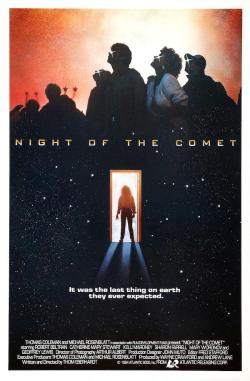
The one thing I know about this movie is I’m pretty sure it’s the standard-setter for modern “fast zombies”. I don’t consider myself a horror fan, so I wasn’t that interested at the time. Now I’m doing a zombies month and dip into horror a few times a year on this blog so I guess my tastes have expanded, but it’s still not one of my top genres.
Looks like a lot of wasteland-type zombies, maybe similar to I Am Legend, which was a zombie movie even if the look in that one was more like vampires.
Night of the Comet. Coleman and Rosenblatt Productions 1984.
Before watching the movie:
I’ve heard this movie mentioned here and there but never that much about it. I didn’t even know the thing that happens the night that the comet comes is zombies until I was looking for zombie movies.
I really don’t know what else to expect. There’s a comet, and something happens, and zombie apocalypse, and it’s considered pretty good but not good enough to be that remembered in the mainstream.
I pointedly stayed away from this movie. I didn’t want anything to do with the 2012 doomsaying because it was a load of bunk and hucksters were coming out of the walls to scare and fleece people, so I certainly didn’t want to touch the big blockbuster movie profiting off of that hype. Anything cosmological being cited was clearly nonsense or overblown, and the much-touted Mayan calendar was almost certainly a case of “plotting out thousands of years in the future is good enough for now”. But I think twelve years (15 years since release) is enough time to put some emotional distance in place.
I didn’t know this movie existed before I decided I wanted to collect some disaster movies. It’s about a volcano erupting under Los Angeles. Tommy Lee Jones is in it. I don’t really know anything else, so I have nothing to say and I’m basically going in cold. Saying anything else would be padding out this section to try to get it closer to the height of the movie poster, which is just not going to happen this week because I have nothing else to say.
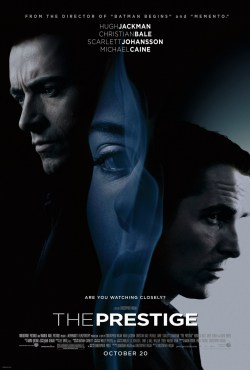
I think the main thing I know about this movie is the big secret that drives the plot. The core mystery is about finding out how a magic trick is done, so I suppose it’s about a younger or rival magician trying to learn the master’s secrets. I’m not sure how an entire movie can come out of that, so I don’t know what’s going on around it.
I believe I’ve heard there’s a lot of Christopher Nolan’s philosophy of moviemaking in how the character approaches being a magician. I recall some discussion of looking through this movie for clues of what Nolan was going to do with the Dark Knight trilogy, or that The Dark Knight Rises was going to be Nolan’s Prestige in the trick he was performing with Batman. I’m not sure that panned out, but speculation drives engagement.
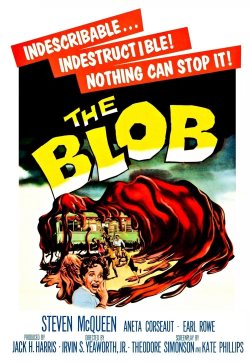
This is one of the most iconic 50s sci-fi monster movies, from what I understand. Alien jelly from space lands on a meteorite and threatens to eat a small town. It’s both a very typical 50s b-movie plot and also has the unique element of the monster being completely unlike any animal entity we’re familiar with, more of a force of nature than anything we usually have to reckon with in this genre.
I’m not entirely sure what the full context was when I saw this movie. I have a clear memory of watching it in a classroom, but I don’t think it was for the Science and Ethics class. I’m not really sure what scientific or ethical discussion could be had from this story. I think it was a “it’s the last week of classes and nobody’s getting any work done” kind of presentation. The main thing I remember is how deeply disturbed I was by it.
A man wakes up in a hotel bathroom with no memory of who his is or where he is. The phone rings, and the man on the other side, Dr. Schreber, tells him that people will be coming for him and he needs to get out. The man in the hotel room finds a murdered woman and a bloody knife in the bedroom and runs. This is John Murdoch, or that’s what all the evidence says, anyway. When the trenchcoated Strangers catch up to Murdoch, he discovers he has the ability to bend reality with his mind, which the Strangers recognize as “Tuning”. Inspector Bumstead gets assigned to the case of the serial killer who kills and decorates prostitutes when the previous detective on the case has a mental breakdown, and now they have enough clues to identify a suspect: John Murdoch, who left his wife Emma three weeks ago when he learned she was having an affair and must have snapped. But the night he woke with no memories, John went up to a call girl’s room and found he didn’t have it in him to do anything. At midnight every night, everyone except John falls asleep and the city rearranges itself according to the Strangers’ design, while Dr. Schreber injects new memories into those they have selected to place in different lives as part of their experiment. John has dim memories of growing up in a place outside the city called Shell Beach, which everyone has heard of and nobody can quite explain how to get to. With new plans in mind for John, the Strangers plan to track him down by injecting one of their own with the memories he was supposed to receive.
This movie has the least light I have ever seen in a movie. People are complaining now about how it’s impossible to see anything in modern movies and TV, but this might be even darker than what we get now. That’s definitely meant to echo how the sun never rises in the city, but as all of the frustrated audiences are saying now, there’s a limit. I definitely was hindered by watching in a brightly lit room, but I don’t know how much better it would have been in a darkened theater.
The Strangers’ experiment is supposed to be about understanding what changing memories does to the human soul, but I don’t think the point was made successfully. Aside from people slowly starting to notice that the world doesn’t make sense, I don’t really see very strong demonstrations of people staying the same in different lives. We only really see two people on either side of an imprinting, and one is basically the same guy but in a very similar setting, and the other one falls asleep telling one side of a story about a work dispute, and wakes up telling the other side of it. There’s altogether some very interesting ideas presented, but the mystery builds so slowly that I’m not sure much is really done with it. Even the climactic final battle is kind of a silly obligation. John gets slipped a syringe full of everything he needs to know (an actually impressive sequence, but not a heroic moment for John) and proceeds to have the goofiest special effects fight where he and the leader of the Strangers glare intensely at each other for a couple of minutes while the environment around them falls apart.
John is so much of an everyman type that I completely forgot about him in the years since I first saw this movie. Schreber, the creepy doctor who works for the Strangers under duress so you’re never fully sure if you can trust him, was incredibly memorable. I realized a little later that that was Keifer Sutherland, best known as the lead on 24, which is an incredibly different role. I’m never going to forget how disturbing Schreber was played, and I don’t necessarily see a reason for that take.
I really thought I’d missed something from the plot the first time around, but it really is just the puzzle box. By the time we understand everything, the movie is over. You’re left with the striking, if dim, visuals and some questions about identity that I think there was an attempt to make a statement on. This is a popcorn movie trying to philosophize, and it’s disappointing it isn’t all it wants to be.
This is a movie I was shown in high school as part of a discussion on genetics. It was a non-standard interdisciplinary class in literature and science that used sci-fi as a jumping off point to discuss scientific concepts and ethical dilemmas, and one of my favorite classes even before factoring it that it was taught by a teacher I already knew and liked well.
In a future where genetic engineering and sequencing are commonplace, few are conceived naturally, without the opportunity to screen candidate embryos for genetic diseases and make enhancements for superior abilities. Vincent Freeman was conceived the old fashioned way, and his genes mark him as an incredibly fragile and deficient “in-valid”, projected to die of a heart defect in about 30 years. Ubiquitous genetic testing and identification means that he’ll never be allowed to pursue his dream of going to space on his own identity, but a black market dealer in “borrowed ladders” connects him with Jerome Morrow, an English swimming champion now paralyzed from the waist down, who looks similar enough that, with help from daily samples of bodily fluids and studious replacement of any of Vincent’s own dropped hair and skin cells with Jerome’s, Vincent is able to fake his way into Gattaca as a mission navigator for an upcoming flight to Titan. Then, a week before launch, an administrator is murdered in the offices and the police find a hair on the scene that identifies as belonging to Vincent, an In-Valid unauthorized to be there, leading the police to start combing the facilities for an impostor among the Gattaca elite.
What stayed with me the most the first time around was how mundane the space travel was. These astronaut candidates are working at a desk in suit and tie jockeying in the bureaucracy until the launch day. I don’t really understand how Gattaca works as a business either, as it’s not clear why they do what they do. They just send rocket after rocket every few hours and I don’t think it’s ever explained. The focus is meant to be on the total genetic surveillance, but as a certified Space Kid, I just had questions about the space program, and I still do.
What struck me this time is how all of the Valids are always wearing immaculate suits, except for when doing the physical training for missions. I suppose this is meant to visually signal class, since most In-Valids we see are in coveralls even when not working, but it seems a bit silly to me that we never see the real Jerome wearing anything other than a perfect three-piece suit even though there’s only one scene where he’s left the house. By all means, his attire is justified when Vincent takes him to the speakeasy for people involved in black market genetics, but most of the time he’s just collecting samples of himself and generally living as much of a leisurely life as he can from a wheelchair, hiding from the world because he’s renting his identity to someone else and ashamed of his lost potential.
It is altogether very striking now, the retro design of the movie. The clothes lend a Film Noir feel, even though the cars are more based on midcentury models, with electric motors dubbed over. The detectives pursuing their hunt for the impostor at Gattaca is even more Noir.
However, I also have much more perspective on the discrimination shown. The warnings of a divide between the technological haves and have-nots I encountered in the 90s and early 2000s seemed academic at the time, but the realities are becoming clearer as we become more connected and more aware of what we’ve given away to big companies, in the technology sector and otherwise. I see that a lot of the criticism directed at the movie by geneticists is that Gattaca has a right to screen astronauts for perfect health, and that’s fair. It’s even reasonable for Gattaca to use genetic samples to identify who is and isn’t authorized to be in certain areas (this surveillance seems omnipresent, but I think that’s because we only see Gattaca and the police). But it’s missing that the only jobs that people without flawless genes can get are unskilled, low-paying labor because every single company wants to use genetic screening to deny jobs for the slightest flaw, and will flout privacy laws by quietly stealing samples from licked envelopes, doorknobs, handshakes, anything they can get.
It doesn’t matter if geneticists say that markers of likelihood for abnormalities are not guarantees, it matters that the employers and insurance companies believe in genetic determinism, or at least find it convenient for the discrimination they want to justify. Throwing away perfectly good applicants based on bad genes isn’t much different than throwing away resumes that were only evaluated by an algorithm or refusing to allow good people without the right government documents to enjoy the full opportunities of the society they live in and contribute to. The ingrained prejudices in the world presented are enabled by genetic technology, not created by them, much like how the disaster of Jurassic Park is caused by hubris and greed that happened to allow resurrected dinosaurs to escape their containment.
This movie is visually striking, narratively compelling, and obviously opens doors to conversations, making it a clear choice for my ethics class. This fully realized vision is probably going to be the definitive take on genetic dystopia for a long time.
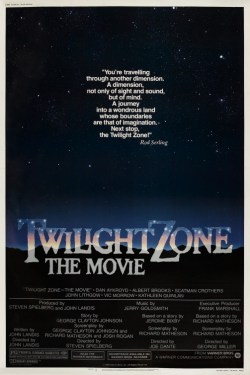
Twilight Zone: The Movie. Warner Bros./Amblin Entertainment 1983.
Before watching the movie:
I first learned that there was a movie based on The Twilight Zone when I read that the first meeting between John Lithgow’s character and William Shatner’s guest character on “Third Rock From the Sun” had them comment that they had similar terrifying experiences on an airplane, and that was a reference to the fact that Shatner had starred in the Twilight Zone episode “Nightmare at 20,000 Feet”, and Lithgow had played the same role in the Twilight Zone: The Movie remake of that story. I thought it was odd that of all the iconic stories told on The Twilight Zone, they chose that one to make a movie out of, but simply titled it “Twilight Zone”, as if the one story summed up the entire show. I much more recently looked it up and discovered that multiple stories are told in the movie, which really makes a lot more sense.
It’s always surreal to me to be reviewing movies I was aware of and wanted to watch around the time I started doing this. As I limit the regular reviews to “10+ years old” and “first watch”, obviously not much I had a lot of interest in at the time makes it a decade before I get to it.
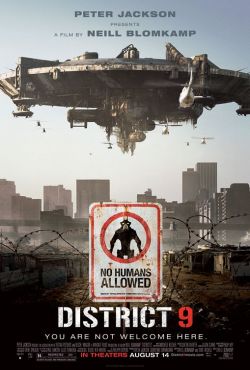
I’ve heard this is an apartheid story in the guise of an aliens on Earth story. It’s not exactly the most attractive idea to watch a dystopia story where the opressors are humans and the opressed are not. That’s probably why after the hype died down I didn’t make an effort to get back to it.
Anyway, I decided I should do some mockumentaries, and I was surprised to see this come up on a list of them, so I’m taking the opportunity.






 Yesterday's Movies