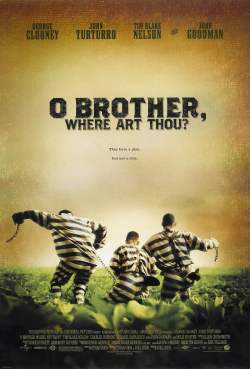
Movies of My Yesterdays: O Brother Where Art Thou?

O Brother, Where Art Thou? Studio Canal 2000.

While I first watched this movie in high school, I think 9th grade English, it also has significance to me as the reason, or at least the excuse, to get Netflix. I had an assignment in a media class to analyze a scene and my group got O Brother Where Art Thou? and I used a free trial to get us a copy of the movie faster than the library could get it to us. That subscription back in the day made catching up on all the movies I’d never gotten around to possible, and while I was doing that and having opinions on them, I was looking for a creative project to put on the internet because I was also really getting into the heyday of webcomics. I didn’t think I was up to drawing a regular strip or making videos on a sustained basis at the time, but I could watch movies, have opinions, and share those opinions.

I’m glad to be able to say that in almost fifteen years, I’ve had something online every week, and I think I can still count on one hand the number that were just apologies for not even having old posts to recommend. I had a review online every week during a month where I had a full load of classes, a part time job, an assignment to write a novel in a month, and a weekly video series for my sketch comedy group’s blog. I got something up in weeks when I was moving all by myself and didn’t have internet service set up yet. I don’t remember what it was but I got something up the week I got married. I wanted to prove to myself I could stick to a posting schedule and it’s only in the last few months that I’ve had to evolve from staying up late on Thursday night to have something for Friday to writing over the weekend to have something by Monday. I’ve seen great movies I might not have gotten to without this push, and I’ve had a good excuse to rewatch movies I already loved and share why I love them.

Ulysses Everett McGill, a man with the gift of gab, leads his fellow convicts Pete and Delmar in an escape from their chain gang with the story of loot from a heist that he buried back home in a place that will be flooded to build a dam in just a few days. They go to Pete’s cousin for help, who immediately turns them in to Sheriff Cooley for the bounty, barely escaping the barn Cooley’s men try to burn them out of. Picking up hitchhiker Tommy Johnson, who says he sold his soul to the devil for guitar talent, they stop at a radio station where “a man will pay you to sing into a can” and record a song for some cash under the name “Soggy Bottom Boys”, then part ways with Tommy again. The gang is separated when some women at a river washing clothes drug them and when they wake up, they find Pete’s clothes laid out with nothing but a frog inside, and assume that they turned him into a frog, when really he’s been turned in for bounty, and confesses the location of the treasure under torture. Meanwhile, Everett and Pete arrive in Everett’s hometown and Everett meets up with the real reason he escaped from prison: his ex-wife is remarrying. All the while, the governor’s race is coming up, with the reform candidate Homer Stokes running a much more popular campaign than the incumbent, flour mill owner, and radio show host Pappy O’Daniel, and the people can’t get enough of that Soggy Bottom Boys record.

Even on this viewing, I can’t really tell how much was directly pulled from The Odyssey. There are the most obvious allusions, but they seem fairly superficial. Most of the misadventures along the way don’t seem to map to specific challenges faced by Odysseus, aside from the Sirens and the Cyclops, but especially the Cyclops is very surface level. It’s much easier to read the movie as a sketch of rural life in the Great Depression that draws some references from mythology to heighten the sense of being the little people in a world ruled by titans.

I’m surprised to learn that the central song of the piece, “Man of Constant Sorrow”, pre-existed the movie just as much as the other bluegrass and gospel music that is a persistent presence through the movie. I’d thought that it was written for the movie to specifically fit the mood they wanted for such a popular song and because “the man of constant sorrow” was one of Homer’s epithets for Odysseus. I see that the epithets include “much-enduring” and “man of pain”, but it seems that while “constant sorrow” could fit as other translations of those, it doesn’t seem to have been used in a popular enough translation to be significant. Regardless, it’s undeniable that the song was perfected for the movie.

I was always a bit confused as to the intended race of the characters. They’re played by three white men, but people keep calling them “Colored” or “miscegenated”, and while they do occasionally partner with Tommy Johnson, a Black man, they also have visibly darkened skin tones. For a while I thought that was some kind of aesthetic choice where they constantly have dirty faces because they’re working class in the Great Depression, but the thought crossed my mind this time around that they were meant to be mixed race, which would be a really bad look for a movie where a popular character gets run out on a rail the minute he outs himself as a white supremacist (a very 1990s moment). I’ve only come to realize now that they’re heavily tanned from working in the sun on the chain gang and the comments specifically from people who can see them are just about how they work with Tommy.

If anything, I’m more certain now that this movie is more about playing with historical and mythological elements more than taking them seriously. And that’s okay, remaking the old ideas in new ways is an important part of mythology and of storytelling. The story doesn’t feel as epic or meaningful as the way in which it’s presented seems to want it to be, but that just makes it more dreamlike, giving it the feeling of fantasy in a setting where everything has a natural explanation if you want it, but it’s not always the most compelling one.


Movies of my Yesterdays: Gattaca

Gattaca. Columbia Pictures 1997.

This is a movie I was shown in high school as part of a discussion on genetics. It was a non-standard interdisciplinary class in literature and science that used sci-fi as a jumping off point to discuss scientific concepts and ethical dilemmas, and one of my favorite classes even before factoring it that it was taught by a teacher I already knew and liked well.

In a future where genetic engineering and sequencing are commonplace, few are conceived naturally, without the opportunity to screen candidate embryos for genetic diseases and make enhancements for superior abilities. Vincent Freeman was conceived the old fashioned way, and his genes mark him as an incredibly fragile and deficient “in-valid”, projected to die of a heart defect in about 30 years. Ubiquitous genetic testing and identification means that he’ll never be allowed to pursue his dream of going to space on his own identity, but a black market dealer in “borrowed ladders” connects him with Jerome Morrow, an English swimming champion now paralyzed from the waist down, who looks similar enough that, with help from daily samples of bodily fluids and studious replacement of any of Vincent’s own dropped hair and skin cells with Jerome’s, Vincent is able to fake his way into Gattaca as a mission navigator for an upcoming flight to Titan. Then, a week before launch, an administrator is murdered in the offices and the police find a hair on the scene that identifies as belonging to Vincent, an In-Valid unauthorized to be there, leading the police to start combing the facilities for an impostor among the Gattaca elite.

What stayed with me the most the first time around was how mundane the space travel was. These astronaut candidates are working at a desk in suit and tie jockeying in the bureaucracy until the launch day. I don’t really understand how Gattaca works as a business either, as it’s not clear why they do what they do. They just send rocket after rocket every few hours and I don’t think it’s ever explained. The focus is meant to be on the total genetic surveillance, but as a certified Space Kid, I just had questions about the space program, and I still do.

What struck me this time is how all of the Valids are always wearing immaculate suits, except for when doing the physical training for missions. I suppose this is meant to visually signal class, since most In-Valids we see are in coveralls even when not working, but it seems a bit silly to me that we never see the real Jerome wearing anything other than a perfect three-piece suit even though there’s only one scene where he’s left the house. By all means, his attire is justified when Vincent takes him to the speakeasy for people involved in black market genetics, but most of the time he’s just collecting samples of himself and generally living as much of a leisurely life as he can from a wheelchair, hiding from the world because he’s renting his identity to someone else and ashamed of his lost potential.

It is altogether very striking now, the retro design of the movie. The clothes lend a Film Noir feel, even though the cars are more based on midcentury models, with electric motors dubbed over. The detectives pursuing their hunt for the impostor at Gattaca is even more Noir.

However, I also have much more perspective on the discrimination shown. The warnings of a divide between the technological haves and have-nots I encountered in the 90s and early 2000s seemed academic at the time, but the realities are becoming clearer as we become more connected and more aware of what we’ve given away to big companies, in the technology sector and otherwise. I see that a lot of the criticism directed at the movie by geneticists is that Gattaca has a right to screen astronauts for perfect health, and that’s fair. It’s even reasonable for Gattaca to use genetic samples to identify who is and isn’t authorized to be in certain areas (this surveillance seems omnipresent, but I think that’s because we only see Gattaca and the police). But it’s missing that the only jobs that people without flawless genes can get are unskilled, low-paying labor because every single company wants to use genetic screening to deny jobs for the slightest flaw, and will flout privacy laws by quietly stealing samples from licked envelopes, doorknobs, handshakes, anything they can get.

It doesn’t matter if geneticists say that markers of likelihood for abnormalities are not guarantees, it matters that the employers and insurance companies believe in genetic determinism, or at least find it convenient for the discrimination they want to justify. Throwing away perfectly good applicants based on bad genes isn’t much different than throwing away resumes that were only evaluated by an algorithm or refusing to allow good people without the right government documents to enjoy the full opportunities of the society they live in and contribute to. The ingrained prejudices in the world presented are enabled by genetic technology, not created by them, much like how the disaster of Jurassic Park is caused by hubris and greed that happened to allow resurrected dinosaurs to escape their containment.

This movie is visually striking, narratively compelling, and obviously opens doors to conversations, making it a clear choice for my ethics class. This fully realized vision is probably going to be the definitive take on genetic dystopia for a long time.

Movies of My Yesterdays of My Yesterdays

Welcome to the next evolution in repurposing old articles: revisiting posts about revisiting movies. I do appreciate a good meta concept. And also this one.

Any collection of highlights from the Movies of My Yesterdays series has to include the very first edition: Lady and the Tramp.

I’m not sure, but I think The Seven Percent Solution might be the longest post I’ve written on this blog, and it looks like I put a lot into crafting it as the final Sherlock Holmes movie review. I hope it doesn’t seem overdone, but I mostly feel good about it still.

Almost as much surplus of retrospective is found with Galaxy Quest. Also almost as much writing quality. I enjoy very much when I can find a topic to Say Something About in relation to a movie, and in this case, I was recognizing the 50th anniversary of Star Trek.

The One Magic Christmas review is its own Christmas redemption story.

While not as heavy on retrospective, I think there’s a good helping of social commentary in the reviews for The Secret of My Success, An American Tail, and Bicentennial Man.

Finally, I can’t necessarily speak to the writing quality of the reviews, but I hope I got across how much I love The Iron Giant and Meet The Robinsons and possibly only love them more with each rewatch.

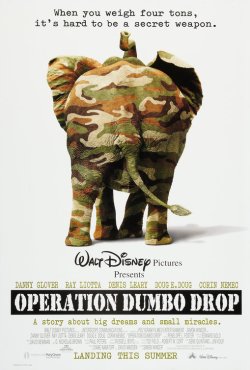
Movies of my Yesterdays: Operation Dumbo Drop

This is a movie I originally saw as the kind of catch up that I later turned into this blog, but the revolution was ordering holds from the library instead of online subscriptions. I have much stronger memories of seeing it advertised on other Disney movies than of the one time I watched it years ago. I mainly remembered that the ads made it look a bit more fun and kiddish than it actually was.

Operation Dumbo Drop. Walt Disney Pictures 1995.

Green Beret Captain T.C. Doyle has been assigned to replace Captain Sam Cahill in maintaining good relations between the US Military and the Vietnamese village of Dak Nhe, strategically important due to its proximity to the Ho Chi Minh Trail. When the Viet Cong soldiers find the wrapper from a candy bar some village children stole from Doyle and realize that Dak Nhe has been helping the Americans, they shoot the village’s elephant as a punishment. In this region, elephants are companions, workhorses, and have ceremonial roles, and the village elders blame Doyle for the loss of their only elephant, but Cahill promises that they will bring a new elephant by the end of the week in time for an important ceremony. Doyle and Cahill requisition two GIs and enough money to buy a new elephant, as well as blackmailing a fast-talking black market racketeer into the group as well. The elephant they can afford, named Bo Tat, comes with an orphaned boy named Linh attached as the driver. Linh’s parents died in the war, and he doesn’t trust either side, but the gang have to trust him to help them transport Bo Tat across hundreds of miles of Vietnamese terrain, while VC soldiers stalk them, determined to make the Americans break their promise.

I didn’t even remember from my initial viewing that this is set in the Vietnam War, but that’s because this is probably the most sanitized Vietnam War story put to film. The 90s were a time when morally grey heroes and antagonists were becoming popular, but the closest that this movie comes to acknowledging the crisis of conscience that America faced in Vietnam is that the American characters admit they can’t be sure which side killed Linh’s parents, and it turns out that his father was gunned down by the VC for unclear reasons. This could have easily been a romp in any jungle with American military presence at any time in the latter 20th century, it could have been Peace Corps, it could’ve been anyone else with any reason a bureaucratic organization stuck them thousands of miles from the Western world, but it’s based on a story from the Vietnam War, so it’s set in the theme park version of the Vietnam War.

There’s a really fun chemistry between the army guys that is most of the reason to watch the movie, however it seems a bit off-balance that of the two GIs who were just assigned as backup, one is the very visible comic relief guy who’s scared of everything because he’s got less than a week until he goes home and wants to survive the week, and the other is just the Iowa farmboy who’s also kinda there. His biggest contribution is failing at being a backup elephant driver when they need to rescue Linh from a VC interrogation.

In the 90s, “Dumbo” felt more like a generic nickname for elephants than it does now. I wonder if that’s because Disney tightened control over their trademark or if I just had a smaller reference pool. I seem to remember the use of “When I See an Elephant Fly” being a bit jarring the first time I watched it, because I didn’t necessarily remember until then that this was a Disney movie. It still feels a bit out of place and forced. If nothing else, it along with the title is a reminder that somebody seems to think that the whole movie is a vehicle for delivering the climax and little else.

I hope this is nobody’s only exposure to Vietnam War history, but aside from that, it’s fun, maybe as much fun as Cool Runnings, which I gather is also more in the territory of being “suggested by” history. Maybe Disney should do fewer “live action remakes” and go back to making more “adventures suggested by true stories”. Even if the results were controversial, they’d be controversial for less silly reasons than the fights over Belle’s dress or the completely soulless hypernaturalism of The Lion King. Also maybe more fun.

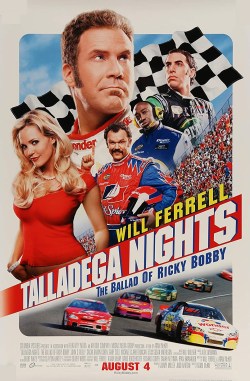
Movies of My Yesterdays: Talladega Nights: The Ballad of Ricky Bobby

This might be the first entry in this series from my time in college. It’s not quite from after the inception of this blog, but getting very close to it. It wasn’t long after when I saw this movie when I got my first opportunity to go back and catch up on movies I’d missed. But that wasn’t the way I saw this one.

I first saw Talladega Nights because it belonged to my my freshman roommate, who set up his TV, small movie collection, and mini fridge, told me I was welcome to use all of them, and then found friends outside the dorm to spend all his days and nights with, leaving me alone with the whole room pretty much all the time. I can’t recall whether this movie got played in one of the rare times he was there or if I put it on myself in a bolder move in using his stuff, as using somebody else’s movies without their direct permission still seems like a breach to me even if blanket permission has been given (it occurs to me that I don’t feel this way about the massive movie and game collection of another roommate I had in the early days of the blog, which was probably represented multiple times on here). I’m pretty sure that was the only time I saw it until now.

Talladega Nights: The Ballad of Ricky Bobby. Mosaic Media Group 2006.

Born in the back of a speeding Chevelle, Ricky Bobby grew up not knowing his father, who left to race cars and do more shady things, which may have imparted his obsession with speed to him. Ricky only saw his father once in his childhood, making an unexpected and ignominious appearance at his class’s Career Day, but he left him with the dictum that “if you’re not first, you’re last”, a phrase Ricky went on to model his life on. Without many career prospects, Ricky found his way into the pit crew for Dennit Racing, finally getting his opportunity to enter a NASCAR race as a replacement for the driver who walked out in the middle of a race while in last place, and Ricky proves himself by finishing third, becoming a racing star. Backed up by his best friend Cal driving Dennit’s second car, who always gives him the assist to get to first, Ricky quickly achieves a life of fame and fortune, living in a mansion with Carley, the smoking hot fangirl he married, their two disgracefully disrespectful sons, and Carley’s father who impotently disapproves of how his grandkids are being raised. Ricky’s maverick driving style makes him a fan favorite, but costs him with the sponsors and the tournament judges, and therefore does him no favors with the new head of Dennit racing, Larry Jr., who hires openly gay Frenchman Jean Girard from the Formula One circuit to be his new, dependable lead driver with European precision. Ricky’s jealousy overwhelms him, causing him to crash and have a psychological breakdown that endangers his ability to ever be able to get behind the wheel of a car again.

This felt really raunchy at the time, but while it’s still kind of raunchy, it doesn’t feel like that’s an exceptional thing. I think the raunchiness largely comes from how it’s both a parody of the contemporary machismo but also kind of an earnest celebration of it. It feels entirely a product of its time, but no moreso than in the jokes about Girard being gay. This is tempered by Girard being revealed to be an honorable guy looking for an equal on the track and definitely a much more rational person than Ricky, but the jokes still significantly Other him. It occurs to me now that by being gay and European, Girard is specifically designed to be the antithesis of the NASCAR stereotype and the American nationalist cultural moment that NASCAR was a significant component of at the time. His being French is probably targeted at the specific distaste for the French after the country refused to support the US in doing some post-9/11 lashing out.

While the extreme farce style can easily get out of hand in a bad way, there were still plenty of laugh out loud moments. Its extremely contemporary nature probably keeps it from being as timeless as Anchorman, but it’s still a lot of fun. It’s not something I would come back to a lot, but I can see occasionally revisiting it to get my expectations exceeded again.

Movies of my Yesterdays: The Secret of My Success

I’m not sure how this evaded my first pass through the filmography of Michael J. Fox in middle school/high school when I discovered Back to the Future. Maybe it was because the library didn’t have it. This one, I found in a rummage sale. I feel like the idea of seeing his character get rich successful quick was an element that attracted me, but mostly it was just that I was a fan of his work.

The Secret of My Success. Rastar 1987.

I think there’s a reason I get a bit of a similar feeling to Ferris Bueller’s Day Off in parts of this movie aside from the fact that they both use “Oh Yeah” by Yello, which I’m sure is the main link between them. Perhaps it’s a general 80s yuppie aesthetic.

Brantley Foster, fresh out of college from Kansas, arrives in New York with the promise of a job in big business and high hopes of growing an impressive career from it, only to find that the job evaporated the day he arrived. Stymied everywhere by entry level jobs demanding experience he hasn’t got, he seeks an audience with Howard Prescott, the CEO of Pemrose Corporation, with whom he has the sketchiest of family ties. Impressed by his brief moment with his “nephew”, Prescott begrudgingly gives him a job in the mailroom. Eager to make the most of this opportunity, Brantley uses his position in the mailroom to learn everything about Pemrose’s operations, and after answering a phone in a vacated office and making good executive decisions for the harried manager on the other end, Brantley hatches a plan to create a fictional executive named “Carlton Whitfield” from his vantage point in the mailroom and commandeer that vacant office to prove his worth to everyone who won’t give “Brantley from Kansas” a chance. Not only do “Whitfield’s” ideas shake up the status quo so much that Prescott worries that he’s a spy from the corporate raider trying to make a hostile takeover of Pemrose, they get him close to the beautiful executive of his dreams Christy Wills. However, his time in the mailroom also got him the attention of an executive’s wife seeking revenge on her cheating husband by having an affair of her own, the executive in question turning out to be Howard Prescott himself.

While the first few times I watched this movie I learned a lot about how hostile takeovers work and vaguely got the idea that the trendy but panicked cuts to expenditures would cause a panic in the market while bold expansion could strengthen the company’s value, what struck me this time is just how much inefficiency is in the upper levels of Pemrose. Of course, Brantley notes in his studies that there are departments with overlap that don’t talk to each other or do their job well, but for all the talk of cutting the company’s expenses to the bone, no mention is made of options like reducing executive salaries, putting the space taken by the company gym to better use, or not using the limousines from the motor pool to chauffeur around non-employees (though Prescott’s wife is technically the company owner). The Suits really do live comfortably on the backs of the trench workers they’re ready to turn out in the streets to raise stock prices a few cents.

The directorial choices often feel like a dream. There are multiple mopey montages set to sad power ballads. Flashbacks aren’t accompanied by any visual language identifying them as flashbacks, leaving it to the intelligence of the audience to work out that this already happened. There’s also one or two dreamy imagine spots just intercut with the scene like they’re supposed to be diegetic. The climax also feels a bit underwhelming. After spending so long frantically keeping all these plates spinning with some big, madcap close calls, Brantley gets outed relatively quietly.

This movie is the main source of my interest in mailroom work. I’ve also since gotten experience that translates well to a corporate mailroom, but mostly I always thought what I saw Brantley, or rather his slacker partner, doing in the mailroom, was work I could handle pretty well. Even that looks better than anything I’ve done until my latest job. And there are plenty of “worked their way out of the mailroom” stories, even if most didn’t do it with the flash of Brantley Foster.

When I first saw this movie I was a bit entranced by not only the elegance of the executive lifestyle, but also the raw independence of Brantley’s meager life on his own in a new city. Having lived through my own “starting out alone in a new city” and gotten jaded by the excesses of the wealthy, a lot of the shine has worn off this movie, but there’s still a kind of melancholy splendor to it. It’s a more mature movie than I could really appreciate at first.

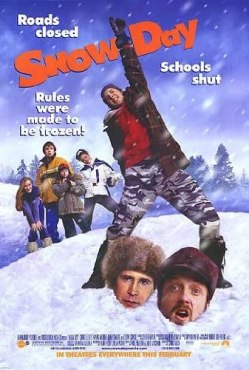
Movies of My Yesterdays: Snow Day

I saw this movie in a theater, but it wasn’t one I chose. A friend had a movie party for his birthday, and I don’t think I knew what we were going to see until we got to the theater. It seems like the kind of movie that was selected more based on what was playing on the date they wanted to have a party than because it was anyone’s first choice, but I remember it was fun in a very late 90s/early 00s Nickelodeon way. I must have recognized Chevy Chase at the time but I completely do not remember him. Actually, the main thing I remember about this day aside from some shots of kids and adults in snow is that it was the first time I heard of Superman ice cream.

Snow Day. Nickelodeon Movies 2000.

In a small neighborhood in upstate New York, an unseasonably warm winter suddenly gets a massive snowfall, and to the delight of all the kids in town, a snow day is declared. Hal and Natalie Brandston’s father Tom Brandston, the third-rated meteorologist in a three-station town, is hoping that having been the first to predict and report on the storm will be his ticket to pulling ratings over showboat weatherman Chad Symmonz and escaping the demeaning costume stunts his producer keeps forcing on him. Natalie’s friends Wayne and Chet make it their mission to stymie the Snowplowman, and maybe for once get a second snow day in a row. Hal spends all day trying to get the attention of Claire, the most popular girl in school, seeing it as destiny that he found her bracelet on the day that Claire broke up with her bully boyfriend Chuck, and drags his friend Lane along in his stunts even as she tries to get him to see how delusional he is.

In rewatching this movie, I didn’t come up with any concrete memories of how I felt at the time, but all the same, the sinking realization that the younger kids’ vendetta with the Snowplowman was relegated to the B-plot behind the high school boy’s quest for unrequited love that doesn’t at all need a snow day to take place on felt very, very familiar. In 2000, I was about the age of the younger kids in the movie, and while I never had the magical adventures this movie invokes of snow days with rose-tinted screenwriter glasses (as an indoorsy kid who lived on unwalkable roads nowhere near any friends, snow days were spent in our house probably watching TV under a blanket and meant relaxation), I think I was very disappointed that the whole concept of “kids having a snow day” got sidelined for a romance plot. They say kids are most interested in the next step up as a preview of what they can expect, but in this case, why would you have a movie called “snow day” and not center actual snow day adventures? It’s hard to push past that fault plus how tired the “guy can’t see the girl right next to him because he’s only got eyes for the unobtainable girl” plot is and get too objective on whether Hal is as lacking in relatability as it seems.

While the movie makes a point of saying how close Hal and Natalie usually are, and how they would usually be playing together on a snow day but he ditched her to go chase his dream girl, I really wish we’d gotten to see that somehow, so it means more to us to see them separate. When they’re together they speak warmly to each other, aside from Natalie being kind of resentful of how obsessed Hal has gotten, but the most significant interaction they have is Hal telling Natalie not to play with his collection of action figures that he wants to keep in pristine condition so he can sell them as a set. Oddly, Natalie acts like they’ve previously played with them before since she identifies him with a specific member of the group of figures.

Natalie’s friends are another missed opportunity. Wayne is marked by being the fat, wimpy kid who’s good for getting damseled and letting the filmmakers substitute farts for jokes, while Chet is… also there. Apparently Wayne and Chet made a snow cave that they were going to hang out with Natalie and Hal in that they brought a video game console out to, but it’s only used in one scene and destroyed by the Snowplowman to make him an extra-personal villain. The snow cave is the kind of thing one would expect to make up the main focus of the movie.

I think I need to come to the conclusion that the best part of this movie, at least as an adult, is Chevy Chase’s subplot, because it’s exactly what it’s supposed to be/ought to be. I think he won the crowd a bit too easily in the end, but this is a movie for middle schoolers and there isn’t really time for something more realistic.

While this is fun, especially for kids, it’s definitely an unbalanced script and isn’t primarily interested in what it claims to be interested in. It’s really hard to put aside all the small ways it disappoints and enjoy it for what it is when it isn’t even concerned with being what it says it is. There are some good seeds of movies in here, but the execution was almost entirely lacking.

Movies of My Yesterdays: National Lampoon’s Christmas Vacation

I recall this movie coming into the house through a joint garage sale with my aunt’s family. Or rather, I remember seeing the tape at one of the garage sales, and then I remember finding it in our collection months or years later. I don’t know why it didn’t interest me for a long time, but I think I didn’t get to it until I was in my 20s or late teens. I can’t recall now if the portion I saw on TV (I mainly remember hearing “Mele Kalikimaka” for the first time) got me interested, or if I was just going through the video collection and connected it with the Christmas movie everybody liked and decided to watch it for that reason. I’m a little surprised I didn’t seek it out when I was in my significant “all the traditions” phase, but I think I would’ve been scandalized at the time if I had.

National Lampoon’s Christmas Vacation.
Hughes Entertainment 1989.

Clark Griswold and his family is hosting Christmas for the extended family for the first time, and Clark is determined to make it perfect. He marches his wife Ellen and their children deep into the forest to find The Perfect Tree, he blankets the house in 25,000 lights that he can’t get working, and packs every room with family members, including the son and daughter of his wife’s uninvited cousin Eddie, who drove the rusty trailer they live in to join the family. Clark is also starting to wonder where his Christmas bonus check is, which he badly needs to cover the deposit he already laid out to install a swimming pool.

I seem to recall that before I first saw the movie,I didn’t think the poster was very much help in understanding what it’s about, but the problem is that it’s an extremely episodic movie that doesn’t have a more significant overarching plot than “Clark tries to make a perfect Christmas for his extended family”, which is hard to convey on a poster. Just about every scene is a vignette of a crazy family Christmas, but the lights and the bonus check are the most consistent throughlines. So a lighting accident it is.

While it’s a Chevy Chase vehicle with many scenes stolen by Randy Quaid, this is the first time I noticed that Clark’s son Rusty is played by a young Johnny Galecki, best known for The Big Bang Theory. Even at the young age, there were moments where I recognized his acting style. My wife also pointed out that Beverly D’Angelo has a strong resemblance to Amy Pohler. I don’t know if any of the elderly uncles and grandparents are notable actors, but many of them are also doing very memorable character work.

This movie is somehow pitched to the point of absurdity yet relatable to the point it at times feels almost like a set of generic scenes of the Christmas experience. John Hughes may have hit a bigger classic with Home Alone, but I think this is better at creating the adult experience of Christmas. I suspect that there are people for whom it’s so relatable, it’s too stressful, like my experience watching The Long, Long Trailer so soon after driving a trailer across the country. It may not be a Christmas staple to me, but it’s always welcome. Because while we have plenty of opportunities to remember warmth and generosity at Christmas, it’s also just a real catharsis to have a laugh at the hassle we impose on ourselves too.

Movies of my Yesterdays: The Rescuers Down Under

While not as embedded in the landscape of my media childhood as Lady and the Tramp or The Little Mermaid, The Rescuers Down Under was always there as far as I can recall. I associate a very youthful spirit of adventure with it that I think predates the time in my adolescence when I was defining my own tastes for what seemed like the first time, the “hit me at the right time” years.

While the original The Rescuers probably more deserves the appreciation of a mature reviewer, I don’t have the same fondness for it. The two movies came from different eras of Disney animation and have a very different look and feel. The first came from the time of The Fox And The Hound and 101 Dalmatians, but it’s almost as obscure as The Black Cauldron and hits a lot more of the same notes. Sensibilities had changed at Disney in the time between the two Rescuers movies and the latter is part of the upward trend moving toward the Disney Renaissance.

The Rescuers Down Under. Walt Disney Pictures 1990.

Cody, a very American sounding Australian boy, is a friend to the animals of the Outback, and rescues a giant Golden Eagle from a poacher’s trap. She gives him one of her golden feathers as a keepsake, and then on his way home, Cody finds a mouse tied up as what turns out to be bait in a trap sat by ruthless poacher MacLeach. MacLeach finds the golden feather and realizes that Cody knows where the last Golden Eagle is, so he kidnaps him in order to try to get him to divulge the location of the bounty. The rescued mouse reports Cody’s peril to the Rescue Aid Society, and soon Bernard and Bianca are on their way through the Outback to him with Australian Jake as their guide.

Where the first was likely modeled after a pulp adventure novel, this feels more like an action adventure movie. It has modern pacing sensibilities, but I think the first is stronger in that as I recall, Bernard and Bianca spend most of the story trying to find a way to get Penny out of her situation, this one doesn’t have them get to Cody until the climax. There’s not much for them to do but ride more Australian animals across the landscape while Jake tries to flirt with Miss Bianca and Bernard tries to find a moment to propose to her. It’s a comic relief subplot, but moreso Wilbur and the hospital mice fixing his back with extreme force.

Two things make this movie feel epically sized: the music and the sweeping three dimensional camera moves. Disney shopped out many backgrounds to Pixar, and while sometimes they’re obviously very primitive CG by today’s standards (I’ve seen previsualization renders more convincing than the city skyscrapers and cars), they do bring to life the camera perspectives and the Outback. People talk a lot about the clock gears in The Great Mouse Detective and the Ballroom in Beauty and the Beast, but I think this is the best demonstration of what cel animation can do with CGI backgrounds as a tool in the kit.

If this had Ashman/Menken songs, it would be 20 minutes longer, but it would also be at least at the level of the actual Renaissance Disney movies. The plot structure makes a lot of the returning or pseudo-returning (Wilbur is allegedly Orville’s brother despite how very different they are aside from being airline albatrosses) characters redundant, but it’s a fantastic adventure for the whole family, and it should be remembered as fondly as Disney’s biggest hits of the 90s.

Movies of My Yesterdays: UHF

As I grew up, I eventually discovered my parents’ music collection, and among it, my father’s Weird Al CDs (and eventually the Doctor Demento cassettes and tape recordings of Weird Al vinyl albums). I considered myself a fan of Al Yankovic, but eventually I learned that there was a lot more than just the self-titled album, Even Worse, and Alapalooza. But I think I was in high school before I found UHF.

UHF. Cinecorp 1989.

While I usually came to these kinds of things through library catalog raids, I distinctly remember my favorite high school teacher showing this movie on a slack day, and a lot of the most iconic parts of the movie were definitely new to me at the time, so except for possibly passing some of the more random elements while channel surfing and not knowing what it was, I’m confident in saying that my teacher playing it in class was the first time I saw this movie, although I don’t think we finished it then (a common theme among movies played at school, considering a class period is a little less than an hour and a movie is at least 75 minutes). I eventually saw it on DVD, the menus of which are how I first encountered Al’s updated (hair down, no mustache, no glasses) look that was probably old, old news by then.

As recall, the plot is probably the most forgettable part of the movie, though it’s clearly constructed as a means to let Al’s comedic ideas and abilities (and those of his writing partner) play. Al’s character George comes into control of a tiny local TV station and builds it into the area’s most must-watch TV through just having weird ideas nobody in the TV industry would have, a sure threat to the big network that wants him out of competition for their ratings.

There’s more story and fewer sketches than I remember. Stanley is shown at the beginning to be a daydreamer, but that’s not carried through most of the movie. The cutaways are almost entirely station ads once the story gets going until the big Rambo parody daydream at the end. The Beverly Hillbillies music video could be argued to be continuing his flights of fantasy, but it’s framed as a dream instead of a daydream, and it’s so different from the imagination sequences that it just seems awkwardly shoved in.

I’m not sure if RJ Reynolds seems like a parody of someone specific in broadcasting or if Kevin McCarthy is just that much of a presence in his own right. He feels like the most noteworthy actor in a movie with Weird Al, Kramer, and The Nanny despite the fact that I had to look up his name. He seems like a Leslie Nielson type whose serious appearance is usually played for comedy.

It’s unfortunate that this movie didn’t do well enough to let Al continue to make movies in the 90s. He’s only in the last few years been able to take the time to pursue comic acting alongside his music career as he reached the end of his album contract. This is at least as good as a classic National Lampoon or Airplane!-type movie, and he seems like he could’ve done more. I should probably look up AlTV, which sounds somewhere between talk show parody and actual talk show, but more in this vein would have been on another level.