I’m often going into these movies wishing I knew more, but I never really felt like I needed to know more than “heated jury debate”. Everyone is frustrated because they’re locked in the room until they’re unanimous and they can’t come to an agreement.
This doesn’t seem like the kind of idea that came to life as a movie script, but much more like a play. The characters are literally locked in one room and have to talk until they come to a resolution. So I’m a little surprised to find that it was not based on a stageplay, but on a television play. That’s a format that doesn’t really exist anymore, and I’m sure if this movie didn’t already cast a long shadow, it wouldn’t gain traction today.
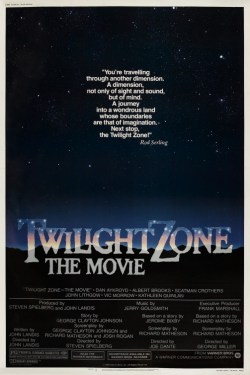
Twilight Zone: The Movie. Warner Bros./Amblin Entertainment 1983.
Before watching the movie:
I first learned that there was a movie based on The Twilight Zone when I read that the first meeting between John Lithgow’s character and William Shatner’s guest character on “Third Rock From the Sun” had them comment that they had similar terrifying experiences on an airplane, and that was a reference to the fact that Shatner had starred in the Twilight Zone episode “Nightmare at 20,000 Feet”, and Lithgow had played the same role in the Twilight Zone: The Movie remake of that story. I thought it was odd that of all the iconic stories told on The Twilight Zone, they chose that one to make a movie out of, but simply titled it “Twilight Zone”, as if the one story summed up the entire show. I much more recently looked it up and discovered that multiple stories are told in the movie, which really makes a lot more sense.
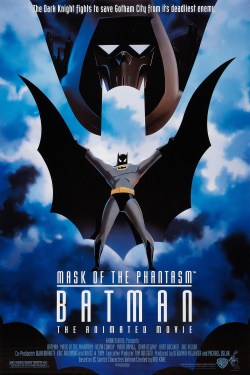
I have vague memories of watching Batman: The Animated Series as a kid. It was a thing that was on, sometimes I would watch it when it was available, but I don’t remember really making a habit of it. Even so, it defined Batman for me as a kid. I was aware of the live-action movies of course. I definitely remember at least one McDonald’s Happy Meal tie in that I got a Hot Wheels-size version of the best Batmobile out of, but I’m not sure the timelines actually sync up, since it would have been the 1991 promotion and I may have been a little young to be as aware of it as I remember.
Regardless, as for many my age, this is the definitive version of Batman to me. I’ve probably watched more episodes as an adult seeking them out, but the series brought as much plot and emotional complexity to half-hour episodes as was possible. It introduced characters and interpretations so compelling they were imported to the comics and other versions, it was the keystone to a shared-continuity animated franchise, and had two direct continuation series.
I’ve gotten around to Batman and Mister Freeze: Sub-Zero before, but I never made it to the first movie spinoff, the one that actually got released in theaters before. And it has taken me entirely too long to get here.
After watching the movie:
Batman busts a meeting of Gotham’s biggest crime lords, and in the ensuing chaos, Chuckie Sol gets accosted by a hooded, masked figure claiming to be his agent of death, who tricks him into crashing his car through a parking garage wall, leaving him dead. When bystanders look up at the commotion, they see Batman at the hole in the wall trying to understand what just happened, and news spreads fast that Batman might have graduated to murdering mob bosses. Councilman Arthur Reeves, in the mafia’s pocket, vows to finally have Batman arrested. Ten years earlier, in Bruce Wayne’s earliest days of crime fighting, before he figured out how to intimidate the criminals, he met Andrea Beaumont in the cemetery talking to her mother’s grave close to where Bruce was talking to his own parents, and they quickly bonded. Bruce became torn between the vow he made to his parents to avenge them against all crime in Gotham when he realized that plan never included having someone waiting for him at home, and their relationship ultimately ended in heartbreak. Now, Andrea is returning to Gotham, and Batman realizes that the gangsters getting killed all share a link with Andrea’s businessman father, but his investigation is hampered by Gotham law enforcement hunting him down for the same murders, while the next don on the Phantasm’s list has gone to a former mook and friend from the old days for help, now in business for himself as the Clown Prince of Crime.
When a movie gets made from a tv show, especially one still on the air, one of the important questions to answer is what can this do that an episode can’t. Aside from the corny early 90s CGI fly-through of Gotham skyscrapers right at the beginning that doesn’t contribute much except to show “look what we can do with a movie budget!” the answer is that I think this story plays with lore too integral to the Batman mythos to trust to a 30-minute story. It doesn’t just rehash Batman’s origin story, it goes inside the often-elided time when Bruce was still trying to figure out how to be a vigilante and tells us the love of his life we never knew about was there. It dangles the Joker’s life before he was the Joker in front of us. It shows us that Gotham once hosted a World’s Fair. And it does it all with incredible care, so that it feels like they’re sharing secrets instead of polluting an established story.
They also take a lot of time to explore the tragedy of being Bruce Wayne. For the first time here, he really has to wrestle with the conflict between what he feels he owes to his parents and a chance to let himself just be happy, and the weight of that dilemma is keenly felt. Of course, in a more realistic world, Bruce would be better served by getting therapy and realizing that maybe he took a flying leap from his parents getting accidentally shot in a mugging gone wrong to a duty to them to clean up all the crime in the city with only wits, fists, and gadgets, but this is not the world he lives in, and regardless of what he wants, becoming Batman is the destiny he cannot escape. And in this story, he rages against that.
Involving the Joker feels almost obligatory. The Phantasm may have unacceptable methods, but the motives are too sympathetic to be satisfyingly defeated alone, so one of the regular villains has to come in the last act to raise the stakes and be properly thwarted in the end. There’s really only one good reason it had to be the Joker, and one could argue that some of the other rogues could be made to make sense too (isn’t the Penguin a crime boss?), but he’s mostly just the one brought into the game late because he’s Batman’s most iconic antagonist, and this is this version of Batman’s first movie. It can feel about as lazy as making Moriarty the surprise mastermind behind every Sherlock Holmes mystery. A version of this story could probably be wrapped up with a dire fight against a well-prepared mob boss and his goons instead of against one of the Usual Suspects while on the run from the law. But Mark Hamill’s Joker is too charismatically sinister to be too upset about.
While this was shown in theaters, that was a relatively late decision, and it could’ve stood to have more production time to make it ready for cinemas instead of just a surprisingly good direct to video feature. I felt I was watching really good storytelling, but I didn’t quite feel like I was watching a real movie. Whatever it is or isn’t, even by the standards of Batman: TAS, this is masterful.
One thing I recall about the circumstances of the George of the Jungle release was that it seemed to come out at about the same time as Disney’s Tarzan, but apparently this actually predates it by two years. Given what I know about animation production schedules, Tarzan was probably already in the works when they started on this, but just came out later. I now recall that it wasn’t until the direct to video sequel that they were able to reference Tarzan.
However, this was definitely part of a wave of Jay Ward cartoon adaptations made in the late 90s. As much as I like 2000’s The Adventures of Rocky and Bullwinkle (so much so that I did a redub of a sequence for college mainly because I thought there was a bad music decision that I wanted to fix. How did it go? Okay enough.) and Dudley Do-Right, I think this was the best of the bunch. Though it’s possible that’s just because I never saw any of the George of the Jungle cartoon, so I don’t know how badly it was changed. That didn’t stop me from loving the Inspector Gadget movie though.
George of the Jungle. Mandeville Films 1997.
Fabulously wealthy San Francisco heiress Ursula Stanhope has come to Burundi to explore the jungle, but is surprised when her equally rich but pompous fiance Lyle Van De Groot tracks her down and joins her expedition, insisting they should return home as soon as possible for the wedding. Lyle has been accompanied by two poachers who are after the White Ape, a legend of the Burundi jungle that could get them a fortune. In reality, the White Ape is actually George, a human who was lost in the jungle as a baby and raised by apes, and now is the King of the Jungle. When Lyle and Ursula are attacked by a lion, Lyle tries to abandon Ursula and run away, and George swings in to save her, bringing her back to his treehouse to help her recover from the shock. When Lyle and the poachers find Ursula and George’s treehouse, there’s an altercation that leads to Lyle accidentally shooting George, leading Ursula to bring him back to San Francisco for medical care. Having seen Lyle for the selfish coward that he is, next to the humble and gorgeous hero George, Ursula now finds herself with questions about her future, much to her status-obsessed parents’ chagrin.
Maybe this is again because I’m not familiar with the source material, but it still feels like this movie more naturally adapted to modern styles than the other cartoon movies I named above. It’s a cartoonish slapstick farce with a lot of self-aware commentary, sometimes even not delivered through the narrator, but it meshes with the 90s writing aesthetic somehow. George is a timeless klutzy hero, but Dudley is a relic of a different era, and Rocky and Bullwinkle spend their entire movie commenting on how they’re 30 years behind. The narration is really the only anachronism I can find in this movie, and the Narrator is a comic character in his own right.
There were things I was expecting in this movie that I guess I was remembering from the sequel. This is entirely in the jungle and in San Francisco (because the Americans won’t be interested if we don’t take the hero to America), except for a tag with Ape in Las Vegas, and I think I was remembering more scenes in other locations that are probably from the plot of that movie.
I still like this movie as much as I did then. The naked product placement was more noticeable now, but it didn’t bother me because it was often the joke. This is my favorite Brendan Fraser movie, and he did some great work in the 90s and 00s. George of the Jungle is a friend to you and me.
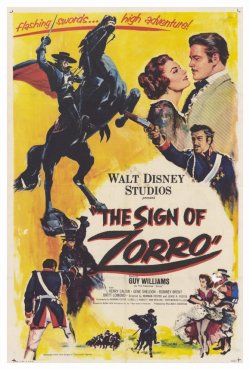
I previously reviewed The Mask of Zorro, but where that is a reboot, this appears to be the actual origin story. I can kind of see now that maybe the other movie didn’t want to reintroduce audiences to a hero who can do the things he does mainly because he’s wealthy. We accept it in Batman because Batman has never been that far away from popular culture, but Zorro’s time in our collective imagination has mostly passed. So instead of a Bruce Wayne story, the reboot gave audiences Terry McGinnis. But I’m not here to talk about “Mask”.
I’m expecting a pretty straightforward classic adventure story, where the good guys are good and the bad guys are bad, and right is restored in the end.
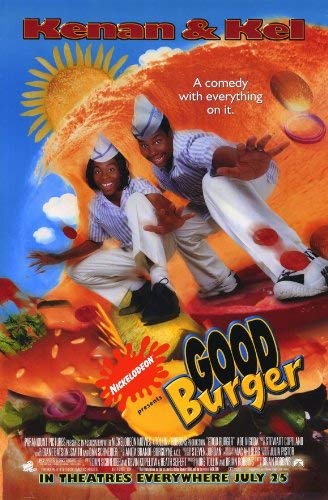
I always thought this was the movie of a series, but it turns out that this is the expansion of a recurring sketch from All That. Keenan Thompson and Kel Mitchell were Keenan And Kel on a completely different (eponymous) show, and Keenan’s character in this movie was not in the All That sketches. All of this just goes to demonstrate that while lots of kids my age were watching All That and Keenan and Kel, I didn’t have Nickelodeon.
Teenage Mutant Ninja Turtles. Limelight Entertainment 1990.
Before watching the movie:
I am broadly aware of the Teenage Mutant Ninja Turtles franchise, but I was never all that into it. I briefly thought I was going to watch the cartoon series, but I was given a parental directive to choose one violent show between TMNT and Mighty Morphin Power Rangers and I chose the latter. Then a few weeks later I abruptly decided the whole premise of MMPR was silly and dropped it.
Apparently there’s a well-known easter egg that in one telling of the Turtles’ origin story, the radioactive ooze that made them was also involved in making Daredevil. That’s pretty neat. That will not be relevant to this movie.
What can be said about this big-budget adaptation of a beloved, long-lasting sci-fi/fantasy/action/adventure franchise? This movie that brought people’s childhood fantasies to the big screen in an ambitious project that had never been done before? The first time moviegoers assembled for The Avengers?
Of course, I mean the 1998 adaptation of the British ITV series from the 60s. What else could I be referring to?
As someone who was not a fan of Scooby-Doo in the early 2000s, my main impression of this was that, if there was a right way to make a live action Scooby-Doo movie, this wasn’t it. The characters looked overly stylized, and the CGI dog was neither cartoon nor real, just a CGI mess.
I’ve since enjoyed some of the Mystery Incorporated reconstructive take on the franchise, and I have enough familiarity with it to know this probably at least isn’t the worst version.
Before watching the movie: This looks way too similar to Down Periscope. Though that’s probably just because of the closeness of subject matter. And tropes of 90s poster design. Some months ago, when I learned of the existence of this movie and queued it, I knew I wouldn’t be able to appraise it well without a better appreciation of the TV show, so I recorded and watched a handful of episodes. I’m sure the rest of the boat was distinctly characterized if one paid attention over the course of the series, but really only four characters stood out to me. So I’m already not too bothered with the fact that they clearly seem to have changed that lineup to move with the times. However, that would just leave a shell of legacy over a story that would otherwise be its own thing. Continue reading →






 Yesterday's Movies