Movies of My Yesterdays: Howard the Duck

This is a little later than most My Yesterdays selections, but it’s still formative. I first saw this movie shortly before starting Yesterday’s Movies and I had Opinions, and at the same time I was looking for an internet project I could add to on a regular basis. And now it’s been ten years of putting my unsolicited thoughts about movies people have forgotten about into the void.

Howard the Duck. Lucasfilm 1986.

On one night of his perfectly ordinary life in a world run by humanoid ducks, Howard is suddenly sucked into space by an interdimensional portal, and lands on our Earth. Stuck in a world that finds him weird, freakish, and otherwise a magnet for harassment, Howard quickly gets mixed up with Beverly, singer for a great girl band with a bad manager, and helps her out. As romance kindles, suddenly a group of scientists arrive and explain that Howard was brought here by an accident with a “laser spectroscope”. Before Howard has a chance to get them to reverse the beam and send him home, there’s another accident with the machine, the police show up and arrest Howard, and the lead scientist, Dr. Jennings, has a Dark Overlord of the Universe taking over his body.

This still seems like two incompatible movies to me. The first act and the epilogue are a very upbeat music-filled story that’s almost a romantic comedy, but once Howard and Beverly are starting to settle into a relationship, an entirely different movie, and not a better one, crashes the party and takes the plot in a completely different direction. It felt like half and half originally, but the space alien section seems much longer now, mostly due to the action scenes that last three times as long as they need to.

I guess the point of that turn was to spend some time establishing a status quo before getting on with a surreal adventure, but Howard still just got there and wants to leave. Nothing is normal for him and Beverly. They’re just interrupted as they’re beginning to figure out what to do with themselves.

The swift escalation of a lot of confrontations between Howard and people who don’t get him is still cartoonish. There are the people who assume he’s a human in a costume or some kind of puppet, and the people who think he’s a deformed human or animal, but somehow, way too many of them, when they find out he’s not what they think, go straight to “picking a fight”. To the point that he practically almost gets lynched at least once. If duck people were common and a lot of humans knew them as a race they wanted to subjugate, that would make more sense than “thing I can’t identify is giving me some lip”.

The filmmakers wanted to “have fun with it”, but the main part of the movie is not much fun. There are some scenes that are trying to be comedic and muddying the tone, but the overall way the Dark Overlord story is handled is a slog of bad to mediocre ideas. It’s not a complete travesty of a movie, but it really doesn’t have much understanding of how to handle itself.

The Lake House

The Lake House. Vertigo Entertainment 2006.

Before watching the movie:

This seems like a strange pairing for a movie that seems to want to be known as a pensive romance. Reeves and Bullock headlined Speed as well, but that was an action blockbuster, which they’re both better known for.

Similarly to how I was wondering how the original source of You’ve Got Mail got things going without the weird social construct of anonymous chat rooms, it’s my understanding that the central concept here is that they send letters to each other, but they’re in the same place a few years apart. I’m again curious to see how that gets started, but also how it can be sustained.

Continue reading

The Bishop’s Wife

The Bishop’s Wife. RKO Radio Pictures 1948.

Before watching the movie:

Cary Grant and David Niven are an unexpected pairing. Grant gets all the focus, so I saw Cary Grant and that it’s a romance and assumed that Grant is the Bishop. But it turns out that he’s an alleged angel and Niven is the Bishop, which makes more sense for their types.

Grant’s character inveigle his way into the Bishop’s life claiming to be an angel here to help with a challenging renovation, but mostly imposes upon him and attracts the attentions of his wife, hence the title. Sounds like an unusual setup for a screwball comedy.

Continue reading

The Monster Club

The Monster Club. Sword and Sorcery Productions 1981.

Before watching the movie:

This is three horror stories as framed by a vampire and the actual author of those stories going to a dance club. The packaged stories could be anything, but that frame sounds bonkers, and they seem to be positioning the rest of the movie as a bit of a spoof too.

It looks like a pretty minor cult classic that didn’t get much outside of the UK, but it features some pretty big names in monster movies, so I’m interested in seeing how this goes.

Continue reading

Jack and the Beanstalk

Jack and the Beanstalk. Exclusive Productions 1952.

Before watching the movie:

I wouldn’t say that a written script is improvisation, though I have known jazz musicians to plan out the “improvised” solos they intend to play. However, I think “improvising around the fairy tale” is a good way to describe what I expect to see here.

A movie centered around a big green thing and a golden thing (unless the only treasure in this version is the woman) seems like a good choice for an early commercial color film.

Continue reading

Masters of the Universe

Before watching the movie:

This is a movie based on a set of toys designed by adults trying to come up with what kind of story would feel most empowering to five year old boys in the 80s. That is the standard it should be held to.

I’m not directly familiar with the Masters of the Universe franchise. I mostly know it through osmosis, but apparently Eternia being a planet distinct from Earth is not a concept unique to this movie. I always considered MOTU a pure fantasy setting, but it seems to take whatever elements make exciting stories, and again, the core concept is for five year olds, so the mashup isn’t inappropriate. I’m still not fully comfortable with Skeletor being a spacefaring warlord subsuming planets into his empire, but this can’t go as poorly as Highlander 2 did.

Continue reading

Kazaam

Kazaam. Touchstone Pictures 1996.

Before watching the movie:

I’m not sure if anyone else felt this way, but at the time that this and Space Jam came out, it seemed to me like you were either for one kids’ movie starring a basketball player or the other, and while I did get a Kazaam toy from whatever restaurant had the promotion, Space Jam had Looney Toons and space aliens, so it was no contest which one I went to see.

This is also the subject of a modern Mandela Effect misremembering, as a lot of people, myself included, started to remember the existence of a movie starring Sinbad as a genie named Shazam instead of Shaq as a genie named Kazaam. Which is strange that I fell into that too, because as I said above, I definitely remembered that it starred a basketball player, and Sinbad is a comedian.

Continue reading

Wholly Moses!

Wholly Moses! Columbia Pictures 1980.

Before watching the movie:

This movie sounds very similar to Monty Python’s The Life of Brian. The major difference, aside from being about a Moses parallel instead of a Jesus parallel, seems to be that Herschel has been deluded into believing he is God’s prophet while Brian spends the whole movie begging the crowds to stop trying to make him their messiah. Apparently it was also protested by Jewish groups for mocking their religion. I didn’t find Life of Brian as blasphemous as everyone said, so I’ll reserve judgment here.

Read more

The Avengers

The Avengers. Warner Bros. 1998.

Before watching the movie:

What can be said about this big-budget adaptation of a beloved, long-lasting sci-fi/fantasy/action/adventure franchise? This movie that brought people’s childhood fantasies to the big screen in an ambitious project that had never been done before? The first time moviegoers assembled for The Avengers?

Of course, I mean the 1998 adaptation of the British ITV series from the 60s. What else could I be referring to?

Continue reading

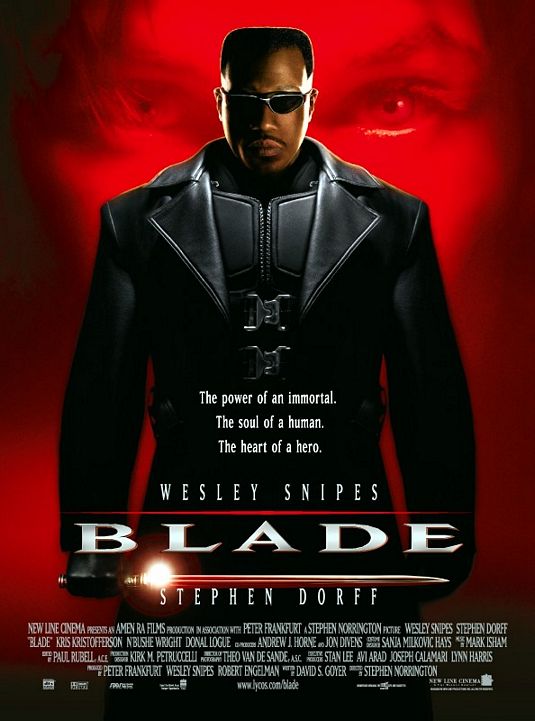
Blade

Blade. New Line Cinema 1998.

Before watching the movie:

I have no familiarity with the Marvel comics this is based on. For all I know, this movie was made because New Line had bought a package of cheap comics properties to turn a fast profit on. I don’t like to be so dismissive, but Blade is one of the most prominent notably black superheroes I can think of who aren’t carrying a legacy mantle, and I wouldn’t know that the book exists without this movie that exemplifies an era of moviemaking where “based on a comic book” was something to hide.

Lacking any of the brand recognition and shared continuity that makes comic book stories enticing now, this is essentially sold on the strength of Wesley Snipes slaying vampires with martial arts for two hours. Which is exciting enough if you’re into that sort of thing.

After watching the movie:

Thirty years ago, a baby was born to a woman dying of a vampire bite. Now, Blade is a Daywalker, a being without the vulnerabilities of vampires, but with many of the advantages, including super strength and speed and decreased aging. Blade and his partner Whistler save Dr. Karen Jenson from a vampire that eluded Blade’s assault on a vampire-owned rave, and they introduce Karen to the secret war to free human society from the elite order of vampires that secretly rule. As Blade fights vampire activity, a vampire named Frost manages to translate one of the ancient texts of the vampires, unlocking plans for a ceremony to bring about the age of the Blood Gods.

In the time this was made, comic book movies were often trying to be mature and serious while at the same time providing spectacular violence shows. This created a lot of movies that seem afraid to have fun, even as the stunt sequences the plots excuse are really fun and cartoonish. This has some really fun fight scenes, and the plot is pretty cartoonish, but the story and the fights often seem to belong to different movies because of how different they are in tone.

Most of the effects are highly effective. There’s a lot of work with prosthetics and practical creature effects that create convincing looks, and probably a lot of background CG that’s not noticeable. The disintegration of silver-stabbed vampires is really good for the time. The only time I was really taken out of the scene by bad effects was in the finale, with the demonic vampire souls flying around. That might have been partially caused by a frame rate mismatch, like how jarring the ED-209 was in RoboCop.

Even though there have been over 20 more years of superhero movies and Hero’s Journey plots further wearing out their cliches since Blade, the tropes this plot leans on seem particularly lazy. Developments in act one set up developments in act three with a megaphone. At least this movie introduces the character already established and just recaps the origin story, which is a rare approach. 

I have to respect that this was one of the vanguards of the modern rebirth of superhero movies, but it’s not a part of it. The success of movies like Blade and Spawn demonstrated that the market was safe for comic book movies again, but they didn’t do it by revolutionizing or commenting upon the genre, just by playing it straight. Often too straight, but I have to keep in mind how early this was. This is still a fun movie that doesn’t need too much of an excuse to explode some vampires, and that’s really all it had to be.