Movies of my Yesterdays: Super Mario Bros (1993)

Super Mario Bros. Cinergi Productions 1993.

This month I’m going to cover a very particular set of movies I’ve already seen before. These are some of the movies I saw for the first time shortly before beginning the blog, and had opinions about. They’re movies that are in many ways responsible for the concept of Yesterday’s Movies as a project.

Super Mario Bros.was maybe the first movie I rented on Netflix for myself. It was infamous on the internet and I decided to see what the fuss was about. And it’s definitely an extremely weird movie.

Millions of years ago, the meteor that struck the earth and killed the dinosaurs created a pocket universe the size of New York where the dinosaurs lived and evolved into people who look exactly like humans with extreme hair gel effects and a taste for spiky clothes. Twenty years ago, Koopa led a coup to replace the benevolent ruler of the Mushroom Kingdom as dictator “President”, but the queen managed to escape to the outside world and hide her daughter along with a piece of the meteorite that opens the gateway between worlds. Now, Mario Mario and his kid brother Luigi Mario run Mario Bros. Plumbing in Brooklyn, but are losing business to Scapelli Construction, which is currently being stymied in a big development project by the local university trying to study and protect an extraordinary fossil collection unearthed by the project blasting. After giving Daisy, the leader of the study, a ride, Mario suggests that Luigi take her on a double date with him and his girlfriend Daniella, and when Daisy takes Luigi to the site after dinner, they find Scapelli goons trying to flood the place, leading Luigi to call Mario to help. While fixing the sabotaged pipes, Koopa minions Spike and Iggy grab Daisy and drag her through a portal between the worlds, with Mario and Luigi, who managed to grab the stone necklace that has been Daisy’s only tie to her mother her whole life, following to the rescue. And then things really get weird.

Whenever I think about the lore of this movie, I try very hard to keep in mind that this movie came out a year before Charles Martinet’s very first time playing Mario, so basically the only way anyone had interpreted Mario beyond a collection of pixels that went beep when you press jump was The Super Mario Bros. Super Show. That at least makes the casting and costuming of the heroes make a little more sense. I still can’t get past how somebody seems to have given the designers the instruction to completely ignore anything from the existing games and cartoon show and just go nuts with spikes and leather and hair gel and wrought iron. This movie looks like it wants to be Blade Runner or Demolition Man (I could swear they’re using the same stage for the city streets) and is trying very hard not to be a cartoon. Mario and Luigi don’t even wear their iconic colors until almost exactly the one-hour mark. In fact, Luigi spends most of the movie in red and Mario spends a lot of the movie in green. I feel like it helps a lot that now, thirty years later, there is a movie based on the franchise we now know. But when I’m watching this, I still can’t help but question every single choice made, and how it actually relates to the world of Mario circa 1993.

I was always confused why they used Daisy and not Peach for the Princess, but maybe it’s because they decided the Princess character worked best as a Luigi love interest and Peach is more associated with Mario. It’s still totally out of nowhere that Mario has a totally normal Brooklynite girlfriend named Daniella. I suppose if they made this movie now, they would have drawn from the game lore and used Pauline, the damsel from the original Donkey Kong who was brought back in stylish fashion as the mayor of New Donk City in a recent game, but nobody was doing that deep a read on the franchise in 1993. Maybe the most bizarre departure from expectations is that the Mushroom Kingdom name and prevalence of mushrooms in the game is interpreted as a slime mold infesting the whole city that turns out to be, in its own way, acting against Koopa too. Maybe there was a mistranslation involved.

I have to admit that Bob Hoskins plays a great Bronx plumber. It doesn’t seem appropriate that he spends most of the movie following behind Luigi, cleaning up after his mistakes, and dismissing his ideas that turn out to be correct like the helpful fungus (again, Luigi is the one in red for the first two acts), but there comes a moment when Mario goes from reacting to taking action, and then he feels like a hero. Whatever Dennis Hopper is doing, it’s nothing like Bowser/Koopa, but he’s a very entertaining villain who leaves no scenery unchewed. John Leguizamo is as charming as can be and I might in some ways like his take on Luigi more than some of the more flat interpretations of the character as voiced by Martinet. And Daisy is that special kind of late 80s/early 90s girl character who’s tough and capable and feels well-rounded and still spends most of the movie captured and waiting for the heroes to rescue her.

I can’t deny this is a really fun movie, sometimes even beyond its own expense. Once you let go of what you expect Mario Bros. to be post-Mario 64 and try to accept it for what it’s trying to do, it’s a bit nostalgic in its own way. I may not have seen it until after 2009, but there’s a kind of tone here that reminds me of other movies made in its day that I did see at the time. This is best watched with friends to mock it with you, a beer or similar if you partake, and plenty of popcorn that you might at some points throw at the screen, but a good time will be had, if you’re ready to take the movie as unseriously as it takes the source material.
Twilight Zone: The Movie

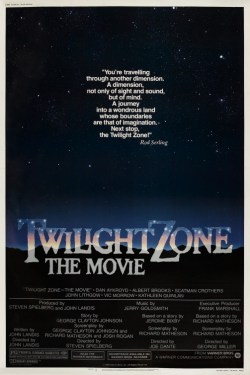
Twilight Zone: The Movie. Warner Bros./Amblin Entertainment 1983.

Before watching the movie:

I first learned that there was a movie based on The Twilight Zone when I read that the first meeting between John Lithgow’s character and William Shatner’s guest character on “Third Rock From the Sun” had them comment that they had similar terrifying experiences on an airplane, and that was a reference to the fact that Shatner had starred in the Twilight Zone episode “Nightmare at 20,000 Feet”, and Lithgow had played the same role in the Twilight Zone: The Movie remake of that story. I thought it was odd that of all the iconic stories told on The Twilight Zone, they chose that one to make a movie out of, but simply titled it “Twilight Zone”, as if the one story summed up the entire show. I much more recently looked it up and discovered that multiple stories are told in the movie, which really makes a lot more sense.

Continue reading

Sinbad: Legend of the Seven Seas

Sinbad: Legend of the Seven Seas. Dreamworks Pictures 2003.

Before watching the movie:

Nobody wanted this movie, nobody saw this movie. I didn’t want it and I didn’t see it. I was completely unthrilled by the concept when it came out, and it still doesn’t excite me. But it was the last straw for traditional animation at Dreamworks, so I always though I’d eventually give it a chance, and now I am.

It’s such a generic pitch, I don’t even know what to expect, beyond probably not that great a depiction of Sinbad, since I understand the legendary figure as an Arabic or Middle Eastern sailor and he’s played by Brad Pitt. I don’t really know anything about the traditional character beyond that except for whatever I retained from that Popeye movie that I think had him as the villain, which I also don’t expect would be the most faithful.

Continue reading

The Secret of Kells

The Secret of Kells. Les Armateurs 2010.

Before watching the movie:

For a long time, I thought that this movie was Japanese in origin, I think pretty much entirely due to first observing it in a collection of animated movies that seemed to otherwise be exclusively Studio Ghibli movies. I had a vague sense that it was a story of Ireland, and likely concerned a fantastical adventure with nature spirits, but barely even that. I pictured something like Fern Gulley with the Irish forests. The box art was not very descriptive at all, and I’ve chosen a poster I haven’t seen before that gives more of a sense of story over mood, though I grant the other version is more visually appealing.

Having so little to go on, I think the main thing that kept me less than interested for so long was the design style of the boy and girl characters not being one of my favorite looks. I’m also not sure if the title is meant to convey more than I’m picking up. I’ve only ever heard of Kells as in “Celtic knots inspired by the Book of Kells”, so for a long time I thought the Book of Kells was a book cataloging design. For a bit, I entertained the possibility that Kells might be another name for Celtic knots.

Continue reading

Abbott and Costello Meet Frankenstein

Abbott and Costello Meet Frankenstein. Universal-International 1948.

Before watching the movie:

For a long time I thought I had a distant memory of watching this movie, but it might have just been Abbott and Costello Meet The Mummy. Whether I saw it or not, my memories are so dim that this might as well be my first time, so I’m doing it now.

It always struck me as strange that the Abbott and Costello movie that Bela Lugosi reprises Dracula in is “Meet Frankenstein”. It looks like they worked in as many of the Universal Monsters as they could make fit into the script, though I guess that list is longer than I generally think of. I don’t know that they ever paired the duo with, say, the Creature from the Black Lagoon.

Continue reading

A stitch in time

The time I planned to spend preparing to write a blog this week was consumed instead by small things causing big headaches, so in its place, have a sampler of time travel stories. I was surprised at first that I found so few in my history given how much I enjoy them, but then I began to realize I was overlooking some.

  • Primer: I don’t know if I’d call it the hardest sci-fi time travel story I’ve covered, but it’s easily the most intricate.
  • A Sound of Thunder: The only time I reviewed a movie less than ten years old at time of publication, and I was soundly let down by it.
  • Somewhere in Time: what if Christopher Reeve could meet the love of his life by meditating really hard? Surprisingly, not as goofy a story as it sounds.
  • Movies of my Yesterdays: Meet the Robinsons: still one of my favorite time travel stories ever and I don’t think that’s just nostalgia.
  • The Lake House: speculative romantic fiction is rarely done better.
  • Sliding Doors: okay, this one is more of time being the one to travel through the character or something. I don’t know if the blog is my best writing, but I’ll always be proud of the technical gimmick I was able to implement.

Christine

Christine. Polar Film 1983.

Before watching the movie:

This is a horror movie about a possessed car. Even though it’s based on a Stephen King novel, I think the chances are good that it’s going to be more silly than actually scary. Maybe it’s just my frame of reference, but when people refer to a story about a living car, they’ll go for a lighter story like The Love Bug or “My Mother The Car” (that one’s almost certainly my reference pools), because the concept really does seem to be better suited for comedy than horror. A car can kill you, and we’ve built our cities with a little too much focus on car accessibility, but ultimately a car is only dangerous to a person under a very specific set of circumstance.

Continue reading

Holiday Rewind: The Bishop’s Wife

I thought I had originally selected The Bishop’s Wife as a Christmas viewing, but I originally reviewed it in a September, so clearly not. I remember it as being less about Christmas than I had expected, which is strange if I hadn’t gone out of my way for it.

I also remember it being a quiet and almost thoughtful movie. It was light and feel-good more than being about the comedy or the drama. The busy man has to feel in danger of losing his wife to a man in tune with her needs to remember to value life outside of his ambitions. Merry Christmas, take nothing for granted. If I didn’t know that It’s A Wonderful Life only got popular much later because it could be run on TV for cheap, I’d suspect that this movie that came two years later was trying to capitalize on it.

The Bishop’s Wife. RKO Radio Pictures 1948.

Harry Brougham used to be the reverend of a small church in a poor part of the city, but not too long ago was appointed as the local bishop and tasked with overseeing the fundraising and construction of a new cathedral, which he’s become obsessed with building as a glorious edifice, but in order to get the money for such a grand work, must brown nose with the area’s wealthy elite, especially Mrs. Agnes Hamilton, who wants to leverage her donation to make the cathedral a monument to her late husband. But with his constant negotiation and planning meetings with the big donors, Bishop Brougham has not only lost all joy and charity, but also any time to love his wife Julia and daughter Debby. Strained by the tension between his principles and his desire to realize the magnificent cathedral of his dreams, Henry prays for guidance, and into his life pops Dudley, an angel who’s come to pose as Henry’s assistant and help him find his path. Though Henry doesn’t want to believe Dudley is who he says he is, particularly as Dudley won’t perform any miracles with witnesses, he does begrudgingly believe that Dudley may be supernatural. But instead of a helper to raise a cathedral from nothing with the wave of a wing, Dudley spends most of his time raising the spirits of Julia and Debby by “representing” Henry in his roles as husband and father. As Julia is lifted out of the misery of her existence since Henry’s duties took him away from his family life, Dudley’s relationship with her begins to resemble something wholly inappropriate.

This gets billed as a comedy, but it seems more like a light feel-good melodrama. Or really, it’s an unorthodox romance, where the central tension is that not only can the central couple really not be allowed to end up together, but the whole point of them getting dangerously close to falling in love is as a wakeup call to the protagonist. Dudley’s lies of omission and other interactions with the secondary and tertiary cast bring some levity, but it really feels more like comic relief than something intended as a comedy. Although perhaps in its day it was entering comedy territory just to put the pair into situations that lend themselves to misinterpretation from the outside. Definitely there’s a mild laugh a couple of times from people getting the wrong idea, but it’s very mild.

One may almost be tempted to consider it interesting that Cary Grant is not here as a romantic lead, only that’s not actually true, since again, the main shape of the movie is a romance story, only Dudley and Julia can’t actually be together. What makes it unusual is that the tragedy of them not being able to be together isn’t really foregrounded, it’s more of a postscript to the morality play of staging a crisis in Henry’s life.

I’m impressed with myself that in the original review I summed up the movie as feeling like a Christmas card, because I came up with the same imagery in organizing what I expected to write this time. Both times I was probably inspired by It’s A Wonderful Life originating as a short story in a Christmas card, even though I didn’t reference that movie directly in the original review. This came from a novella, as most movies with an unusual amount of texture do.

I also think I was pretty harsh on the diversions from the plot for entertainment value. Does the scene with Dudley, Julia, and their cab driver advance the plot the whole time? No, but it advances the theme of brightening the world with understanding and unconventionality. Does the boys’ choir scene advance the plot? No, but it illustrates some Christmas magic. I don’t know why I remembered it as barely a Christmas story, since so many scenes are steeped in at least being in early winter and the climax is on Christmas Eve, as well as having a very Christmas message of love, generosity, and fellowship. This could easily be among the movies left on repeat on cable channels that send everyone home for Christmas week.

The Shaggy Dog

The Shaggy Dog. Walt Disney Productions 1959.

Before watching the movie:

While I’d seen brief promos for this movie before with other Disney home video rereleases, I never really got an idea of what it was like beyond somebody turning into a dog. I did see the Tim Allen remake, but if that draws on anything past the “human turned into a dog” idea, it looks like it has more to do with the sequel The Shaggy D.A. I do see that where that remake used genetic research as the catalyst for the metamorphosis, I’m kind of amused that this is just “a magic ring”. Or rather, a magic ring the Borgias had, because dropping random historical names makes things sound more legitimate.

I know a few more details now but I still don’t really know what shape the story will take. It’s always nice to see Fred MacMurray though.

Continue reading