Seven Chances

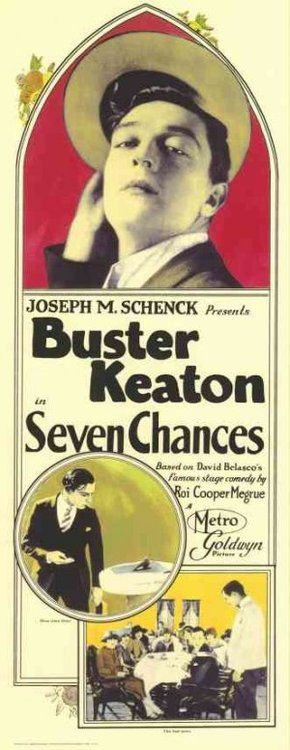
Seven Chances.  Buster Keaton Productions/Metro-Goldwyn Pictures 1925.
Seven Chances. Buster Keaton Productions/Metro-Goldwyn Pictures 1925.

Before watching the movie:

Buster Keaton is possibly the most enduring silent film personality, next to Charlie Chaplin. Few have made and starred in so many silent films that still get counted as great entertainment now.

This one is probably one of them. Unlike The General and Sherlock Jr, I think I’ve only encountered this as a heavily represented modern release of Keaton’s body of work. So it’s well known on the silent film shelf, but I don’t know of any buzz outside it.

The basic story appears to be an heir who must get married to receive his fortune getting mobbed by gold-digging suitors. Which would provide plenty of fodder for slapstick, and I’m not sure if there will be time for much else, though it’s apparently based upon a play. I wonder what the result will be in the translation from a dialogue-driven medium to a purely visual one.

Continue reading

Fast and Loose

Fast and Loose. Group Film Productions 1954.

Before watching the movie: Automatically recommended to me based on titles like The Fuzzy Pink Nightgown and Monkey Business, this appears to be somewhere between manners comedy and code-compliant titillation farce. A happily married man and a happily married woman who used to date get separated from their spouses, have to share a room at an inn, and find themselves in increasingly compromising situations.

What caught my attention are the words “British” and “Farce”. And Stanley Holloway, although I’m not sure if I’ve actually seen him in anything, or if his name is just close to Sterling Holloway. None of the other people involved ring any bells, although apparently Kay Kendall was a Name at the time. I’m just not familiar enough with that era, most likely. Continue reading

Only the Lonely

Whose leg is that in behind Candy? It's completely wrong for Sheedy's position.
Only the Lonely. Hughes Entertainment 1991.

Before watching the movie:

From what I can tell from summaries, this movie covers several years of John Candy sneaking a relationship/engagement behind his mother’s back. The length of time that seems to be involved is throwing me off so I have no idea what to expect from the plot.

It’s not even readily apparent why his character has to hide his lover from his mother, but from some minor things on IMDB I glean that there’s a strong Irish-American element, so my guess is that O’Hara’s character is a very traditional Irish mother and Sheedy’s is not Irish enough or Catholic enough or something for her.

I expect good things from a movie written and directed by Chris Columbus and produced by John Hughes.They both have a strong track record on earnest portrayals of life and family.

Continue reading

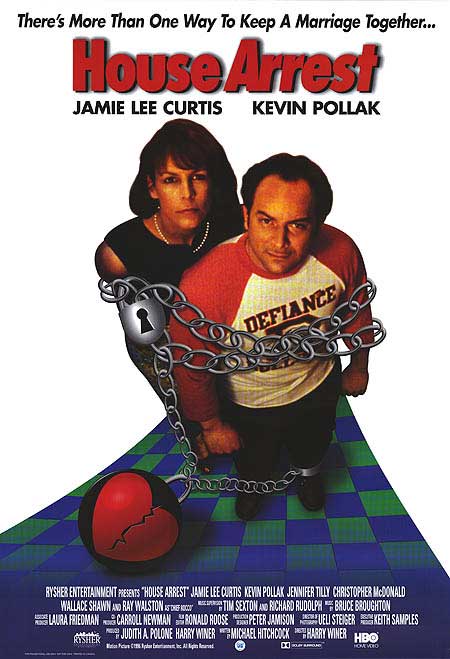
House Arrest

House Arrest. Metro-Goldwyn-Meyer 1996.

Before watching the movie:

I’m not sure how I feel about the premise of this movie. Parents get trapped in a locked room by their children so they won’t get divorced. Kids turning the tables on adults, family funtime hijinks, that sort of thing. I believe that divorce should be a last resort after attempts at saving what was once a happy, healthy relationship have failed, but forcing people to find a way to stay together really depends on how it’s handled.

There are a lot of good actors I’m looking forward to seeing, even if they’re presenting material I disagree with.

Continue reading

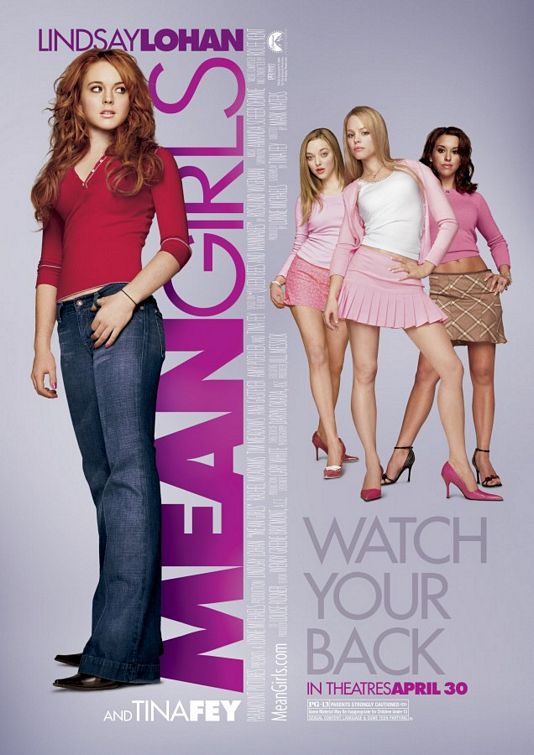
Mean Girls

Mean Girls. Paramount Pictures 2004.

Before watching the movie:

I’m fairly certain there were girls’ clique stories before Mean Girls, and of course many more after and because of it. So my impression is that this is extremely generic. But that’s probably unfair. Especially because of the influence this has had on the ten years since. And there’s always room for the writing to rise above a generic story type. I know there are a handful of lines that have become memetic.

This is also likely the most in-depth look at the girls’ clique trope. I seem to recall an idea that this is nearly anthropological in its study of catty high school girls, but that may be an argument beyond the depth of this blog.

Continue reading

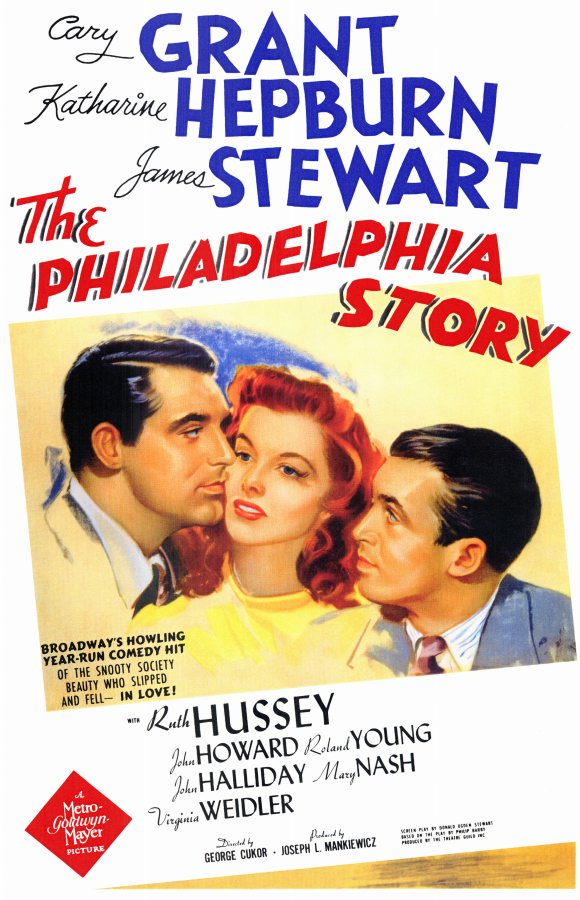
The Philadelphia Story

The Philadelphia Story. Loew's Productions 1940.
The Philadelphia Story. Loew’s Productions 1940.

Before watching the movie:

This is one I thought I’d get to for years and never did, until now. I had access to it for a long time, and then I moved away from it. But now I can see it again, so I am.

I have the impression this is a screwball comedy, but I may be reading too much into it from its superficial similarity to His Girl Friday via the married couple and ex-husband dynamic and the fact that it shares one third of the same stars. Certainly it has more to do with that movie than with Philadelphia. Continue reading

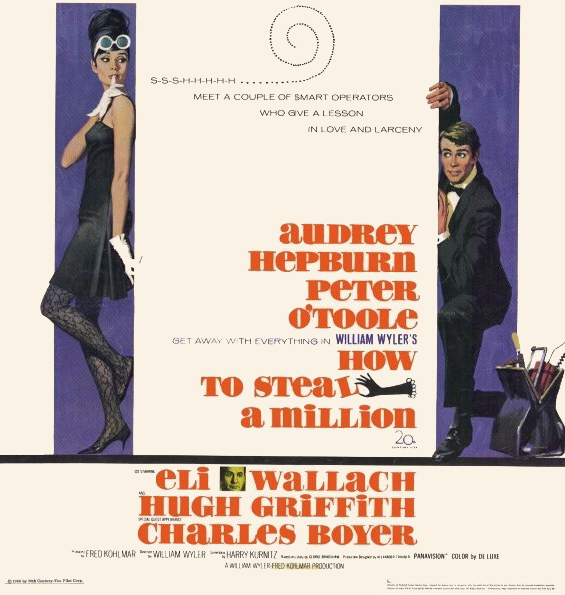
How to Steal a Million

How to Steal a Million. 20th Century Fox 1966.

Before watching the movie:

The stars are the headline for this movie. Peter O’Toole is no doubt a scoundrel with class and Audrey Hepburn brings glamour with… playfulness? I’m not as familiar with her type as I should be.

This appears to be a story of an unlikely pairing of people who never expected to be art thieves. Something to do with an art forger who gives his master forgery to an art museum, presumably meaning these two decide to steal it back. I’m predicting a clumsy, snarky heist, but I recognize I’ve built a lot of preconceptions on top of what little I actually know.

Continue reading

48 Hours

48hrs_onesheet_uk-1Before watching the movie:

I think I first heard this existed in some kind of Eddie Murphy retrospective. I just remember an interview clip of Murphy talking about being awed at getting the chance to work with Nick Nolte. This looks like a slight revision of the “buddy cop” formula, where in this case, one of the chalk and cheese pairing isn’t a cop but a convict, presumably with the connections the one who is a cop needs.

Buddy cop wasn’t played out in the early 80s, but I think it was still well established at the time. What comes to mind right now is that the two-year later Beverly Hills Cop seems like a streamlined version of this premise without the buddy cop dynamic, merging the streetwise fast-talker character with the unshakeable detective character. It’s highly likely from the similarity and proximity that Murphy got Beverly Hills because of this movie.

I’m not sure I’ve seen Nolte in anything other than Lorenzo’s Oil, which I saw in a science class in high school. I don’t remember much of it, but I do know it’s clearly a very different film from this. Continue reading

Monkey Business

Monkey Business. Twentieth Century Fox 1952.

Before watching the movie:

Here’s another that I found rattling around my automated recommendations, having never heard of it before The log line for this movie goes something like “a scientist discovers the fountain of youth, and a screwball comedy ensues”. It looks like there’s a love triangle, and there’s probably some dispute over who gets control over the youth serum, but I’m fairly clueless about it otherwise. Maybe it’s a bit like The Man in the White Suit?

I often think about how I’d like to watch a movie without knowing anything other than the genre, the cast, and the title, if that. But while it’s nice to watch a movie without preconceptions, it’s not as enjoyable to write about a lack of them.

I’m pretty sure I’ve seen Cary Grant handle witty screwball dialogue well before, but I don’t think I know Ginger Rogers as anything but Fred Astaire’s dancing partner, which now occurs to me as almost certainly unfair to her.

Continue reading

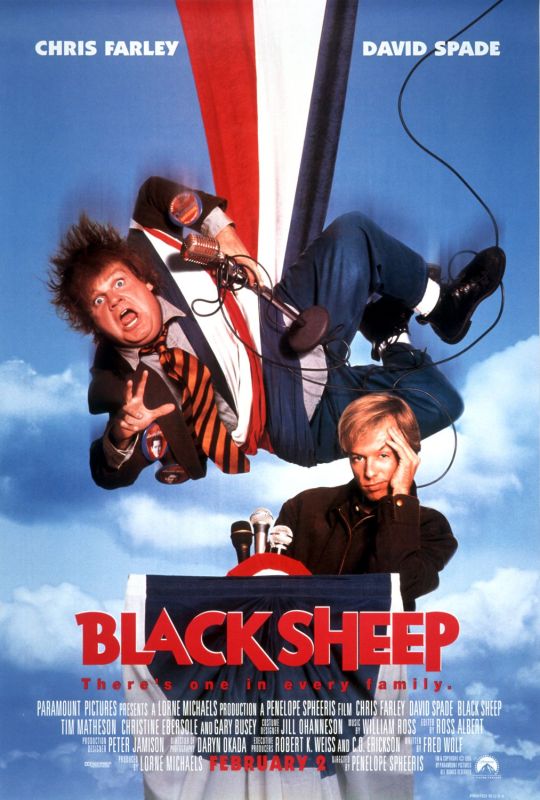
Black Sheep

Black Sheep. Paramount Pictures 1996.

Before watching the movie:

Chris Farley and David Spade. That’s all I need to know.

Okay, apparently there’s a man running for office and Chris Farley is Rob Ford his misbehaving brother who keeps getting into headlines for all the wrong reasons, dragging the family name though the mud. What comes to mind is Spin City or The Thick of It, but with familial ties instead of political ones.

I guess I should say that from what I have in front of me, I’ve been assuming that Farley and Spade play brothers (which I would buy in the context of such a comedy), but on second thought, Spade is probably the head of the PR team or at least the member personally responsible for keeping Farley’s character in line, because that’s the combination that gives them the most opportunity to play off each other. Spade’s type of character is much more of an image manager than an office-seeker, anyway.

Continue reading