We’re Back! A Dinosaur’s Story. Amblin Entertainment 1993.
Before watching the movie:
Despite definitely remembering a trailer, I couldn’t say anything more about what this movie is that isn’t on the poster. Cartoon dinosaurs in the modern day. There are a lot of names I recognize in the credits, but I don’t know what to expect other than John Goodman is definitely the lead dinosaur and Jay Leno’s character is probably a minor chomic relief player.
I’m not sure if this is so much popular as memetic anymore. It’s still a go-to reference for “creepy and dangerous children”, but I think it’s more referencing other references than familiarity with the film anymore. At least, I haven’t heard of anyone actually watching it recently.
This spawned a ridiculous number of sequels. Yes, it’s a horror movie, but it’s a horror movie about a cult. Seems fairly self-contained.
How to Lose a Guy in 10 Days. Paramount Pictures 2003.
Before watching the movie:
I thought this came out later. I seem to remember a poster for this movie being up like it was new when I was in college. Maybe I was mistaken about why it was up, or maybe a movie with a similar poster was out at the time. It’s not a very original poster design.
Anyway, there are few better ways to manufacture conflict in a romantic comedy than to have the romantic leads have opposing goals they’re hiding from each other, and this is one of the most basic forms of that. He’s made a bet that he can make her love him in 10 days, she’s trying out a relationship destruct plan for an article she intends to write. And there’s a lot of quirkiness along the way I guess.
It is strange to recall that Hugh Jackman used to be known as a romantic lead. For one thing, that was around 20 years ago, but also I can’t remember the last time he was in a romantic role. And that’s not a genre I pay much attention to.
Romantic comedies are almost all basically the same plot, but with a few elements thrown in for flavor. The main added flavor here seems to be “she’s an advice columnist who’s about to be proven wrong.” Which I don’t really have a lot to say about, but I’m interested in seeing how it gets where it’s going.
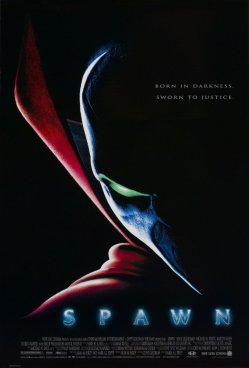
Every time I think I understand what this movie is, I go looking for something to verify that and I come up with more confusing information. I think I can safely say that the main character is a recently deceased man recruited by demonic forces whose main internal conflict comes from coming to decide this work isn’t right. I’m not clear on much of anything else. Except this isn’t as similar to Blade as I thought. Every still I’m being presented looks like it’s from a different movie.
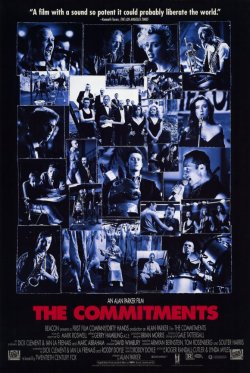
I’ll be honest, a screencap with Colm Meaney was what attracted my attention, though it looks like he has a pretty minor role. And really, an Irish movie in the 90s would be remiss not to include him in some way.
The actual point of this movie seems to be a bunch of wannabe musicians being put together in a band by a wannabe manager. Which could go several different ways, and since it’s billed as a dramedy, probably goes many of them.
I’m unclear whether the anti-Semitism the main character wants to expose is within a particular institution, or more broadly, within society at large, like the seminal Black Like Me, or less seminal White Chicks.
While there are people, perhaps even people who would not be considered eugenicists or race-nationalists, who consider “Jewish” a morphological race, the physical characteristics are very subtle, to the point where I’m not sure how a Gentile reporter would pose as a Jewish man other than introducing himself to people who don’t know him with a “hi, I’m Jewish, by the way!” A long game approach would probably be to get a new job somewhere and drop big hints, but that would point back to “within a single institution”. I feel like I got out of my depth three paragraphs ago and I should just let the movie tell its own story.
I have no idea what to expect. This was an algorithmically generated recommendation I’ve never heard of, and all I have to go on is that it’s a courtroom drama about some amoral law students who believe they’re above the law. And Orson Welles is in it.
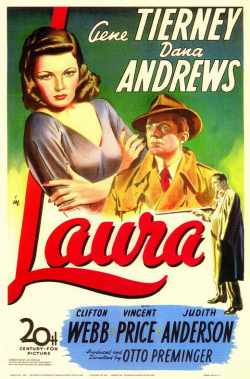
I’m not sure if I’ve been aware of this movie before it came up in recommendations or not. I seem to be vaguely aware of “Laura” as a title, but I may just be thinking of the song (which I know because Spike Jones exploded it), that turns out to be the theme from the movie with lyrics added.
Vincent Price appears to have a small role, judging by his billing, but he’s the biggest name I can see. The only other name I even recognize on the shortlist is Clifton Webb.
All the President’s Men. Wildwood Enterprises 1976.
Before watching the movie:
I’ve always felt that the Watergate wiretapping investigation was the single moment that America lost popular faith in its government. Perhaps that’s a naive view of history before it. Certainly the Vietnam War was a black eye for the nation. And I know there were other scandals gaining headlines between the Civil War and the Great Depression. Not long ago I covered a movie about political corruption from the 30s.
I will certainly grant that corruption has been around as long as there has been power to abuse. But if I had to point to one reason why pretty much anyone will tell you they’re all crooks in Washington, I’d say it was the CREEP coverup revelation. That was, in my mind, when the spin broke down and we saw the President’s New Clothes. The day a sitting president resigned in disgrace to avoid impeachment was the day we stopped believing that as a whole, our leaders had our best interests at heart. At least, that’s the narrative I’ve developed as someone who was born almost two decades later, having lived in a world where no substantiated political scandal has yet compared.
After watching the movie:
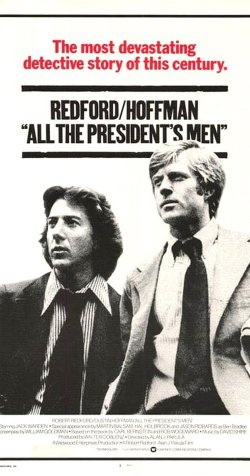
When the Washington Post’s newsroom signs young reporter Bob Woodward to cover a burglary at the Watergate hotel, it’s a simple police story. But as he covers the legal proceedings, he finds that they were assigned counsel but turned out to have private counsel they couldn’t have had a chance to hire themselves. Following that mystery leads to uncovering a meeting with a someone who works for the Special Advisor to the President. As the story grows, younger Carl Bernstein joins with Woodward to help pursue and report the case. Everything about it indicates deep corruption, but no source will go on record, and hardly anyone will give any information at all. There are plenty of hints that this is something big, but hints and hearsay don’t make concrete journalism, and the harder they push, the higher the pushback comes from.
This doesn’t play much like a movie. It’s more a methodical presentation of events. It seems almost as clinical as the case studies Sherlock Holmes would prefer Watson write. Despite dealing with the very heart of what makes our free society work, there’s next to no emotional investment asked for by the narrative. The duo fight through cold trails to get their facts, but we don’t get any kind of personal level of narrative conflict, just the professional challenge. This is almost excusable by the fact that we as the audience know how things turned out.
The end seems very abrupt. I’d consider the story beat it concludes on to be the beginning of the third act. After a major reversal, they get back on their feet and roll up their sleeves… and then it’s over, and all their vindication comes from an epilogue told in headlines. Perhaps this decision came from realizing the movie was already reaching two and a half hours in length.
Perhaps due to the limitation of scope of the story told, there doesn’t seem to be time in those two and a half hours to really explore the gravity of just how big the conspiracy was. It’s a gut punch to learn how much of the government was in on the election interference, but then everything wraps up with all the mess of that handled off camera. This further leaves the impression that nothing really matters in this movie about uncovering very important things.
Ultimately, this story isn’t as concerned with the erosion of democracy as it is with journalistic integrity. Journalists will say that journalistic integrity is key to democracy, but in this case, the report could only be made after the damage had been done. The scheme worked, all the papers could do was refuse to let it stick. And by the narrative shown here, even that was a long shot.




 Yesterday's Movies