
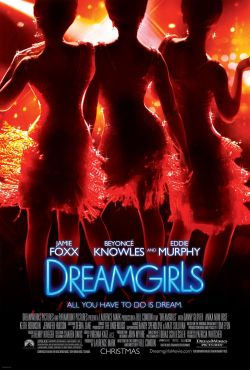
Before watching the movie:
A large part of why I’ve avoided this movie is because I have always confused it with Showgirls. I don’t know much about that movie either, but I realized I was confused when I went looking for the movie poster for Dreamgirls and didn’t see the weird leg women, a design that told me enough to stay away.
What I do know is that Eddie Murphy is in it somehow. I always imagined him as the Emcee in front of a cabaret show, but that’s because of the confusion with the other movie.
After watching the movie:
In the early 60s, the Dreamettes, a trio of Black girls trying to get a singing act off the ground, enter an R&B talent contest at the Detroit Theater. While they don’t win, they do attract the attention of Curtis Taylor jr, a Cadillac salesman angling to enter the music business. Curtis offers to try to get them the gig as the backup singers behind Jimmy Thunder Early on his tour, acting as their manager and agent. Deena and Lorrell are eager to accept, but their lead Effie is hesitant to do backup, afraid that as backup singers they’ll have a hard time stepping out from behind the star, but ultimately accepts for the benefit of her friends and her brother C.C., their songwriter. Curtis soon worms his way in as Jimmy’s manager too, supplanting his longtime agent Marty, and they have modest local success with their first single until a white artist steals the song and makes a national hit. Curtis liquidates his dealership to fund a payola campaign to get their next song on the charts while pursuing a relationship with Effie and promising her own record soon. When Jimmy’s act fails to appeal to white crowds the way he hoped, Curtis separates him from the trio, now renamed the Dreams, and plans a national music domination campaign with them, but with Deena in front as a younger, lighter, more broadly appealing face and pop-friendly voice. Cheated of her stardom and feeling physically ill, Effie is disillusioned and increasingly belligerent with the group, until Curtis hires a replacement. Having just learned that she’s pregnant, Effie leaves Rainbow Records on her own, and Deena, Curtis’s new girlfriend, is on the way up.
Apparently the best way to go into a movie cold is to mistake it for a completely different one. I have to say I was rather relieved to realize that I was thinking of the wrong movie as I watched. An exploration of the Detroit sound music industry through the 60s and 70s is much more attractive to me than what turns out on looking it up to be an even more explicit portrayal of stripper life than I realized. I have no idea why Showgirls came into my awareness about the same time as Dreamgirls. I always thought that they came out at about the same time, but they’re almost exactly a decade apart.
I thought the setting was going to be a mainly aesthetic backdrop at first. It wasn’t until “Cadillac Car” got stolen by a white singer that I started to get the sense that this was going to be a history lesson about the business. I had to read after the fact that this is directly inspired by the story of Motown Records and the Supremes, but I probably could’ve gotten a clue from the obvious Jackson Five pastiche we see a few times as an example of a Rainbow Records act not directly involved in the plot.
I wasn’t sure how well Eddie Murphy was going to fit, especially with the setting, but he can take a turn for the dramatic so well it’s a surprise he doesn’t do it more often. He turns out to play a manchild in a serious world perfectly, and sings so well you wouldn’t know his earnest solo discography is often called forgettable at best (though he does do a lot of singing in comedy, come to think of it). I also don’t really think of Jennifer Hudson as a singer, and so I was surprised her credit here was “introducing”, but apparently she’s considered a singer before being an actor. And then on the other end of the spectrum, I was blindsided to realize that Deena was played by Beyonce. She disappeared completely into the role. However, even among all these luminaries, my eyes were always on Jamie Foxx when he was in the scene, quietly becoming the villain. I was also pleasantly surprised to see Jaleel White in what turned out to be a smaller role than I thought right at the beginning. I’m sure he’s been doing things since playing Urkel on Family Matters and Sonic on the 90s Sonic the Hedgehog cartoon (something I only learned a few years ago), but he hasn’t been nearly as visible, so it’s nice to see him getting to have something like a normal career after the national fame/infamy.
One thing that’s always interesting with musicals about show business is how they balance the songs that are happening because a character is actually singing and songs that are happening because it’s a musical and characters get to sing. The first song that isn’t initiated by someone being on a stage, behind a piano, or in front of a microphone happens about 30 minutes in, by the point I’d assumed there weren’t going to be any non-diegetic songs. Even so, almost every in-world number is thematic to the moment it takes place in, though they can get taken out of context and re-arranged for plot reasons too. C.C. is actually increasingly frustrated with Curtis ruining his songs by changing the soulful tune he had in mind into something poppier, but every one that Curtis changes is mostly just “yeah, that’s a different way to do that song and I can kind of tell it’s more dazzle and less heart”. The two changes that are calculated to hurt the most are “One Night Only”, which, while it’s an arrangement that takes it into a different mood, the real turn is how the meaning is turned on its head just by flipping a pronoun from “you’ve got one night only” to “I’ve got one night only”; and the theft of “Cadillac Car”, which manages to ruin the song entirely, as if drowned in mayonnaise.
I’m coming to notice how much I appreciate stories told across decades so we can see how people change in the long term. I’m not sure the characters change so much as the historical environment they’re in, but that’s also fascinating to watch unfold in over ten years. The songs and intrigue are a lot of fun, but it’s also just fascinating to see the world they live in evolving and how they adapt to fit in it. The songs, while really well done, are already kind of fading from my memory, but the trek through music history is what’s sticking with me from this movie.



 Yesterday's Movies