This came up in automatic recommendations, and I know very little about it. Apparently, it concerns a jewel thief trying to recover his stash, which had a police station built over it while he was in jail. I’m expecting something of a heist, but there are indications he spends a while posing as a police officer to get inside, which implies a deeper level of infiltration than I usually think of for a heist.
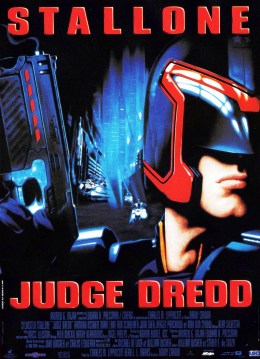
I expect this movie to be a lot like RoboCop. A police state dystopia set in the near future that is now both uncomfortably dated and also overly optimistic about technological advances.
I’m not sure if Dredd is a satire or just a warning, but I know the point of him is that the degree of force he and other law enforcement are allowed to use is meant to be far beyond excessive. I don’t know if that carried through into the movie, or into fan understanding of the comic or the movie. Starship Troopers is mostly loved for the hyperviolence it was meant to be satirizing, and I wouldn’t be surprised if the same happened to Dredd.
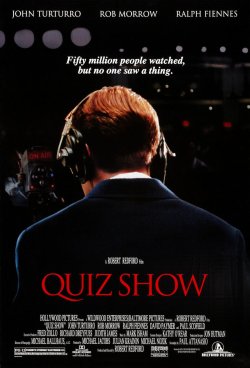
I have a dim memory of being aware this movie was in theaters. It was nothing I would have gotten to see at the time, but it vaguely sparked some interest as a regular viewer of Jeopardy. I didn’t know what it was about then. It was 20 years later that Jeopardy had their own ratings-driving long-runner, but the reason it hadn’t happened before is that they had only recently dropped the forced retirement rule instituted to keep above the appearance of doing the same rigging that actually happened on Twenty-One.
There is absolutely no reason I can think of why this should remind me of The King’s Speech, but here we are. Maybe one of the posters for that movie shows the King making the radio address from behind? It’s completely immaterial, so. Continue reading →
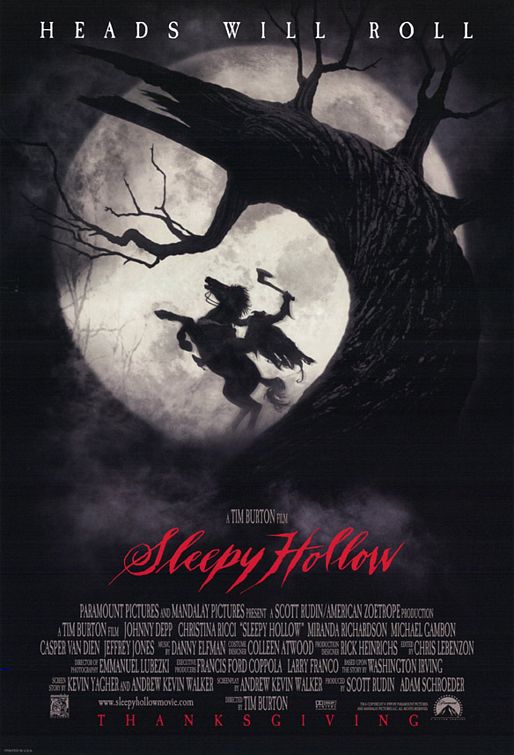
I principally know the story of The Legend of Sleepy Hollow through the Disney featurette. Wishbone did an adaptation, but it was the second season that I’m much less familiar with. It would be easy to go more into why Crane gets involved with the Horseman legend than the Disney version did, but it seems to pretty simply be that he’s spooked by the legend and happens to become a victim of the ghost. Well, it was a short story to begin with, so there’s not much need or room for motivation.
In this version, apparently they’ve changed him from a superstitious schoolteacher to a detective. Which would let him drive the plot, so it might be a good change. Definitely means this is going to be very different. Continue reading →
I really like modern-day spellcaster stories. I even found a fondness for Teen Witch. So all that I really need to be interested in this movie is that there are modern-day witch sisters. Their conflict has something to do with a curse upon their love lives, which sets up a romantic comedy apparently, and I’m further intrigued. I also like Sandra Bullock in pretty much anything, so that’s a plus as well. Continue reading →
Few things have been kept alive by love for half a century. That club will probably be growing enormously for the next few years because so much of our culture was born in the 60s and 70s, but this week, fans are celebrating that milestone for Star Trek. While anything can achieve fifty years since just by the nature of time, fifty years continuous is something special in pop culture. If the Animated Series is included, the longest hiatus in Star Trek is only around five years. There’s a new movie in theaters now and a new series coming direct to home streaming next year. And it all began before men walked on the moon.
So I came to the question of how to celebrate it here. I grew up with Trek. Trek was in the house before I was born. The number of times I’ve watched the first six movies probably adds up to dozens, and the ones worth talking about as representative of the franchise have been talked about to death. I’ve seen every episode of the original series at least once. I saw the new movie a few weeks ago. What can I talk about?
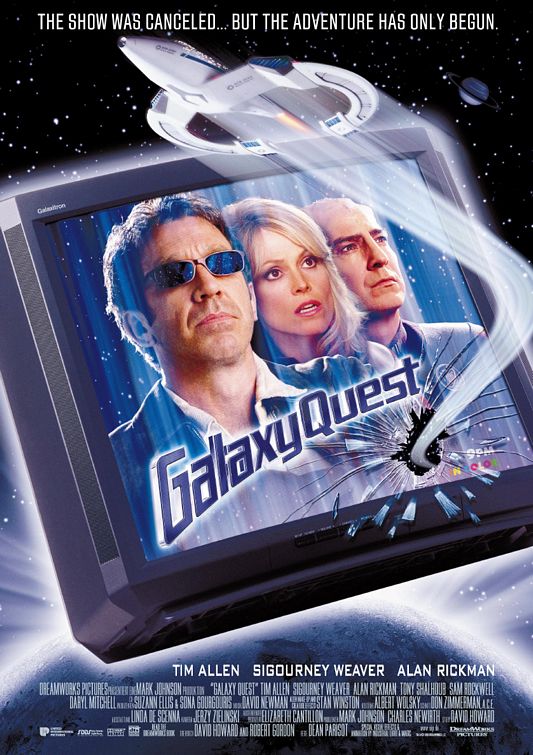
Galaxy Quest. Dreamworks Pictures 1999.
The 90s were the height of Star Trek as a franchise. From 1993 to 1999, there were always two series in production, and from 1994, there were movies on top of that. There was always something new in Trek, and as the internet grew, it became much easier to talk about it with other fans. Continuity was huge even before there was a shared universe across three productions to keep track of. And as the preeminent fandom in the public’s eye, Trekkies were the easiest target to spoof the weird fans who take the things they love maybe a bit too seriously.
And then along comes a movie that spoofs Trekkies themselves. What if somebody completely didn’t understand the concept of fiction and dedicated their lives to a show, forcing the actors to be their characters for real? What if somebody loved a show so much they made it real?
What strikes me about describing the story like that is that the idea of a fictional story colliding with the real world is actually pretty common, but it’s always through magic. Last Action Hero comes to mind, and Stranger Than Fiction is a good example of not explicitly being magic, but it’s a weird thing that is narratively indistinguishable from magic. The Thursday Next novels interestingly begin with a bit of technology to jump into the fictional worlds in the first book, but dispense with it subsequently. I’m sure there must be other examples of fiction intruding upon reality through a purely sci-fi mechanism (aliens receive TV broadcasts, model their society around the show), but I can’t think of any.
Of course, Peter Q. Taggart is clearly based on William Shatner. Ego to the brim, alienating the castmates that are stuck with him, and too stuck in the glory days to realize it. That he is the main protagonist makes him sympathetic, but it has to get pretty savage to break Taggart down to the point where a real-life space adventure is what he needs. Everyone else is a bit more vague. Tawny Matheson’s best parallel is Uhura, but they cast Sigourney Weaver and arguably her function is more of a parody of Tasha Yar at tactical. I have a dim memory of the novelization letting her find a function that wasn’t just repeating the computer and looking pretty, but unfortunately the movie doesn’t have time for it and she just ends up embracing the part. Tommy Webber is mainly a Wesley Crusher type, but casting him black invokes Geordi’s season at the helm as well. Dr. Lazarus is kind of a hybrid of Spock and Worf. Dane/Rickman is clearly emphasizing the Spock side, but his cool logic in this case is an attempt to control his hot-blooded warrior tendencies.
I really enjoy Tony Shalhoub’s performance, but they cast him as Fred Kwan/Tech Sgt Chen, and he’s not at all Asian. If they’d given Fred a surname of a more appropriate ethnicity it could’ve at least been a joke about Hollywood casting anyone vaguely not white in any ethnic role, but instead it’s an honest example. Shalhoub is of Lebanese descent, but could be mistaken for Mediterranean European, and so this spoof of a show that was promoting diversity before diversity was a watchword comes off as having a token black guy and a token woman/love interest, and everyone else is white guys. And one green monster.
But they’re just the ones having the adventure. The real heroes of this story are the fans. The alien fans who were united by their respect for the “historical documents” from another world, and the human fans whose knowledge of the show guides the crew to victory. In the end, the Thermians are encouraged to make their own adventures, to be inspired by the Protector rather than devoted to it. Fans that become creators are what keeps franchises going, spawning legacies without bound. The Thermians will make their own history, and Galaxy Quest will live again. And Star Trek, and its fans, will continue the mission.
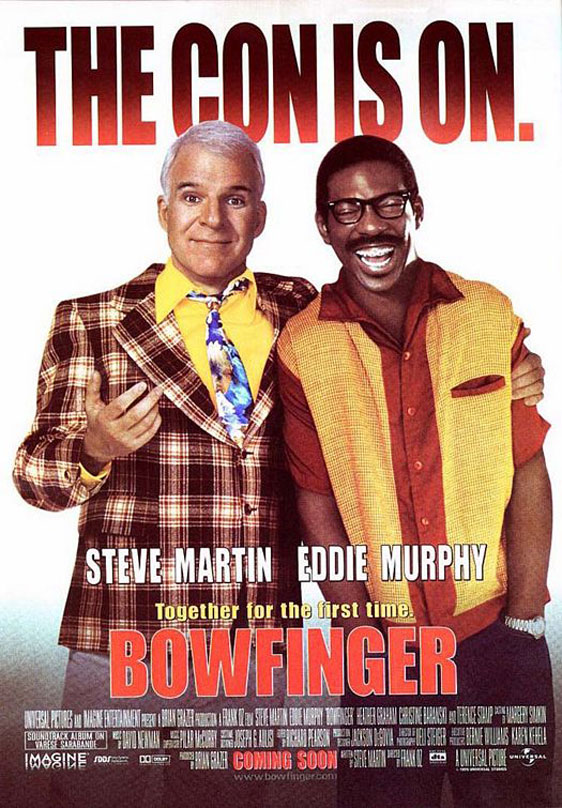
Why haven’t I seen this movie? Well, it’s PG-13, and I was ten or eleven when it came out. But why haven’t I seen it since? I’m not sure why I never circled around to it. Eventually I started doing this blog and I knew when I saw it, I’d have to review it here, which has a tendency to slow things down. But Steve Martin and 80s-90s Eddie Murphy together make for a film I’d have to experience eventually.
I always had some concept of the plot as being about a scam going down, so I was picturing something like Dirty Rotten Scoundrels. But then a movie is involved, so maybe it was more like After the Fox. It turns out, the scam is that a box office superstar is getting tricked into acting in a no-budget film for free, I guess via hidden cameras. This is going to be fun.
While it was never really a favorite, more of something not disagreeable between other shows I did like, I recall there was a period in my youth when I watched a lot of The Beverly Hillbillies. Boy, those yokels who don’t know how they’re supposed to use egregious amounts of wealth, right? Actually I recall it using both extremes to mock the other. The Clampetts may have been walking stereotypes, but they were also people of simple tastes who highlighted just how absurd the excesses of wealthy Southern California can be. They bought a mansion in a nice neighborhood, but they still lived simply. I recently spent a lot of time thinking about what to do with a massive windfall, and I think it’s smart not to change much about one’s habits simply because smoking cigars wrapped in hundred-dollars bills on a yacht becomes an option.
I don’t know what to expect from a reboot movie made 20 or 30 years later. The show was made in a media landscape that believed in a simpler world than what the 90s accepted. The plots that stick strongly in my mind are the time Jed decided that the “billiard room” was the place to have Thanksgiving dinner because it had the nicest table in the house, and if possible he should serve a “billyard” (a rhino, like the head mounted on the wall in that room) on it, or when their banker turned out to be the last descendent of a family feud inspired by the Hatfields and McCoys, until Granny found out and revealed she was from the other family. When I try to imagine the 90s equivalent, I see a lot of manic slapstick. “From the director of Wayne’s World” being a selling point does not sound promising.
This is one of those movies I’ve heard the title bandied about and little else. Perhaps the phrase predated the movie, since I’ve always known it as an idiom rather than a title.
Unfortunately, that gives me very little to go on for comment in this section. It apparently has an incredibly positive reputation, but yet I only came across it by specifically researching documentaries to consider for this month. I know it follows two inner city kids who are trying to get basketball scholarships to lift them out of where they are. Do they compete, or simply run parallel? I couldn’t say. There must be plenty of athletic scholarships out there, but they might be both scouted by one school for one spot. I can see the potential for a powerful portrait of their lives and potential, but I couldn’t guess at much more.
Unrelatedly, anyone who wishes to can now support this blog on Patreon. I promise not to have obtrusive reminders about it, whether it works out or not.
Kevin Costner is on the poster, but I’m not going to talk about him right now. I’m sure I’ll have plenty to say after the fact.
I’m not sure if I heard the news late at night or in the morning. Last Thursday, and on into the weekend, the internet was filled with euologies for Alan Rickman. It was too late to cover last week.
But more than ever before, I had a sense that people weren’t mourning an actor, they were mourning his roles. Nobody was eulogizing Alan Rickman, they were eulogizing Severus Snape, Hans Gruber, Metatron, and Alex Dane/Dr. Lazarus. And I simply felt that nobody had a sense of what Rickman was really like, since nobody would accuse him of actually being like an abusive professor, terrorist, aut al. I sure didn’t know what he was like, but I try to believe the best about people, and that’s been borne out by some statements from people who knew him personally.
And so, here I am reviewing one of his more popular movies, where he plays another villain. Well, I can’t review him narrating a viral video for charity. This was a movie that came up a lot in a way that didn’t seem to focus too much on the character, and of the two that came up that I hadn’t seen, this one seemed a better choice. It’s also the version most directly spoofed by Robin Hood: Men In Tights.






 Yesterday's Movies