However, I’ve never liked non-narrative series that make the last installment a retrospective or otherwise more of a special thing about the project as a whole than another installment that can mostly stand on its own, leaving the penultimate entry as the actual last one. So even though retrospective is an easy way to fill space, I wanted to resist that urge and end Yesterday’s Movies with a normal review. But what to pick, if not a Rewind?
I’ve always felt a bit strange about the blog outlasting its moratorium. This is a fifteen year old project that’s allowed to reach back ten years. So it occurred to me to check out the movies that released around the date that Yesterday’s Movies launched. And I got lucky. The same week, a movie called Nine had its initial limited release. It’s a musical, which is a bonus, and it’s about making movies. It’s about an Italian director trying to work out what his next movie should be. And that’s about all I know about it.
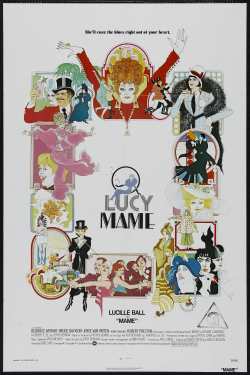
I really have no concept of what this movie is about. I think Mame is an outrageous character and I think this has the reputation of being an overblown production heralding the collapse of the musical bubble like Hello Dolly was.
I don’t know if I’m more surprised to learn this is starring Lucille Ball (not someone I think of as a singer) or that there was a nonmusical stage play and nonmusical film before this show. Or that this version is just “Mame”, not “Auntie Mame”.
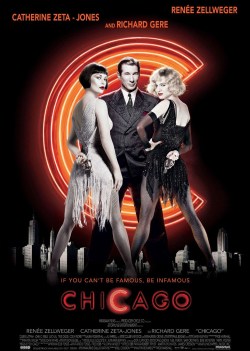
When I think of classic musicals, this is one of the first ones that comes to mind. So I was a bit surprised to see the movie came out in 1985, when I always assumed it was one of the highlights of the musical trend of the 60s-70s. It turns out that it did open on stage in 1975, it just took a while to get made for the screen. My original criteria for “classic musical” was nothing from after 1980, which is why it wasn’t in my last series of classic musicals. But this feels more of a different age of musicals than what I consider to be modern musicals (though I guess shows from after sometime in the 2000s are by now yet another category from what I’m getting at).
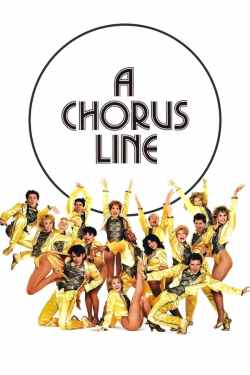
I don’t really know much beyond “I Hope I Get It”, so I know that it’s about musical performers desperate for jobs, so I expect a lot of diegetic numbers. I don’t really have an idea of the shape of a plot, if there even is much of one.
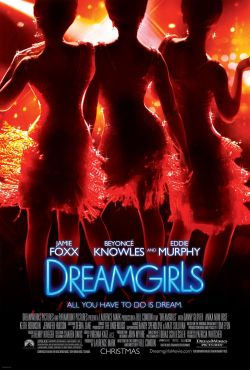
A large part of why I’ve avoided this movie is because I have always confused it with Showgirls. I don’t know much about that movie either, but I realized I was confused whenI went looking for the movie poster for Dreamgirls and didn’t see the weird leg women, a design that told me enough to stay away.
What I do know is that Eddie Murphy is in it somehow. I always imagined him as the Emcee in front of a cabaret show, but that’s because of the confusion with the other movie.
After watching the movie:
In the early 60s, the Dreamettes, a trio of Black girls trying to get a singing act off the ground, enter an R&B talent contest at the Detroit Theater. While they don’t win, they do attract the attention of Curtis Taylor jr, a Cadillac salesman angling to enter the music business. Curtis offers to try to get them the gig as the backup singers behind Jimmy Thunder Early on his tour, acting as their manager and agent. Deena and Lorrell are eager to accept, but their lead Effie is hesitant to do backup, afraid that as backup singers they’ll have a hard time stepping out from behind the star, but ultimately accepts for the benefit of her friends and her brother C.C., their songwriter. Curtis soon worms his way in as Jimmy’s manager too, supplanting his longtime agent Marty, and they have modest local success with their first single until a white artist steals the song and makes a national hit. Curtis liquidates his dealership to fund a payola campaign to get their next song on the charts while pursuing a relationship with Effie and promising her own record soon. When Jimmy’s act fails to appeal to white crowds the way he hoped, Curtis separates him from the trio, now renamed the Dreams, and plans a national music domination campaign with them, but with Deena in front as a younger, lighter, more broadly appealing face and pop-friendly voice. Cheated of her stardom and feeling physically ill, Effie is disillusioned and increasingly belligerent with the group, until Curtis hires a replacement. Having just learned that she’s pregnant, Effie leaves Rainbow Records on her own, and Deena, Curtis’s new girlfriend, is on the way up.
Apparently the best way to go into a movie cold is to mistake it for a completely different one. I have to say I was rather relieved to realize that I was thinking of the wrong movie as I watched. An exploration of the Detroit sound music industry through the 60s and 70s is much more attractive to me than what turns out on looking it up to be an even more explicit portrayal of stripper life than I realized. I have no idea why Showgirls came into my awareness about the same time as Dreamgirls. I always thought that they came out at about the same time, but they’re almost exactly a decade apart.
I thought the setting was going to be a mainly aesthetic backdrop at first. It wasn’t until “Cadillac Car” got stolen by a white singer that I started to get the sense that this was going to be a history lesson about the business. I had to read after the fact that this is directly inspired by the story of Motown Records and the Supremes, but I probably could’ve gotten a clue from the obvious Jackson Five pastiche we see a few times as an example of a Rainbow Records act not directly involved in the plot.
I wasn’t sure how well Eddie Murphy was going to fit, especially with the setting, but he can take a turn for the dramatic so well it’s a surprise he doesn’t do it more often. He turns out to play a manchild in a serious world perfectly, and sings so well you wouldn’t know his earnest solo discography is often called forgettable at best (though he does do a lot of singing in comedy, come to think of it). I also don’t really think of Jennifer Hudson as a singer, and so I was surprised her credit here was “introducing”, but apparently she’s considered a singer before being an actor. And then on the other end of the spectrum, I was blindsided to realize that Deena was played by Beyonce. She disappeared completely into the role. However, even among all these luminaries, my eyes were always on Jamie Foxx when he was in the scene, quietly becoming the villain. I was also pleasantly surprised to see Jaleel White in what turned out to be a smaller role than I thought right at the beginning. I’m sure he’s been doing things since playing Urkel on Family Matters and Sonic on the 90s Sonic the Hedgehog cartoon (something I only learned a few years ago), but he hasn’t been nearly as visible, so it’s nice to see him getting to have something like a normal career after the national fame/infamy.
One thing that’s always interesting with musicals about show business is how they balance the songs that are happening because a character is actually singing and songs that are happening because it’s a musical and characters get to sing. The first song that isn’t initiated by someone being on a stage, behind a piano, or in front of a microphone happens about 30 minutes in, by the point I’d assumed there weren’t going to be any non-diegetic songs. Even so, almost every in-world number is thematic to the moment it takes place in, though they can get taken out of context and re-arranged for plot reasons too. C.C. is actually increasingly frustrated with Curtis ruining his songs by changing the soulful tune he had in mind into something poppier, but every one that Curtis changes is mostly just “yeah, that’s a different way to do that song and I can kind of tell it’s more dazzle and less heart”. The two changes that are calculated to hurt the most are “One Night Only”, which, while it’s an arrangement that takes it into a different mood, the real turn is how the meaning is turned on its head just by flipping a pronoun from “you’ve got one night only” to “I’ve got one night only”; and the theft of “Cadillac Car”, which manages to ruin the song entirely, as if drowned in mayonnaise.
I’m coming to notice how much I appreciate stories told across decades so we can see how people change in the long term. I’m not sure the characters change so much as the historical environment they’re in, but that’s also fascinating to watch unfold in over ten years. The songs and intrigue are a lot of fun, but it’s also just fascinating to see the world they live in evolving and how they adapt to fit in it. The songs, while really well done, are already kind of fading from my memory, but the trek through music history is what’s sticking with me from this movie.
I’m decently acquainted with the plot of the book, but somehow more through osmosis than from actually having watched the 1998 movie in class. I also recall attempting to read the book, but when I picked up the distressingly large tome with shockingly small text I was already having second thoughts, and then when this supposed English translation began with five pages in Latin, I put the book down and gave up.
I’ve wanted to experience the musical for a long time, and it’s always been a disappointment to me that the 1998 version was not based on the musical and that the musical was never properly filmed on stage (though there was an “original cast in concert” film just lined up on the stage performing the music, which I saw some of possibly in the same class that watched the other movie). When I decided to include Les Mis in this run of musicals, I was hoping there would’ve been another version because I’ve heard mostly bad things about Tom Hooper’s directorial decisions. But somehow this monumentally popular show has only been done on film the one time.
I remember being unclear if this was ever on the stage when it came out or if it was original to the screen, just because I’d never heard of the musical before. Apparently it opened in the 70s, and what surprises me even more is that the musical was based on a play from 1926, so its origin wasn’t even a period piece.
There was a brief period in the 2000s when a lot of the great Broadway musicals of the last few decades were brought to movie theaters. Rent is one of the most modern musicals in that sweep, but what I know about it is basically “a bunch of young friends trying to keep going when their high rent is starving them” and “the AIDS musical”.
Once again, this movie is not in the public domain yet, but thanks to being based on a stage musical, the score and song lyrics are. Though apparently not the script of that stage show, which I don’t know the legal mechanisms behind. Aside from Marx Brothers Vaudeville schtick, I don’t really know what to expect here.
When I think “Animal Crackers” and musical, I think of the song made famous by Shirley Temple, but it seems not even the song is here, let alone Temple, so I’m already going in a little disappointed.
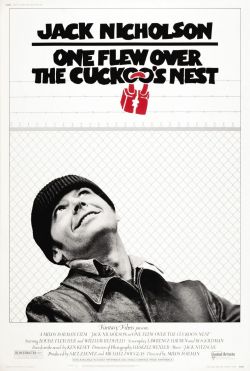
One Flew Over the Cuckoo’s Nest. Fantasy Films 1975.
Before watching the movie:
December is Oscar Bait season and on Yesterday’s Movies, this December is for those canonized movies that have become unquestionable in film culture.
I have seen mainly seen two opinions about this movie: glowing praise for Louise Fletcher, and faint repudiation of the depiction of mental health therapy techniques, particularly electroconvulsive therapy. I have this impression of a bleak slide into despair under the oppression of a corrupt and abusive mental health system. I also think this is one of the movies that made Jack Nicholson famous (or at least one of his earliest roles anybody talks about), so I’m curious to see if he’s got his recognizable style or if he’s more of a blank slate.
Romy and Michele’s High School Reunion. Touchstone Pictures 1997.
Before watching the movie:
This is probably a surprise entry for the month. I always wanted to include Romy and Michele and I’m not sure why they came to mind with the others. Possibly because one of the most notable images associated with the movie is the two women in a convertible, something also strongly associated with another iconic title duo.
I first learned of this movie’s existence from a podcast interview with Kudrow, who discussed how she’d done a pilot based on a play she’d been in that didn’t get picked up right before she got cast in Friends, and if that pilot had sold, then Friends wouldn’t have happened for her, but without the success of Friends, this movie based on the same characters from the play wouldn’t have gotten made. I have the vague idea that it’s about the pair realizing on the occasion of their ten-year reunion that they haven’t made much of themselves, but I don’t know much more and I’m mainly drawn to it because of how much it seems to mean to the actors and to the cult fanbase.






 Yesterday's Movies