I’d never heard of this movie before I stumbled across it in back catalogs looking for B-movies. The title didn’t sound particularly interesting, but the blurb threw a lot of sincere sounding superlatives around for a movie I’d never heard of.
Supposedly this has one of the most accurate portrayals of nuclear radiation, but the combination of most movies treating radiation as “field of evil chaotic magic” and the plot apparently having something to do with a monster with magnetic abilities, I’m not expecting much scientific accuracy.
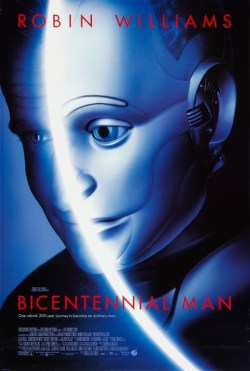
This movie may have been my most anticipated movie of my childhood, or at least the most anticipated non-Star Trek movie. Robin Williams, playing a robot, in a movie based on a story by one of my father’s favorite sci-fi authors? Sign me up! I don’t remember being disappointed not to see it in the theater, but I’m sure I was anxiously awaiting the chance to order it from the library when it came out on video.
In the very near future, Richard Martin introduces his family to his newest labor-saving purchase, NorthAm Robotics’ NDR-114: a humanoid robot with a positronic brain whose purpose is to serve the family around the house, named “Andrew”. After snotty older daughter Grace orders Andrew to throw himself out a window, Richard makes the decree that although Andrew is not a person, he is to be treated with the same respect one would give a person. After breaking younger daughter Amanda’s favorite glass horse sculpture, Andrew takes it upon himself to carve a replacement from wood, and quickly begins to display unique characteristics that Richard decides to encourage, mentoring him, giving him access to all the books he could want, and, at Amanda’s suggestion, providing Andrew with his own bank account for the money he earns from making clocks. As years pass, Andrew eventually asks for his own freedom, which Richard bitterly grants, stung at the assertion he hasn’t given Andrew enough. Soon, Andrew begins to feel lonely, and goes on a 20-year journey looking up every other NDR unit hoping to find others like him. The search leads him to cyberneticist Rupert Burns, a tinkerer obsessed with making more lifelike androids, sending Andrew on a new course to remake himself as a member of human society.
It occurs to me that I have a fondness for the dated charm of late 90s/early 00s sci-fi, especially the optimistic stories. Real world technology was already reshaping the world, but there was a radical readjustment to the kinds of futures we were imagining after the mainstreaming of mobile computing, the social internet, and all-knowing algorithms. Even the dystopias can seem a bit naive now, especially considering the social mindset that our culture was in between the end of the cold war and the beginning of the global war on terror. I especially appreciate how this movie isn’t really afraid to make the near future implausibly near. Most other stories would set the technology required to make robots like the NDR at least 20 years out, but this movie makes it explicit that Andrew was first activated in 2005, which was only six years in the future from the release date.
While I appreciated the civil rights concept in the abstract, Andrew is sapient and should be respected as any other sapient being, I didn’t really appreciate the story of the slow path to acceptance and justice before. It takes Andrew generations to be fully granted the rights he deserves. He needs four generations of allies to wield their privilege on his behalf to even have a chance of going from the othered, lesser role he was intended to be becoming a fully recognized member of society, and he couldn’t even imagine himself taking such a place and standing up for himself without multiple people telling him he deserved it. I also saw allegorical resonance in how even those allies varied in their acceptance of Andrew’s true nature. Richard, who saw Andrew’s nascent personhood and encouraged and defended it with everything he had, couldn’t imagine the necessity of such a person to have true autonomy. Amanda’s son Lloyd, who rejects Martin’s personhood but helps him for his own selfish interests. And Amanda’s granddaughter Portia, who can accept Andrew’s personhood but for a long time hesitates at recognizing the humanity of his full self. The “a tree will always be a tree” conversation never stood out to me before I had an understanding of the real world struggle of people who are having similar arguments with their loved ones every day, some of whom are even making radical body modifications of their own to make the outside match the inside while fighting for the government to recognize their truth and grant them their dignity.
The tone is always a surprise. I carry with me the light-hearted romp that the trailer promised, emphasizing the jokes and the feel-good and omitting the somber, inexorable march through the lived experience of learning what it is to be human, the highs and the lows, the love, but mostly the parade of heartbreak and disappointment along the way. It’s not overall a sad movie, but it’s almost constantly introspective, contemplative, and pensive, mostly ruminating on loneliness and loss along the road of self-discovery. It’s a bit exhausting, but yet I love it. There’s almost enough levity sprinkled in to keep it from getting too overbearing, it’s never too depressing, and it’s irrepressibly hopeful, tracing a path of only positive progress, the setbacks mostly in losing relationships and never permanent. There are few movies of the recent decades that better capture the wonder and potential portrayed in early 20th-century science fiction. If it feels off, it’s because it’s a spoiled era’s reflection of an inspiringly, if naively, hopeful one.
I clearly remember the promotion for this movie (it’s still a little strange to have films from about the time I started this blog that are old enough to show up here), but everything I saw indicated that Dave wasn’t a real person but a ship piloted by tiny people for some reason. One of the more intriguing Eddie Murphy vehicle concepts since the late 90s, but since so few of his projects have been well received since he got enough fame to make any movie he wanted, not that compelling. Also I seem to recall the little people were all played by Murphy, which seems to further underscore the artificiality while also playing into his enthusiasm for multiple roles (something I can’t begrudge him for, as when I was regularly making videos I kept writing stuff that let me act against myself too).
However, when I came across this opportunity now, the summary I saw described Dave like he’s a man hijacked in his own body by tiny aliens sabotaging his love life. Everything I assumed may be wrong and I’m now more interested in the story instead of just the concept.
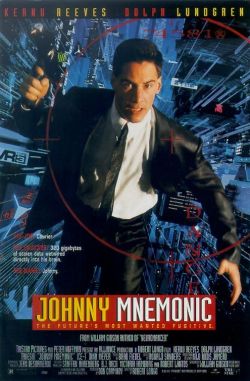
I heard about this movie a long time ago, though I’m not sure what movie it was brought up in contrast to anymore. I know I already knew of Keanu Reeves as the central player in the Matrix movies, and that heavily colored what little I knew about the movie. I still really only know the core concept, but I’ve always thought of this movie as being very cyberpunk, and had a hard time separating the idea of “mind in computer (simulation)” from “computer in mind”.
Taking a look at the poster right now, it seems like it’s positioning itself as the futurist version of Speed, but that might just be because it’s an action movie with Keanu Reeves.
From the first time I heard about this movie, I was vaguely interested in the reality-hopping concept, but I wasn’t into martial arts movies and so I wasn’t all that attracted to it. What I know about the movie hasn’t really changed, I’m mostly just warmer to Kung fu films in general, and also I’m a little more aware of Jet Li’s work.
Apparently the movie was originally meant for Dwayne Johnson, who would’ve been very different, but I also would’ve been less familiar with 20 years ago.
I remember this being framed in the commercials like the invisible guy was the villain of a horror story, which I suppose could be from his slide into monstrous behavior without human consequences for his actions. I vaguely remember the movie coming up in an early explanation of Six Degrees of Kevin Bacon, though that’s probably more because it was recent than because it’s a particularly significant hub in Bacon’s connections with other actors.
I also remember it putting CGI effects that seemed completely novel front and center to do a more visually engaging telling of The Invisible Man than had been seen before. The League of Extraordinary Gentlemen came out not long after, but I don’t think they put as much effort into the Invisible Man effects because he was part of the ensemble, but also it wasn’t as new anymore.
The Day of the Dolphin. Avco Embassy Pictures 1973.
Before Watching the Movie:
There were three things that I knew about this movie when I decided I had to watch and review it:
It has George C. Scott
It features a plot to train a dolphin as an assassin
This insane pitch is a real movie made in the 70s.
It turns out that this is based on a novel, because even in the 70s, Hollywood can’t be so creative to put The Manchurian Candidate underwater. I also suspect that this was inspired by the ketamine-fueled investigations into dolphin speech by John C Lilly.
I vaguely recall the publicity for this movie at the time, and it didn’t particularly interest me then. The concept of extraterrestrials reacting to an astronaut from Earth as an alien invasion plot turned inside out was moderately intriguing, but it didn’t particularly call out to me at the time. Animation outside of Disney and Pixar (and sometimes them as well) at the time struck a tone that didn’t really connect with me, and still doesn’t. But as that tone was almost obligatory for the market of the day, it was probably exaggerated in the advertisements and this has the potential to be more in line with what does appeal to me.
I didn’t even know that the astronaut is played by Dwayne Johnson. The character design even looks a little bit like a redheaded reimagining of Johnson, how his appearance (and race) would have to change to fit the classic image of space race NASA astronauts. Or I may just be very bad with faces.
So much as I thought I knew what this was about, it seems I completely misunderstood this movie. I had the idea this was some kind of action drama about conservation, like fighting poachers or something. Maybe a military operation in the jungle.
What this actually seems to have something to do with is a new species of killer gorilla and also a signing gorilla, and the preview I saw looked a lot funnier than I expected. So I’m completely at a loss for what to expect now, besides Tim Curry and Ernie Hudson being in it.
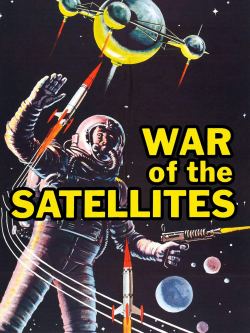
War of the Satellites. Santa Cruz Productions 1958.
Before watching the movie:
I probably know about as much about this movie as Roger Corman did when he decided to make it. Earth is about to start launching satellites and aliens disapprove, and it’s all very “hey, remember Sputnik?”
It sounds more interesting to watch than to write. The effects and action sequences will probably be hilarious but also the best part. It looks like even though the United Nations is standing in for the United States, they still manage to let the United States be the most American part of the Earth.
I like going into movies completely blank on them until I have to write about my nonexistent preconceptions.





 Yesterday's Movies