The Thin Man

The Thin Man. Metro Goldwyn-Mayer 1934.

Before watching the movie:

I’ve heard the popularity of Nick and Nora Charles is in their banter. As this is not the version that left that out (that would be the Broadway musical…), I’m looking forward to it. The writing must be up to it, or it wouldn’t have been and still be popular.

This is an early example of heavily sequelized films, all with silly titles that probably belie their lack of purpose. If you thought today’s sequels were pointless, you haven’t heard of The Thin Man Goes Home.

I’m at a loss for what else to look out for. I don’t doubt much that the mystery is also worthwhile, since it’s the original Hammett story. I’m always more entertained by films of this age than I expect to be, and that goes right back to the character banter.

Continue reading

To Be Or Not To Be

To Be Or Not To Be. Brooksfilms 1983.

Before watching the movie:

Mel Brooks. Nazis. Shakespeare. Sounds like a lot of fun. My concern creeps in with the facts that this is a remake of a 40s film and has been described as less satirical than his best. When I think of Mel Brooks without satire, I think of Dracula: Dead and Loving It, which (as I said on Twitter) relied too much on physical comedy.

Useless fact time: as you can find out from any other reference on this film, it’s the only time Mel Brooks acted in the same movie with his wife Anne Bancroft. Much like that Wall Street is notable for featuring Martin Sheen and Charlie Sheen as father and son (and Michael Douglas as the inspiration to all the authors of the economic recession), it’s an interesting fact that doesn’t mean much but takes up space.

Continue reading

Mars Attacks!

Mars Attacks!. Warner Bros. Pictures 1996.

Before watching the movie:

I’ve always expected this film to be modern camp. A film with modern sensibilities and humor that’s unashamed to be cut from the same cloth as old-fashioned B-movies. That’s the story sold by the advertising anyway, which isn’t always the most trustworthy.

This is definitely offbeat, but it doesn’t seem like Tim Burton’s style of offbeat. For one thing, it appears to have a distinct lack of Johnny Depp. This must have been one of his last films before he started making the same movie every time.

Continue reading

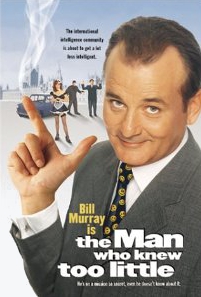
The Man Who Knew Too Little

The Man Who Knew Too Little. Warner Bros. Pictures 1997.

Before watching the movie:

I can sum up everything that makes me look forward to this movie in one sentence: Bill Murray in a mistaken identity crime ring farce. Unfortunately, that probably makes the rest of this leader redundant.

Thinking deeper about what I expect though, I realize there’s little more than minor details separating this from other mistaken identity farces. That makes me less interested, but it should still be a good time with good jokes. Not every movie has to be a special snowflake to be enjoyable.

Continue reading

Canadian Bacon

Canadian Bacon. Dog Eat Dog Films 1995.

Before watching the movie:

From the synopsis, I was expecting stereotypes and satire even before I read further and found that this is a rare (I think) non-documentary from Michael Moore.  So maybe it will be like An American Carol, only on the other side of the political spectrum. Regardless, I expect satirical stereotypes of both Americans and Canadians.

This is a satire of the first Gulf War, so I wonder if  I’ll see anything relevant to the second. I also wonder if this film can top South Park: Bigger, Longer, and Uncut for silliest war with Canada.

Continue reading

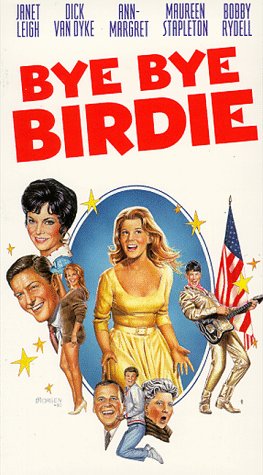
Bye Bye Birdie

Bye Bye Birdie. Columbia Pictures 1963.

Before watching the movie:

I seem to have moved from a situation where post-1980s films are more abundant to one where there are hardly any to choose from.  Lucky I found Bye Bye Birdie, one of the more popular musicals of the first stage-to-screen push.

I always assumed that Conrad Birdie, the Elvis Presley expy of the story, was a more central character than the synopses I’ve seen make him out to be. It’s all about him, but he sounds more like a Macguffin than a lead player. The actor who plays him isn’t billed specially, and has a name I don’t recognize.

I’m not quite sure why this film/musical has resonated enough to endure in ways others haven’t. It’s not a Grease, but it’s not a… well, the less well-known ones didn’t usually get adapted into films. I can’t really think of a musical film on a lower tier, but I’m sure there are multiple tiers of obscurity yet below this.

Anyway, big stars, big show, and the 1960s before things got tense (well, before the tension got into the mainstream). Some more good clean fun.

Continue reading

The Three Musketeers/The Four Musketeers

The Three Musketeers/The Four Musketeers. Este Films 1973/1974.

Before watching the movie:

A large-budget film with a star-studded cast and strict attention to period accuracy could go poorly in all sorts of ways. The actors could fight for attention to the detriment of the film, the visual appeal could be lost in gritty details or vice versa, and the effort put into the enormous practical concerns could stomp out any entertainment value of the film.

These worries are only enhanced by the subject material. I vaguely recall an adaptation of The Three Musketeers in that a young man wants to be a Musketeer, gets in a fight with some, and then they all have adventures together. Rather dull, especially if one isn’t into swashbuckling tales.

I recognize many names, but I can connect hardly any of them with anything I know. At least it’s sold as a comedy, but I don’t expect much out of a 70s film.

Usually, I avoid sequels, but this pair was intended to be a single film, so I am taking it as one.

Continue reading

Back to School

Back to School. MGM Studios 1986.

Before watching the movie:

This concept is hardly new to me, but I don’t know if it was new at the time or not. Rodney Dangerfield’s character goes back to school and embarrasses his son by being his classmate. It seems to me that the 1980s would be a time when adults were faced with re-entering education, since the changing markets would shut down factories and force people to get better degrees.

Anyway, in the films I’m familiar with (Billy Madison, An Extremely Goofy Movie) have extenuating circumstances forcing  the adult back into school. In the latter case, Adam Sandler has to get a high school diploma within a few months or he won’t inherit his father’s riches, and in the latter, Goofy gets laid off and doesn’t have a college degree. In this case, it appears that Dangerfield’s character is simply wealthy and has nothing better to do than go out for some higher education. That’s fine if it plays well.

Also, supporting actors: Robert Downey jr. when he was a young heartthrob! Robert Picardo in a minor role! Kurt Vonnegut in a cameo! (I’ve never seen the man in motion)

I don’t expect to have to hold this film to a high standard, because it’s clearly intended to be a fun popcorn movie vehicle for Dangerfield.

Continue reading

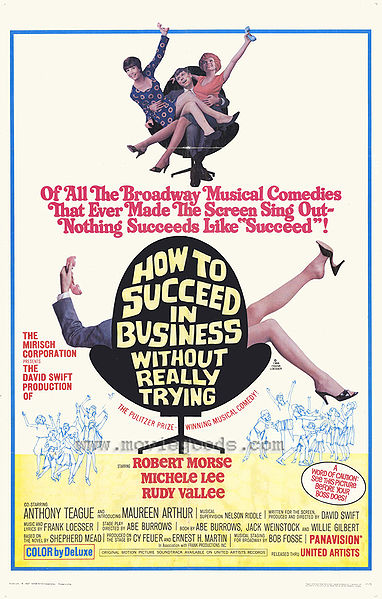
How to Succeed in Business Without Really Trying

How to Succeed in Business Without Really Trying. The Mirisch Corporation 1967.

Before watching the movie:

For as long as it runs, this blog will mostly center on the 80s and later, because that is what appeals to my tastes and what I’m most likely to have something to comment on beforehand. I’ve challenged myself to focus on older films for the last few weeks because I felt they needed more of a focus, but although the films themselves have been positive experiences, it’s mostly just created more work looking for older films and trying to fit my thoughts on them into the format of this blog. My reserve of pre-80s films has almost run out, so why not finish this run off with a musical that’s even on Broadway today?

So… a fun romp in song and dance that satirizes the business world. It sometimes seems like “Business” in the sense that this film presents it was never as keenly analyzed as in the 60s. Then I remember The Secret of My Success, which was made in the 80s and shows a young man climbing the ranks similarly.

It occurs to me to wonder if the children’s books How to be a Perfect Person in Just Three Days and Make Four Million Dollars by Next Thursday draw any direct inspiration from this story, though I doubt it.

Continue reading

Fitzwilly

Fitzwilly. The Mirisch Corporation 1967.

Before watching the movie:

I never realized how little I’ve seen of Dick Van Dyke’s work, or the fact that most of it is in television. Even more than Peter Sellers, Dick Van Dyke is just kind of an institution. It strikes me that his best work is in his films of the 1960s and 70s, because those show off not only his comic skill but also often the physicality he didn’t have opportunities to express in domestic sitcoms and is probably no longer capable of. I’m not saying I necessarily expect him to dance on rooftops in this film, but I wouldn’t be surprised if there was some slapstick for him to get into.

What sort of movie is this? Well, once again I’d never heard of it, but I’m expecting a madcap web of lies caper, and possibly some screwball elements.

Continue reading