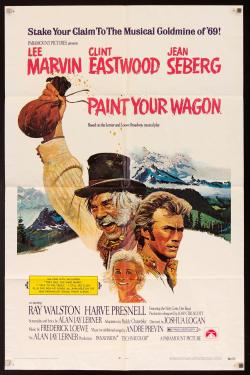
I didn’t mean to put two westerns back to back, but I couldn’t finish a month of musicals without Paint Your Wagon and I didn’t realize this was a short month.
I know precious little about this movie other than that it has Western movie stars not known for singing bafflingly cast in a musical. And I also know about the Simpsons taking the mickey out of it, but it’s so ridiculous that it has to be completely unrelated to the actual movie, no matter how ridiculous the movie itself is.
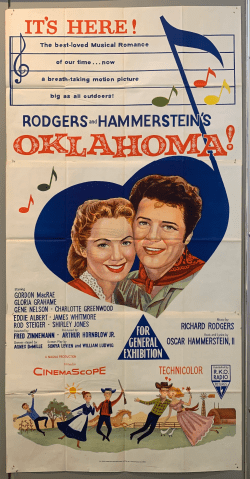
I have no idea what this is about, other than that it’s set in Oklahoma in the 19th century and has a lot of songs that have become standards with lives of their own, maybe more than any other.
I guess it’s a love story on the prairie? I have nothing to go on but those famous songs. It’s almost certainly going to have a lot of scenes outside for the purpose of taking advantage of being a movie and no longer a stage play, but how much will that actually matter?
After watching the movie:
Cowboy Curly McLain has a prickly relationship with Laurey Williams, farm heiress. They both take quite a lot of sport out of knocking each other down a peg, and while neither of them would admit affection for each other, they are both secretly fond of one another, something that Laurey’s Aunt Eller, the widowed owner of their farm, can plainly see. Everyone in the region is excited about a box social being held in the evening, and Curly comes to suggest that Laurey go with him in a fancy wagon he will be renting, but Laurey already accepted the invitation from her hired hand Jud. Jud is a simple, brutish kind of man, but when Laurey starts to think about breaking off with him to go with Curley, Jud’s response suggests it would be dangerous to disappoint him. Meanwhile, Will Parker, another cowboy, has just returned from the fair in Kansas City and, having won a roping contest, now has the $50 his girlfriend Ado Annie’s father said he wouldn’t be allowed to marry her without. But while Will was away, Annie, a fun loving, variety seeking girl, has been taking up with the traveling peddler Ali Hakim, a man who is clearly in a habit of leading on girls with promises of marriage he doesn’t intend to keep. Annie’s father, especially keen to keep Will from marrying his daughter, pressures Ali to marry her instead, and Ali starts searching for any way out, like helping Will press his agreement with Annie’s father while trying to also keep his intentions from Annie, though Will has his reservations about marrying so flighty a girl. As Jud and Laurey drive to the box social, Jud tries to force a kiss on her, and she wrestles him away, whips the horses into a bolt, and takes off for the dance alone, with Jud swearing not to let her be rid of him so easily.
Early in the movie, I felt like none of the songs were really doing much to build the plot, but somehow I didn’t care as much about that as usual. Maybe it’s because the stakes were relatively low and the songs were familiar, but for a long stretch of the movie I was happy to let the story take a back seat to yet another song painting a picture of romanticized, whitewashed rural life in the Oklahoma territory. I only particularly felt they should be getting on with it during a couple of incredibly lengthy dance numbers. By the time we get to the box social the plot has finally fully engaged, and I was fully engaged with it. However it’s weird the lengths the movie went to to make sure everyone knows within Code decency how violent and perverted Jud is and then treat him as so minor a complication to Curly and Laurey’s romance that the fight that finishes him for good is pretty much over the minute it begins, and Curly has no figurative blood on his hands whatsoever.
I have tags for some of these actors so I must have seen them in other things (I particularly remember the name Gordon MacRae but I couldn’t tell you what I’ve seen him in). The one exception is that I knew the Persian peddler Ali instantly as Oliver Douglas of Green Acres, Eddie Albert. His accent is all over the place and I’m not sure it has any resemblance to a Persian accent, but then neither is his appearance, and that’s par for the course with productions from this era. But knowing him from a kooky TV sitcom made it especially weird to see him playing such a rake, even if a bit of a bumbling one.
At least three songs have gone on beyond this musical. Everyone knows “Oh What a Beautiful Morning”, which is a beautiful song about not very much, and “Surrey with the Fringe On Top” is just as much a chestnut (though I was surprised that the original lyric was “Isinglass curtains” and not “clear glass curtains”. I had to look up Isinglass, but it makes infinitely more sense to call that substance “curtains”), and I was surprised how late the title song, perhaps most famous in my generation for the Sesame Street skit where the muppet keeps getting the wrong opening vowel, comes in. It’s not nearly as prominent a song as the other two, which are major recurring themes.
The story is a bit unusual, but somehow I’ve never been more okay with letting the plot slide while the show takes more interest in its musical numbers. Almost all of them are worth the time, even if they aren’t about much of anything but a mood. I’m not sure what it means to romanticize a past where just about everyone is excited about impending modernization, but on the other hand, I miss being excited about the future too, so maybe I do understand it. This is just a portrait of an idyllic day in an idyllic time, and it’s nice to be in that space for a little while.
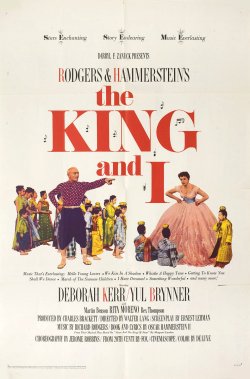
This is one of the most enduring musicals of classic Hollywood (an era I’m sure some would argue I’m stretching). I always had the sense it was something of a modern fairy tale, a common woman swept into the royal court and falling in love. It didn’t seem that interesting except for how popular it is. I think I’ve come across before that she’s there to teach the king’s children, but I keep forgetting it. I also don’t always remember that the king is Siamese until I remember that another title in its orbit is “Anna and the King of Siam”, which explains why his fashion doesn’t look much like the Western perception of kings.
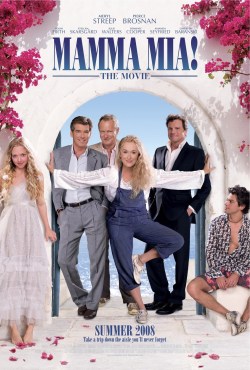
This month I will be focusing on jukebox musicals, and for me in my experience, there’s no more obvious jukebox musical film than Mamma Mia!, having spent 20 years of my life being very aware of the music of ABBA being in the world.
I think the plot they’ve woven around these songs has to do with a woman about to get married and wanting to include the father she’s never met, only to find out her mother isn’t sure who that is because she was seeing three men at the same time. There are some details I’m more certain of than others, but finding fathers is definitely involved. I think the “sequel” is a flashback to that time frame entirely.
The music has already stood the test of time, but the story has to live up to one episode of Community that spent all its budget on the gag that the Halloween party playlist was just ABBA’s entire catalog.
I always had the impression this was a story about mafiosos and their molls, but the closest I ever came to any glimpse of the actual contents of the musical was… highly adulterated, and I’m pretty sure bears no relationship to the actual musical.
The summaries I’m seeing now seem to revolve around illegal gambling, which probably means organized crime, but it doesn’t really seem to be the focus. Obviously the real focus is probably “That Frank Sinatra is having a swell time singing”, more than likely with a dash of “and that nun is going to break her vows for him.”
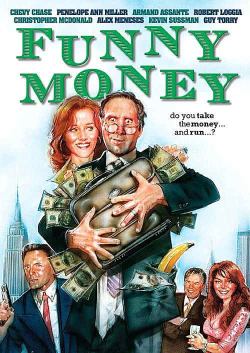
I had an impression that Chevy Chase completely disappeared from whenever he left the Vacation movies in the 90s until the late 00s, when he suddenly resurfaced in Zoom, a Tim Allen vehicle about a retired superhero, and on Community. Apparently what he was actually doing at the time was starring in German/Romanian adaptations of British plays. An American company was also involved, but I sure don’t recall any significant American release.
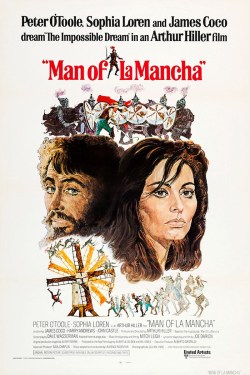
I think this is the way most people have experienced Don Quixote. I’ve read some of the book, but despite the new translation I was using, the stilted nature of it still sometimes overpowered the comedy, which itself sometimes felt a little too much like “mental illness is funny!” It’s at the same time amazing how modern it feels at over 400 years old and yet how basic the storytelling can be at times, because it’s had 400 years to become part of the way we always tell stories.
But the grandeur of the way Man of La Mancha interprets the book is enticing and accessible. Everyone has heard at least a few bars of “The Impossible Dream”. It’s a classic showtune ballad. The romance is probably more feel-good in this take as well.
On the surface, this looks like just as much fluff as State Fair, but the setup sounds rather dark. It’s a man’s one more day to get it right with his family after a fatal accident. Moreover, one summary I saw specifically calls him abusive, though that’s probably from subtext. Depressing themes in a musical? Not something one would expect before the late 60s.
But then it manifests as flowy dancing around a carnival, so it can’t be entirely bleak.
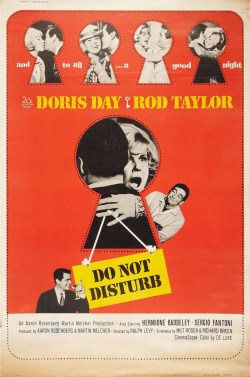
This is being promoted as a romp with a wife who invents a lover to get revenge on her husband for spending more time with his secretary. Apparently it also involves travel to Europe, but I’m not clear how big a part of the movie that is. I suspect the story starts with them relocating for business reasons, and then the new secretary at the new office gets too much of the husband’s attention.
This is based on a play, so I’m expecting some really good dialogue, very long scenes, and a handful of location scenes in Europe because movies feel obligated to Open Up a play.
I’m sure there are other movies that reach this level of substanceless fame, and probably ones that I’ve reviewed here before, but while I know I’ve reviewed well-known movies nobody actually seems to discuss the content of before, I can’t think of one so big yet so mysterious.
I roughly know its time period, but mainly because Wall-E used some clips. Otherwise, it’s somehow the codifier of what a classic musical film is, to the point that it’s taken as a generic for “musical”. But it’s theoretically in that position because it’s good and because it’s influential. But the mold got overused and eventually musicals started defying it. Later on Broadway reinvented Disney reinvented Broadway, but that’s beyond the scope of a review of Hello, Dolly!Continue reading →





 Yesterday's Movies