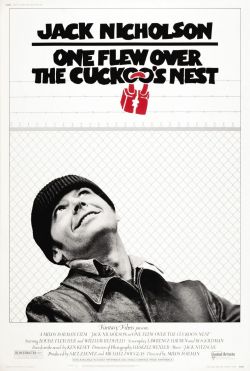
One Flew Over the Cuckoo’s Nest. Fantasy Films 1975.
Before watching the movie:
December is Oscar Bait season and on Yesterday’s Movies, this December is for those canonized movies that have become unquestionable in film culture.
I have seen mainly seen two opinions about this movie: glowing praise for Louise Fletcher, and faint repudiation of the depiction of mental health therapy techniques, particularly electroconvulsive therapy. I have this impression of a bleak slide into despair under the oppression of a corrupt and abusive mental health system. I also think this is one of the movies that made Jack Nicholson famous (or at least one of his earliest roles anybody talks about), so I’m curious to see if he’s got his recognizable style or if he’s more of a blank slate.
I think I first heard about this movie about a decade ago, somewhere on the internet. I don’t really know much about it other than that Christian Bale plays a serial killer business executive and it’s somehow really popular. There was a parody of a murder scene where Huey Lewis kills Weird Al for doing a middling parody of one of his songs. It lives in my mind next to American Beauty which I don’t think is much related at all, but I expect it to be more like Fatal Attraction.
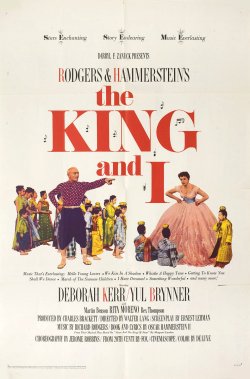
This is one of the most enduring musicals of classic Hollywood (an era I’m sure some would argue I’m stretching). I always had the sense it was something of a modern fairy tale, a common woman swept into the royal court and falling in love. It didn’t seem that interesting except for how popular it is. I think I’ve come across before that she’s there to teach the king’s children, but I keep forgetting it. I also don’t always remember that the king is Siamese until I remember that another title in its orbit is “Anna and the King of Siam”, which explains why his fashion doesn’t look much like the Western perception of kings.
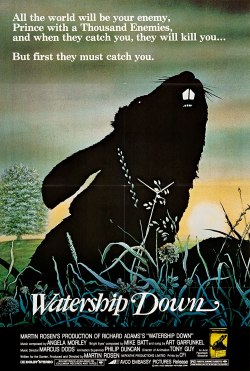
If there is one thing I know about this movie and book, it’s that they traumatized a lot of children. I know there are rabbits, and I think they go to war, and the horrors of that war are not shied away from. I have to confess that with the sum of that information, I always pictured rabbits holding rifles on a battleship or submarine. When I first heard the title, I pictured an airship crashing, which was especially silly because an airship is not a watership. But anyway, nobody seems to want to discuss what it is aside from “cute rabbits experiencing The Horrors” so I don’t have any idea what to expect.
That poster does look pretty bleak and existential though. I have strong Ralph Bakshi movie vibes from that design, but it might just be a late 70s aesthetic.
Sinbad: Legend of the Seven Seas. Dreamworks Pictures 2003.
Before watching the movie:
Nobody wanted this movie, nobody saw this movie. I didn’t want it and I didn’t see it. I was completely unthrilled by the concept when it came out, and it still doesn’t excite me. But it was the last straw for traditional animation at Dreamworks, so I always though I’d eventually give it a chance, and now I am.
It’s such a generic pitch, I don’t even know what to expect, beyond probably not that great a depiction of Sinbad, since I understand the legendary figure as an Arabic or Middle Eastern sailor and he’s played by Brad Pitt. I don’t really know anything about the traditional character beyond that except for whatever I retained from that Popeye movie that I think had him as the villain, which I also don’t expect would be the most faithful.
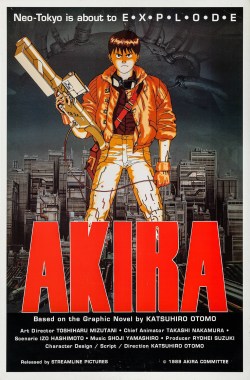
I’ve heard the title of this movie thrown around a bit, but I never really understood much more. I didn’t know if it was a movie or a series or what, probably anime but maybe not. I assumed it was action, and probably grim and gritty, and that’s about the end of what I thought I knew, until I saw it called out as being extremely influential on Eastern and Western animation alike, and as the referent of that one motorbike slide that’s everywhere in animation.
It turns out this seems to also be the source of that “Neo-Tokyo” I’ve heard about. And this is probably why some of the names I hear come up a bunch in Anime circles come up so much, but I don’t know what Japanese names are more generic versus more unique.
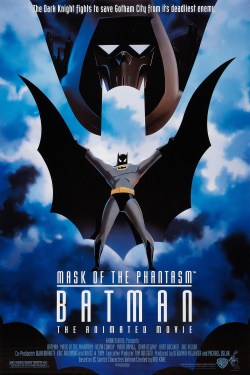
I have vague memories of watching Batman: The Animated Series as a kid. It was a thing that was on, sometimes I would watch it when it was available, but I don’t remember really making a habit of it. Even so, it defined Batman for me as a kid. I was aware of the live-action movies of course. I definitely remember at least one McDonald’s Happy Meal tie in that I got a Hot Wheels-size version of the best Batmobile out of, but I’m not sure the timelines actually sync up, since it would have been the 1991 promotion and I may have been a little young to be as aware of it as I remember.
Regardless, as for many my age, this is the definitive version of Batman to me. I’ve probably watched more episodes as an adult seeking them out, but the series brought as much plot and emotional complexity to half-hour episodes as was possible. It introduced characters and interpretations so compelling they were imported to the comics and other versions, it was the keystone to a shared-continuity animated franchise, and had two direct continuation series.
I’ve gotten around to Batman and Mister Freeze: Sub-Zero before, but I never made it to the first movie spinoff, the one that actually got released in theaters before. And it has taken me entirely too long to get here.
After watching the movie:
Batman busts a meeting of Gotham’s biggest crime lords, and in the ensuing chaos, Chuckie Sol gets accosted by a hooded, masked figure claiming to be his agent of death, who tricks him into crashing his car through a parking garage wall, leaving him dead. When bystanders look up at the commotion, they see Batman at the hole in the wall trying to understand what just happened, and news spreads fast that Batman might have graduated to murdering mob bosses. Councilman Arthur Reeves, in the mafia’s pocket, vows to finally have Batman arrested. Ten years earlier, in Bruce Wayne’s earliest days of crime fighting, before he figured out how to intimidate the criminals, he met Andrea Beaumont in the cemetery talking to her mother’s grave close to where Bruce was talking to his own parents, and they quickly bonded. Bruce became torn between the vow he made to his parents to avenge them against all crime in Gotham when he realized that plan never included having someone waiting for him at home, and their relationship ultimately ended in heartbreak. Now, Andrea is returning to Gotham, and Batman realizes that the gangsters getting killed all share a link with Andrea’s businessman father, but his investigation is hampered by Gotham law enforcement hunting him down for the same murders, while the next don on the Phantasm’s list has gone to a former mook and friend from the old days for help, now in business for himself as the Clown Prince of Crime.
When a movie gets made from a tv show, especially one still on the air, one of the important questions to answer is what can this do that an episode can’t. Aside from the corny early 90s CGI fly-through of Gotham skyscrapers right at the beginning that doesn’t contribute much except to show “look what we can do with a movie budget!” the answer is that I think this story plays with lore too integral to the Batman mythos to trust to a 30-minute story. It doesn’t just rehash Batman’s origin story, it goes inside the often-elided time when Bruce was still trying to figure out how to be a vigilante and tells us the love of his life we never knew about was there. It dangles the Joker’s life before he was the Joker in front of us. It shows us that Gotham once hosted a World’s Fair. And it does it all with incredible care, so that it feels like they’re sharing secrets instead of polluting an established story.
They also take a lot of time to explore the tragedy of being Bruce Wayne. For the first time here, he really has to wrestle with the conflict between what he feels he owes to his parents and a chance to let himself just be happy, and the weight of that dilemma is keenly felt. Of course, in a more realistic world, Bruce would be better served by getting therapy and realizing that maybe he took a flying leap from his parents getting accidentally shot in a mugging gone wrong to a duty to them to clean up all the crime in the city with only wits, fists, and gadgets, but this is not the world he lives in, and regardless of what he wants, becoming Batman is the destiny he cannot escape. And in this story, he rages against that.
Involving the Joker feels almost obligatory. The Phantasm may have unacceptable methods, but the motives are too sympathetic to be satisfyingly defeated alone, so one of the regular villains has to come in the last act to raise the stakes and be properly thwarted in the end. There’s really only one good reason it had to be the Joker, and one could argue that some of the other rogues could be made to make sense too (isn’t the Penguin a crime boss?), but he’s mostly just the one brought into the game late because he’s Batman’s most iconic antagonist, and this is this version of Batman’s first movie. It can feel about as lazy as making Moriarty the surprise mastermind behind every Sherlock Holmes mystery. A version of this story could probably be wrapped up with a dire fight against a well-prepared mob boss and his goons instead of against one of the Usual Suspects while on the run from the law. But Mark Hamill’s Joker is too charismatically sinister to be too upset about.
While this was shown in theaters, that was a relatively late decision, and it could’ve stood to have more production time to make it ready for cinemas instead of just a surprisingly good direct to video feature. I felt I was watching really good storytelling, but I didn’t quite feel like I was watching a real movie. Whatever it is or isn’t, even by the standards of Batman: TAS, this is masterful.
When I decided to cover jukebox musicals, I did some research to try to get some more variety. I found that Wikipedia is a bit lax with their definition of a jukebox musical. My impression is that they count any musical that has at least one preexisting song in it. However, a significant percentage of the songs in this show seem to be songs that were not originated for the production, and among those, many seem to be from the time the story is set in, if not already associated with the 1904 World’s Fair. It is at least close enough that I’ll take it.
That said, a lot of musicals from the golden age of Hollywood musicals have songs that originated with them but have become completely divorced from them and become standards. I’ve been taken by surprise by some other musicals, but in studying the musical credits I see that “The Trolley Song” and “Have Yourself a Merry Little Christmas” both appear to have basically originated with this movie, but have long since come to stand on their own.
This is one more legend that’s a bit of a black box. I know there’s a monster besieging a research station in the Arctic or Antarctic, and that’s about it. I think almost the entire movie goes without showing the monster? It might be an alien but it’s left ambiguous? The poster is as much of a masterpiece as the movie, they say, and it is a fantastic poster.
I dimly recall a TV special about practical and visual effects in horror movies in general that may have touched on this movie, but I’m not sure. The images I’m remembering could be almost any horror movie, but they could fit a frozen research station for all I know.
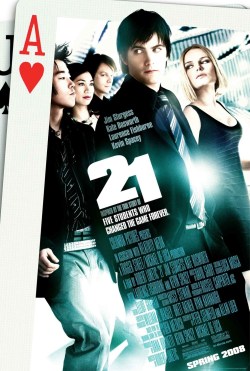
This is a movie I have clear memories of being advertised in a poster case in my high school cafeteria, which wouldn’t be possible since it was released almost a full year after I graduated. It does occupy close quarters in my brain with The Perfect Score (a 2004 heist movie about students stealing SAT answers) and Easy A (a reimagining of The Scarlet Letter set in a modern high school that didn’t even come out until 2010, why is it even in this trio?), but I don’t recall Perfect Score being in that case. Memory is incredibly fluid sometimes.
Right. This is the one with MIT students counting cards in Las Vegas. It seems like it’s being positioned as a heist movie, so it will be interesting to see how the film makes counting cards visually and emotionally engaging.





 Yesterday's Movies