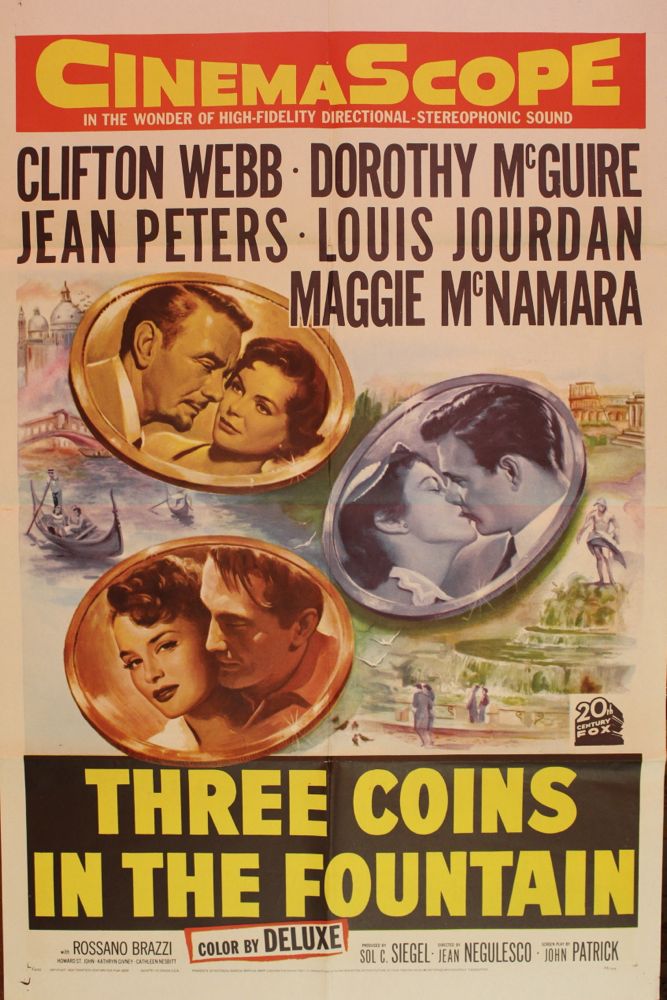
Three Coins in the Fountain. 20th Century Fox 1954.
Before watching the movie:
This is one of those movies that seem to boil down to a log line and nothing more enters the general consciousness. This is three romances centered wishes at Trevi Fountain. I know nothing more than this. It was shot on location because all the big Hollywood pictures were shot in Italy in those days. It seems to be a particularly fondly remembered example, but nobody seems to talk about much other than “shot on location” and “three American women in Rome wish for love”.
It’s in color and CinemaScope, so the Italian views won’t be squandered. In fact, I get the impression they’re the best part of the movie for a lot of people.
A Study in Scarlet is, as the first Holmes story, important, but is also very unlike most other stories, in that half the book completely departs from Watson’s narrative and instead lays down motive. From another point of view, Holmes’s investigation sets up a half-novel romance on the American frontier. I’m interested in seeing how adaptations handle this oddity, though in most cases they handle it by ignoring the second part. On the one hand, it doesn’t have Holmes in it, which is the draw, but on the other, it’s the more cinematic part of the story. I have a sneaking suspicion this movie will dip into it more than most.
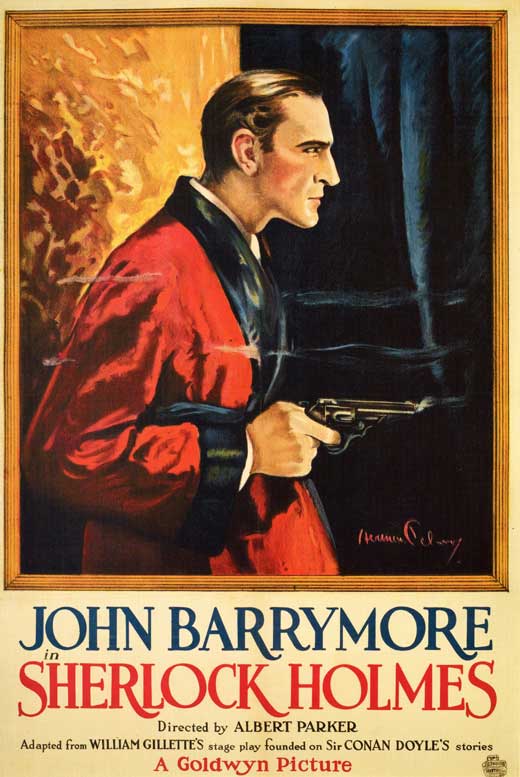
Sherlock Holmes (/Moriarty). Goldwyn Pictures Corporation 1922.
Before watching the movie:
I was somewhat concerned to see that this movie is also silent and based on the Gillette play, but a glance at the first paragraph of the synopsis tells me this is definitely a different adaptation. Not being familiar with the text of the play I can’t say if the differences were added to this production or subtracted from the other one. This looks hopefully more engaging.
When I first attached a disambiguating year to a title, I never expected to do two movies with the same title back to back. I can’t say it’s just because there were fewer movies to get confused with back then, since even the past decade has seen multiple productions simply titled “Sherlock Holmes”. So it’s worth noting that in Britain it was titled Moriarty.
Not very long after I started this blog, I realized that I was reviewing so many Sherlock Holmes films that they would probably qualify for their own genre category. It seems like I’ve covered more than is tagged there, but it’s still a healthy sampling.
My fondness for Sherlock Holmes stories far predates Yesterday’s Movies, so I find myself running out of eligible and desirable films to review. The list of adaptations seems endless, but once I apply my criteria for a review selection, they’re just about dried up. As well, I have no intention of leaving recent and future films to age into eligibility before watching them, so I’ve decided to give Sherlock a retirement sendoff with a themed month of some of the most notable films.
It is only right, then, to begin with the silent film adaptation of the very first official adaptation of Doyle’s work. William Gillette was given an attempted stageplay by Doyle and tasked with rewriting it into something serviceable, and also starred as Holmes. Holmes’s iconic deerstalker hat, calabash pipe, and “Elementary, dear Watson” all came from Gillette. This is a historic piece of Sherlockiana.
Bonus mini-review: Sherlock Holmes Baffled (1900) – In his first-ever film appearance, the world’s greatest detective is no match for camera magic.
John Wayne is remembered as playing cowboys or other heroes of the American West. So it always surprises me to learn that some of his most praised movies cast him as something else. Here, he’s an Irishman who spent some time as a boxer in America, but has come home to court a wife.
The main conflict appears to be that his lover’s brother doesn’t approve of the match, and the argument gets physical. Boy is that a mistake to let an argument come to blows with a professional boxer. I really hope that conflict is exaggerated by the synopsis I’m seeing and it’s mostly just courtship in the Irish countryside. I’m also curious to see if Wayne bothers with an Irish accent.
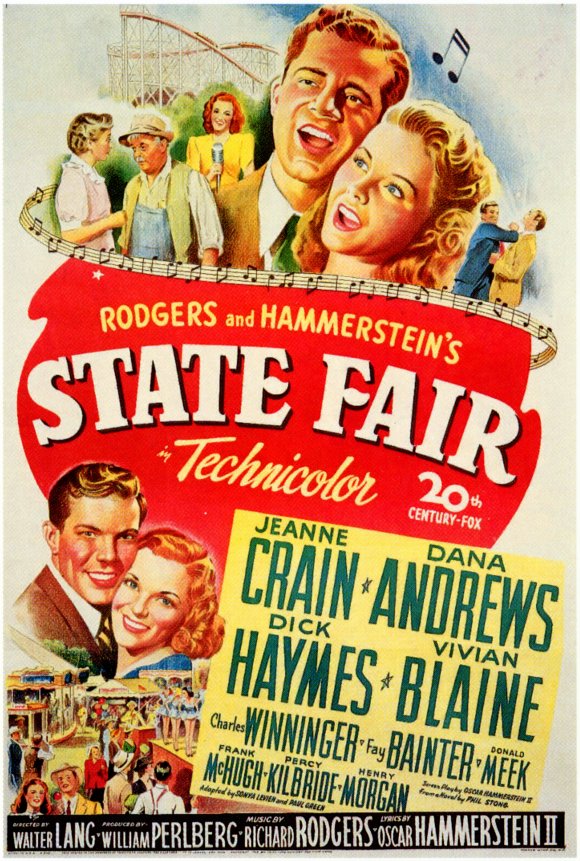
There are at least three major screen adaptations of this show, and I’m not sure if this version is the most popular or just the most available. The 1933 version stars Will Rogers, but it’s in black and white, so it’s probably not expected to sell as well.
I thoroughly expect this to be a thin plot for hanging songs about rural Americana on, but it’s Rodgers and Hammerstein, so they should be great songs. I’ve probably heard of at least one, but I can’t think of any I specifically associate with it. Continue reading →
I suppose I shouldn’t be so surprised a movie known for one sequence (slow-motion astronauts) is over three hours long. After all, Lawrence of Arabia is mainly known for the desert montage. I am surprised to learn the scope of the movie. I always understood it to chronicle the Mercury program, and possibly Gemini leading to Apollo. But I’m now seeing it described as starting with breaking the sound barrier. On reflection, supersonic speed would have come from the same test programs that produced the Space Race astronauts, but I never connect aeronautics and astronautics.
I should address that I somehow got the idea the film was made in the 60s, which is ridiculous, since it chronicles the 60s. But on the rare occasions I thought about that, I considered it kind of a propaganda film doing a victory lap after a successful moon landing. Which would still probably make it early 70s, but that’s quibbling.
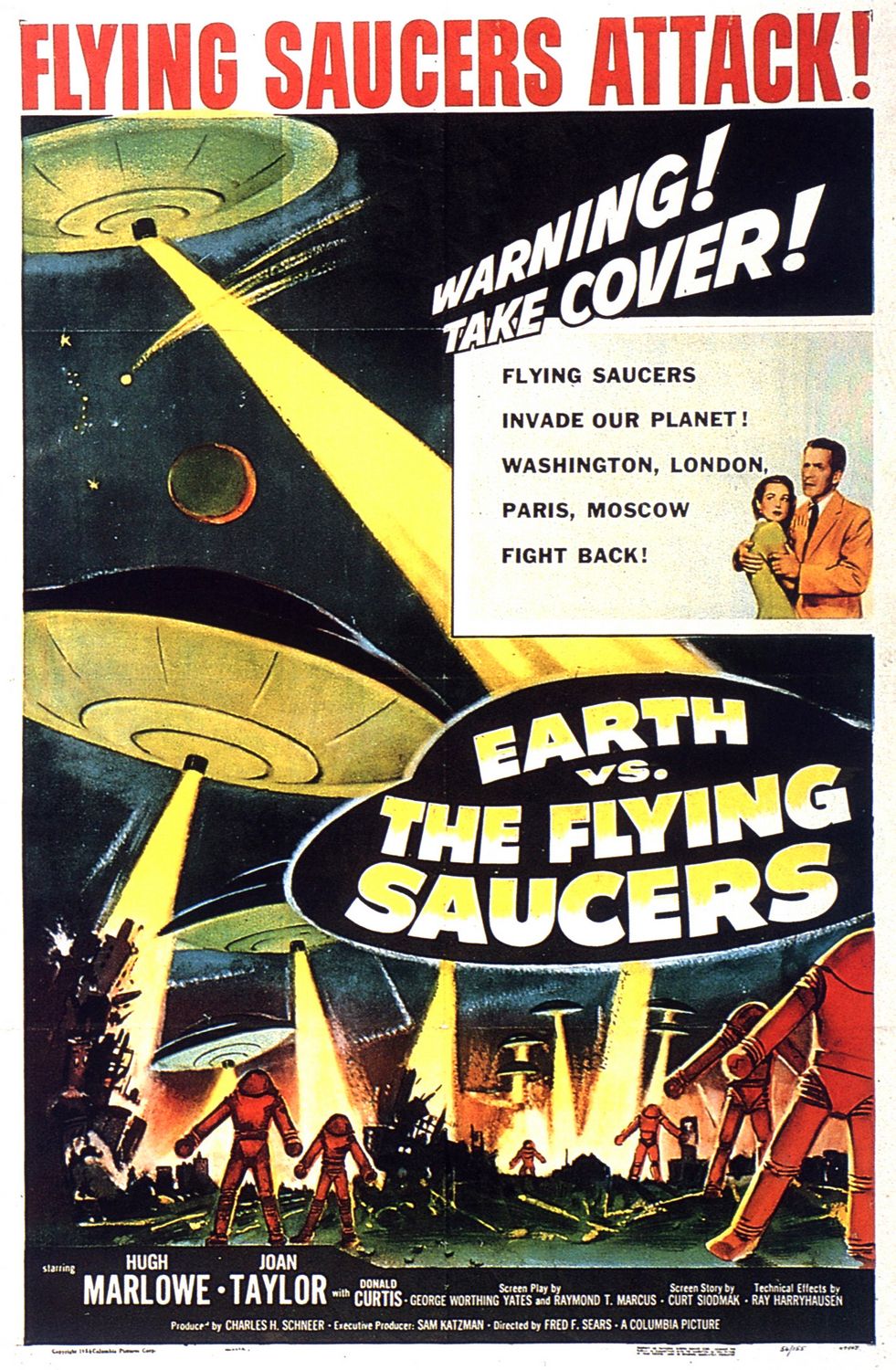
Earth vs the Flying Saucers. Clover Productions 1956.
Before watching the movie:
I’m closing the month with another sci-fi B-movie. I’m not sure how I first heard about this one, but I know it only by the title. It sounds like one Mystery Science Theater 3000 would have riffed, but they haven’t (at least, a cross-reference search only points to an episode for Earth vs. The Spider). It’s one of the B-Moviest of B-movie titles out there.
Knowing nothing of the plot besides the title (which pretty much spells it all out), I can only assume that the pilots of those flying saucers are eventually shown, so this can count as a monster movie. This seems to be a safe assumption, since the poster appears to show menacing ground troops, but these are either spacesuits, mechs, or robots. Which are probably good enough.
This isn’t in 3D, but I almost feel like I should wear red-blue glasses for it.
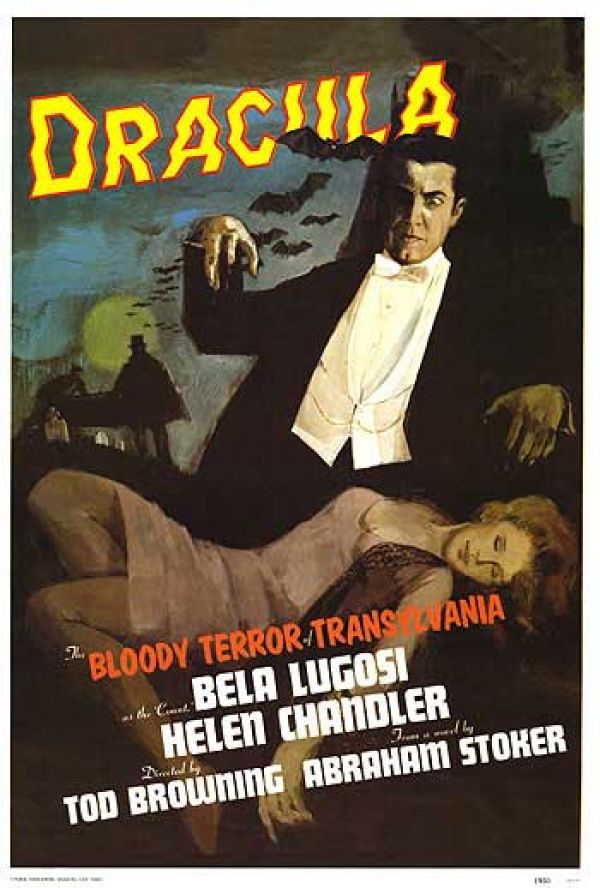
The Ur-vampire story. Everything classical vampires are comes from this movie. While the movie is based on a book, the movie has more range and probably took some liberties.
I’m not sure I’ve ever directly experienced Dracula played straight, not in parody or playing off the legend as “another monster/baddie”. By pop culture osmosis, I think I have a basic understanding of the plot, but there could be something new to me here.
This movie made Bela Lugosi and Dracula inseparable. I’ll definitely be looking out for how much of that is from the performance and how much from the popularity of the whole film.
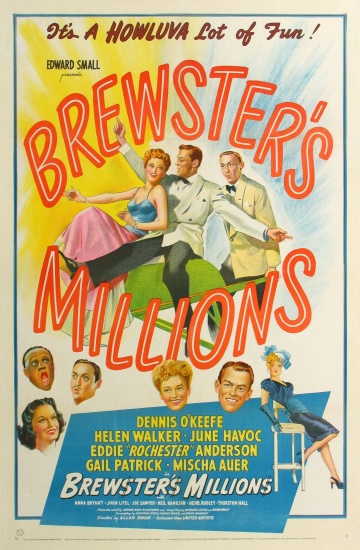
Brewster’s Millions. Edward Small Productions 1945.
Before watching the movie:
I felt like I knew a lot about this movie until I started to try to write about it. What I know is that it was remade as a Richard Pryor vehicle (infamously), and the plot concerns having to spend a lot of money quickly in order to inherit a massive fortune. Apparently this is one in a long line of adaptations of a book, so it must have been very popular.
The name Dennis O’Keefe sounds familiar, and I thought I must have reviewed something else starring him, but I don’t seem to have a tag for him. Also the poster clued me in to the fact that Eddie Anderson, breakout star from the Jack Benny Program, has a role. I think it’s the first time I’ll be encountering him not playing Rochester, though the popularity of that character may mean this one is basically the same under a different name.








 Yesterday's Movies