I always thought that a “Roman Holiday” was just recreation with wild abandon and no care for responsibility, like a Bacchanal, and as such I expected a carefree road movie. However, looking it up just now, I have learned that it was at least originally coined as an idiom to mean a depraved kind of schadenfreude (as in a crowd-pleasing public execution). Considering that the summary I’ve seen describes a sheltered princess escaping from her handlers and into the company of a reporter looking for a story, that seems ominous. But it’s a romantic comedy, so not very ominous.
I’ve known this movie existed for a long time, and never noticed the male lead is Gregory Peck. Nobody ever talks about Gregory Peck outside of To Kill a Mockingbird and Moby Dick anymore.
Movies of my Yesterdays is an irregular series where instead of writing about a movie I’ve never seen, I choose a movie important to my past and discuss why that is.
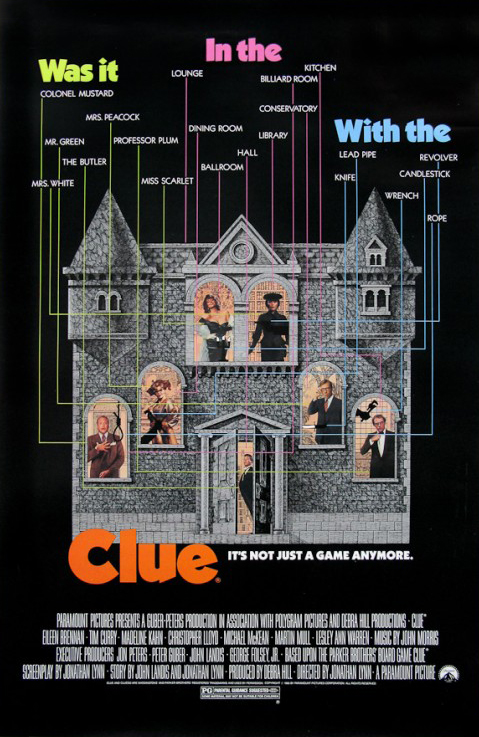
I clearly remember that the first time I saw this movie, it was on a New Year’s Eve at home. It was one of the rare movies we had on hand that wasn’t made for children, didn’t even look like it was for kids, and wasn’t Star Trek (The only other one that comes to mind is Trading Places, which is very not for kids.) I don’t remember how old I was at the time, but I must have been in middle school or close to it, because I was staying up for midnight and my parents put this on for us. It must have been on the basis of how much I enjoyed the movie that first time, because I remember nothing else about that particular New Year’s, but watching the movie was so formative for me that I recall it every New Year’s Eve, and I’m always pleased when I have a chance to include the movie or the game in a New Year’s now.
A few months or years later I developed an obsession with Back to the Future, and the fact that Christopher Lloyd has a prominent role here deepened my appreciation of this movie. I also think this is most of the reason Martin Mull makes me happy whenever I see him pop up in something. Tim Curry is of course, simply a legend. I can probably make a list of all the movies he makes better, but that would be a needless digression (and it’s probably “everything he’s been in except Rocky Horror” anyway).
As anyone who’s seen the movie probably knows, what makes Clue particularly unique is the multiple-choice ending. I never got to experience the buzz when it was released, where different theaters got different endings and I don’t think it was announced there would be differences, but home releases on tape include all three endings and releases on disc have the option to play one at random. I do have a favorite, but I find it interesting that the linear version declares only one of them to be “the real one”. I think I’ve heard that it’s the only one that actually lines up with all the details, but I’m not sure if that’s true. There are too many subtle moments to keep track of. Regardless, it’s a fascinatingly unorthodox approach to storytelling.
I’m not sure if I’ve played this movie since college, but it’s never been one I got tired of. By now I can recognize that, in concert with the amazing wit in the dialogue, one of the biggest strengths on display is that the script supports a large ensemble with fantastic characterization for everyone involved without giving too much focus to any one of them. It’s like an English high society detective novel without the high society or the detective, just a bunch of people being nasty to each other while trying to solve a puzzle. Lovely mansion though.
Over thirty years later, this continues to be the paragon of game to film adaptations. Clue is a fairly simple game but with a lot of data points, and while every single one of them are included here, none of them feel forced. There are even half a dozen extra characters added (mostly as cannon fodder) and it still somehow doesn’t feel unwieldy. I don’t think this movie will ever get old.
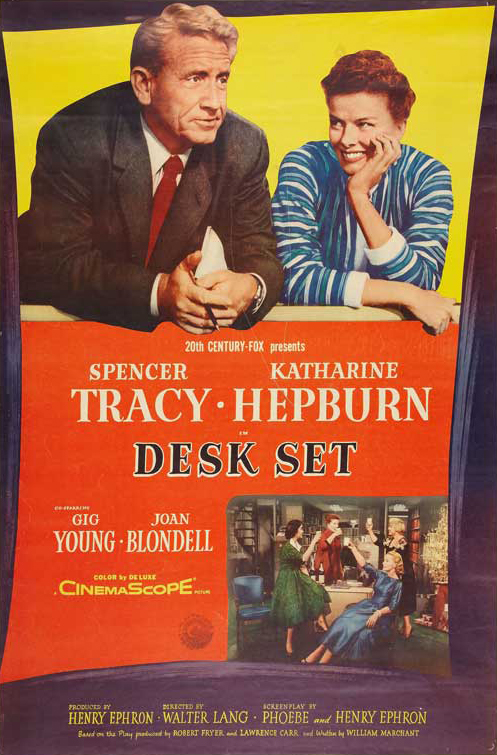
I can’t recall if this is something I saw come up specifically referenced by somebody as a story about a woman tasked with automating her research department and it turns out even just alone she’s better than the computer, or if this is unrelated and just came up in my algorithmic recommendations.
All I know for sure is that Spencer Tracy and Katharine Hepburn apparently do a lot of verbal sparring, and I’m a big fan of verbal sparring, especially by legends. I guess I haven’t seen all that much of Spencer Tracy. It may just be Guess Who’s Coming To Dinner and nothing else. But I know he’s highly regarded and that William Shatner in particular looked up to him.
It says this is a romantic comedy, and I’m wondering if the center couple is both Tracy and Hepburn. They seem mismatched in age.
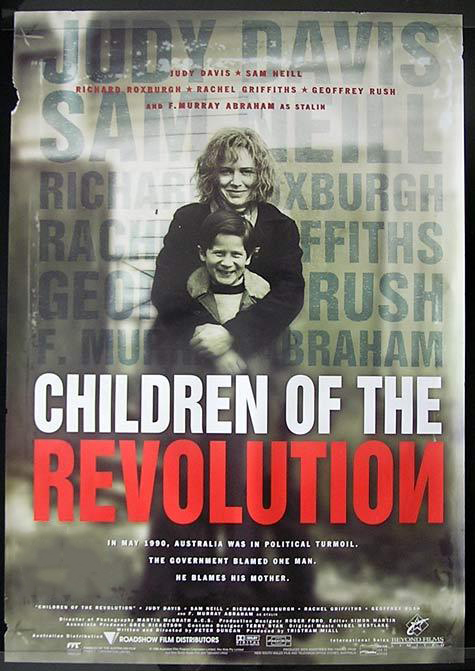
This just came up in my digital recommendations a few weeks ago. I thought at first it was a documentary because the promotional images really don’t do much to convey that this is a scripted comedy, instead really getting into the cold war aesthetic.
So basically an Australian woman raises Josef Stalin’s love child in the true Party way, and somehow this leads to political disaster in the modern day. My first thought is that it’s another Australian comedy inserting Australians into places in history where they were not (an interesting apparent trend that may not exist outside these two movies, and I could do with more stories of real Australian history), but I’m really looking forward to the journey getting there, especially with a cast of familiar names, some of which I can actually place.
While it was never really a favorite, more of something not disagreeable between other shows I did like, I recall there was a period in my youth when I watched a lot of The Beverly Hillbillies. Boy, those yokels who don’t know how they’re supposed to use egregious amounts of wealth, right? Actually I recall it using both extremes to mock the other. The Clampetts may have been walking stereotypes, but they were also people of simple tastes who highlighted just how absurd the excesses of wealthy Southern California can be. They bought a mansion in a nice neighborhood, but they still lived simply. I recently spent a lot of time thinking about what to do with a massive windfall, and I think it’s smart not to change much about one’s habits simply because smoking cigars wrapped in hundred-dollars bills on a yacht becomes an option.
I don’t know what to expect from a reboot movie made 20 or 30 years later. The show was made in a media landscape that believed in a simpler world than what the 90s accepted. The plots that stick strongly in my mind are the time Jed decided that the “billiard room” was the place to have Thanksgiving dinner because it had the nicest table in the house, and if possible he should serve a “billyard” (a rhino, like the head mounted on the wall in that room) on it, or when their banker turned out to be the last descendent of a family feud inspired by the Hatfields and McCoys, until Granny found out and revealed she was from the other family. When I try to imagine the 90s equivalent, I see a lot of manic slapstick. “From the director of Wayne’s World” being a selling point does not sound promising.
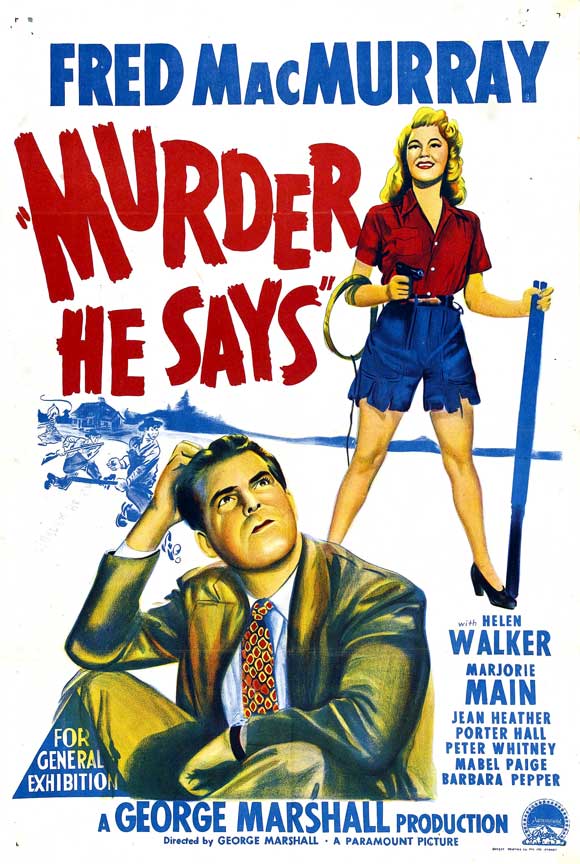
This was a suggestion from a Facebook friend. All I needed was Fred MacMurray or “murder comedy”, but this appears to be both. I actually wasn’t sure when I decided to do this if it was a comedy or a thriller, but I was fairly certain MacMurray never played against type (0r at least in anything dark) in anything but Double Indemnity. So I was fairly certain it’ll be a good time.
I’m a little surprised I don’t already have a tag for Fred MacMurray. I’ve invoked The Happiest Millionaire in a few other blog posts, and he actually appeared via archive footage in Dead Men Don’t Wear Plaid, but in too minor a role to merit getting tagged as a star, and also I didn’t like what the movie did with the clips from Double Indemnity. Thanks to classic Disney films like Happiest Millionaire and The Absent-Minded Professor, as well as the impact Double Indemnity left on me as a young film student, I’ve always felt like MacMurray has had a minor presence here, but this is somehow the first time he’s starred in a review.
I’ve been looking for this for years. It’s easy to find the sequel, it’s much harder to come across this one. I’m not sure why that is.
The marketing looks like it’s positioning this as “Mr. Bean is James Bond”, but I’m hoping Atkinson will be doing something closer to Blackadder. Some of that hope may be fueled by the idea that if it’s the case, it might find a place as a missing link in my silly theory that Atkinson’s Doctor in The Curse of Fatal Death is a continuation of the Blackadder line, which tends through history to get smarter (though usually of lower station).
For years, Terry Gilliam has wanted to make a Don Quixote movie. And for decades, it’s been in development hell. Except once, it actually went into production. And never came out. This is the story of Terry Gilliam’s impossible dream.
I always thought Gilliam made this documentary himself when production fell apart, but it’s attributed to a couple of other directors. Makes sense, I guess. He’s too busy making weird movies (or at least trying) to make a documentary.
Apparently the title for Gilliam’s movie is The Man Who Killed Don Quixote. I always thought it was going to just be Cervantes’s story with a Gilliam bent, but that title sounds like he intended to at least tell a new frame story. I am unfortunately not familiar enough with Quixote to know how the original story ends, but I expect it’s a classical tragedy. So it might yet not be an original story on Gilliam’s part.
This is one of those movies I’ve heard the title bandied about and little else. Perhaps the phrase predated the movie, since I’ve always known it as an idiom rather than a title.
Unfortunately, that gives me very little to go on for comment in this section. It apparently has an incredibly positive reputation, but yet I only came across it by specifically researching documentaries to consider for this month. I know it follows two inner city kids who are trying to get basketball scholarships to lift them out of where they are. Do they compete, or simply run parallel? I couldn’t say. There must be plenty of athletic scholarships out there, but they might be both scouted by one school for one spot. I can see the potential for a powerful portrait of their lives and potential, but I couldn’t guess at much more.
Unrelatedly, anyone who wishes to can now support this blog on Patreon. I promise not to have obtrusive reminders about it, whether it works out or not.
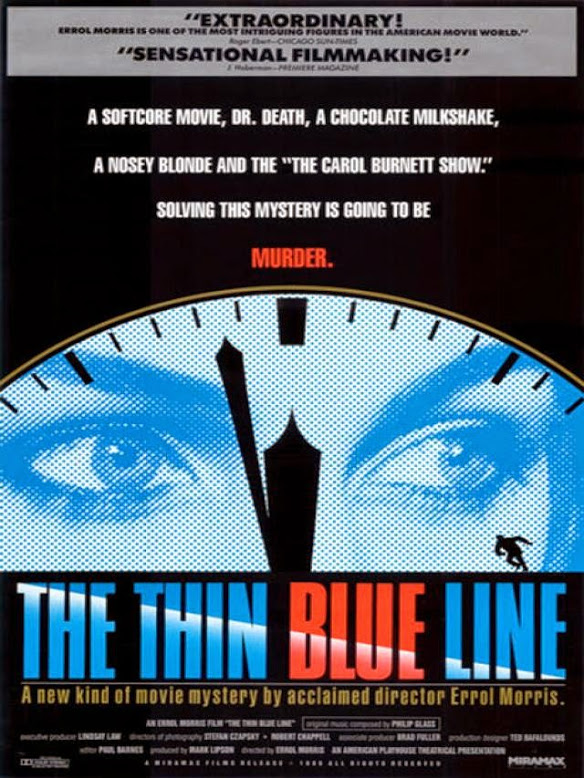
I understand that this has reenactments. Originally, I was thinking of the technique of historical documentaries putting actors in appropriate dress and marching across a battlefield, sitting at a desk writing, or talking in a group, basically silent illustrations for a narration to play over. But I’m starting to wonder if it’s more like a traditional dramatization, just mixed in with the documentary.
I find the idea of the latter an interesting mix, but kind of disappointing to think that half of my doc selections are more fabricated than a documentary should be.






 Yesterday's Movies