Movies of my Yesterdays: Dark City

Dark City. Mystery Clock Cinema 1998.

I’m not entirely sure what the full context was when I saw this movie. I have a clear memory of watching it in a classroom, but I don’t think it was for the Science and Ethics class. I’m not really sure what scientific or ethical discussion could be had from this story. I think it was a “it’s the last week of classes and nobody’s getting any work done” kind of presentation. The main thing I remember is how deeply disturbed I was by it.

A man wakes up in a hotel bathroom with no memory of who his is or where he is. The phone rings, and the man on the other side, Dr. Schreber, tells him that people will be coming for him and he needs to get out. The man in the hotel room finds a murdered woman and a bloody knife in the bedroom and runs. This is John Murdoch, or that’s what all the evidence says, anyway. When the trenchcoated Strangers catch up to Murdoch, he discovers he has the ability to bend reality with his mind, which the Strangers recognize as “Tuning”. Inspector Bumstead gets assigned to the case of the serial killer who kills and decorates prostitutes when the previous detective on the case has a mental breakdown, and now they have enough clues to identify a suspect: John Murdoch, who left his wife Emma three weeks ago when he learned she was having an affair and must have snapped. But the night he woke with no memories, John went up to a call girl’s room and found he didn’t have it in him to do anything. At midnight every night, everyone except John falls asleep and the city rearranges itself according to the Strangers’ design, while Dr. Schreber injects new memories into those they have selected to place in different lives as part of their experiment. John has dim memories of growing up in a place outside the city called Shell Beach, which everyone has heard of and nobody can quite explain how to get to. With new plans in mind for John, the Strangers plan to track him down by injecting one of their own with the memories he was supposed to receive.

This movie has the least light I have ever seen in a movie. People are complaining now about how it’s impossible to see anything in modern movies and TV, but this might be even darker than what we get now. That’s definitely meant to echo how the sun never rises in the city, but as all of the frustrated audiences are saying now, there’s a limit. I definitely was hindered by watching in a brightly lit room, but I don’t know how much better it would have been in a darkened theater.

The Strangers’ experiment is supposed to be about understanding what changing memories does to the human soul, but I don’t think the point was made successfully. Aside from people slowly starting to notice that the world doesn’t make sense, I don’t really see very strong demonstrations of people staying the same in different lives. We only really see two people on either side of an imprinting, and one is basically the same guy but in a very similar setting, and the other one falls asleep telling one side of a story about a work dispute, and wakes up telling the other side of it. There’s altogether some very interesting ideas presented, but the mystery builds so slowly that I’m not sure much is really done with it. Even the climactic final battle is kind of a silly obligation. John gets slipped a syringe full of everything he needs to know (an actually impressive sequence, but not a heroic moment for John) and proceeds to have the goofiest special effects fight where he and the leader of the Strangers glare intensely at each other for a couple of minutes while the environment around them falls apart.

John is so much of an everyman type that I completely forgot about him in the years since I first saw this movie. Schreber, the creepy doctor who works for the Strangers under duress so you’re never fully sure if you can trust him, was incredibly memorable. I realized a little later that that was Keifer Sutherland, best known as the lead on 24, which is an incredibly different role. I’m never going to forget how disturbing Schreber was played, and I don’t necessarily see a reason for that take.

I really thought I’d missed something from the plot the first time around, but it really is just the puzzle box. By the time we understand everything, the movie is over. You’re left with the striking, if dim, visuals and some questions about identity that I think there was an attempt to make a statement on. This is a popcorn movie trying to philosophize, and it’s disappointing it isn’t all it wants to be.

Safe House

Safe House. Filmquest Pictures 1999.

Before watching the movie:

For all the actors I mowed through the filmographies of when I first realized I had the ability to discover and summon movies, somehow I never did that for Patrick Stewart. Most Star Trek regulars don’t seem to have enough high profile projects outside of Star Trek to get me to think in those kinds of terms.

So I first heard of this movie from a viral video recasting a clip of it as “Look at how jarringly out of character Captain Picard is!” I had to look up the source, and it sounded funny, but it’s heavily marketed as a thriller. Maybe it moves from comedy to thriller?

Also it seems to be a TV movie, which I try to avoid, but here it is anyway.

Continue reading

Jack Frost

Jack Frost. The Canton Company 1998.

Before watching the movie:

I saw one trailer for this movie very many times because it was on the tape for Thomas and the Magic Railroad or something else that played a lot at our house, but I don’t think I’ve actually seen the whole movie.

I completely spaced who played the father and somehow got to thinking it was Jack Nicholson, which would’ve been pretty late for Nicholson to take a role like this.

Anyway, I remember not being very interested at the time because the trailer leaned heavily on some sophomoric humor, but trailers rarely represent their movies well, especially when they have that kind of heavy reliance on a single note that isn’t at the core of the genre.

Continue reading

Godzilla (1998)

Godzilla (1998).
Centropolis Entertainment/Fried Films 1998.

Before watching the movie:

I don’t quite understand why Godzilla captured people’s imaginations. I would’ve said that a large part of the charm of the original Japanese kaiju movies was camp and cheap effects, but everything that sells eventually gets three high-budget reboots here, and I think this did pretty well in theaters.

I certainly remember it being heavily promoted and cross-promoted. It probably made its money back just on toy sales, or at least the studio thought they had a shot at doing so.

Continue reading

The Avengers

The Avengers. Warner Bros. 1998.

Before watching the movie:

What can be said about this big-budget adaptation of a beloved, long-lasting sci-fi/fantasy/action/adventure franchise? This movie that brought people’s childhood fantasies to the big screen in an ambitious project that had never been done before? The first time moviegoers assembled for The Avengers?

Of course, I mean the 1998 adaptation of the British ITV series from the 60s. What else could I be referring to?

Continue reading

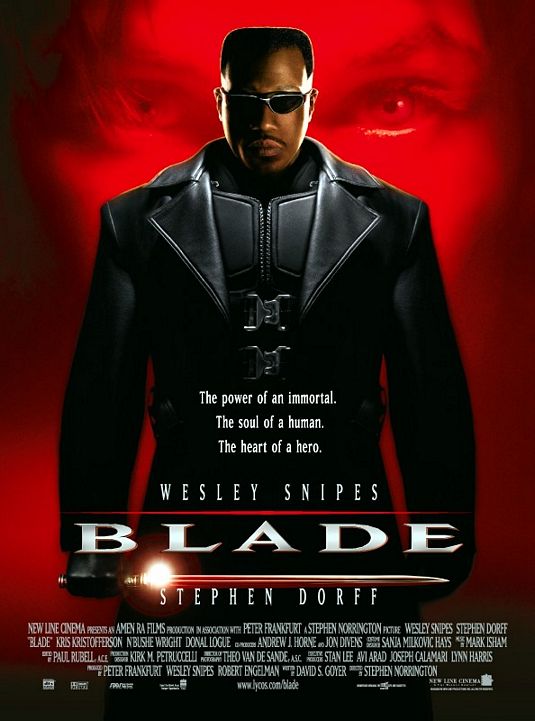
Blade

Blade. New Line Cinema 1998.

Before watching the movie:

I have no familiarity with the Marvel comics this is based on. For all I know, this movie was made because New Line had bought a package of cheap comics properties to turn a fast profit on. I don’t like to be so dismissive, but Blade is one of the most prominent notably black superheroes I can think of who aren’t carrying a legacy mantle, and I wouldn’t know that the book exists without this movie that exemplifies an era of moviemaking where “based on a comic book” was something to hide.

Lacking any of the brand recognition and shared continuity that makes comic book stories enticing now, this is essentially sold on the strength of Wesley Snipes slaying vampires with martial arts for two hours. Which is exciting enough if you’re into that sort of thing.

After watching the movie:

Thirty years ago, a baby was born to a woman dying of a vampire bite. Now, Blade is a Daywalker, a being without the vulnerabilities of vampires, but with many of the advantages, including super strength and speed and decreased aging. Blade and his partner Whistler save Dr. Karen Jenson from a vampire that eluded Blade’s assault on a vampire-owned rave, and they introduce Karen to the secret war to free human society from the elite order of vampires that secretly rule. As Blade fights vampire activity, a vampire named Frost manages to translate one of the ancient texts of the vampires, unlocking plans for a ceremony to bring about the age of the Blood Gods.

In the time this was made, comic book movies were often trying to be mature and serious while at the same time providing spectacular violence shows. This created a lot of movies that seem afraid to have fun, even as the stunt sequences the plots excuse are really fun and cartoonish. This has some really fun fight scenes, and the plot is pretty cartoonish, but the story and the fights often seem to belong to different movies because of how different they are in tone.

Most of the effects are highly effective. There’s a lot of work with prosthetics and practical creature effects that create convincing looks, and probably a lot of background CG that’s not noticeable. The disintegration of silver-stabbed vampires is really good for the time. The only time I was really taken out of the scene by bad effects was in the finale, with the demonic vampire souls flying around. That might have been partially caused by a frame rate mismatch, like how jarring the ED-209 was in RoboCop.

Even though there have been over 20 more years of superhero movies and Hero’s Journey plots further wearing out their cliches since Blade, the tropes this plot leans on seem particularly lazy. Developments in act one set up developments in act three with a megaphone. At least this movie introduces the character already established and just recaps the origin story, which is a rare approach. 

I have to respect that this was one of the vanguards of the modern rebirth of superhero movies, but it’s not a part of it. The success of movies like Blade and Spawn demonstrated that the market was safe for comic book movies again, but they didn’t do it by revolutionizing or commenting upon the genre, just by playing it straight. Often too straight, but I have to keep in mind how early this was. This is still a fun movie that doesn’t need too much of an excuse to explode some vampires, and that’s really all it had to be.

Slums of Beverly Hills

Slums of Beverly Hills. Wildwood Enterprises 1998.

Before watching the movie:

This is clearly some kind of culture clash movie, but I’m not sure what kind. My best guess is that the family is trying to continue living in Beverly Hills even as the money is gone. It’s mainly about quirky family dysfunction. Maybe there’s an element of “this is what rich people think rock bottom is”.

Practical Magic

Practical Magic. Stargate Studios 1998.

Before watching the movie:

I really like modern-day spellcaster stories. I even found a fondness for Teen Witch. So all that I really need to be interested in this movie is that there are modern-day witch sisters. Their conflict has something to do with a curse upon their love lives, which sets up a romantic comedy apparently, and I’m further intrigued. I also like Sandra Bullock in pretty much anything, so that’s a plus as well. Continue reading

How Stella Got Her Groove Back

How Stella Got Her Groove Back. Twentieth Century Fox 1998.

Before watching the movie:

So maybe this will be the lighter film I was hoping for last week. This is definitely sold as a feel-good movie and I think a romantic comedy? It can’t be too serious with Whoopi Goldberg playing the best friend.

I always have this movie’s plot conflated in my head with Peggy Sue Got Married, for no other reason than the vaguest of similarities in the title (“past-tense complete sentence that refers to the female protagonist by name”). Obviously they are very different movies.

So anyway, this is the story of a 40-something (who looks like she’s in her early 30s) having a fling with a 20-something on a vacation and… embarking on  a journey of self-discovery? Rediscovering a youthful spirit she’s lost in the rat race? Telling her boytoy to stay the hell away from her daughter? I’m not entirely clear on what this groove is, but it’s obviously a good thing, not something to beware.

Continue reading

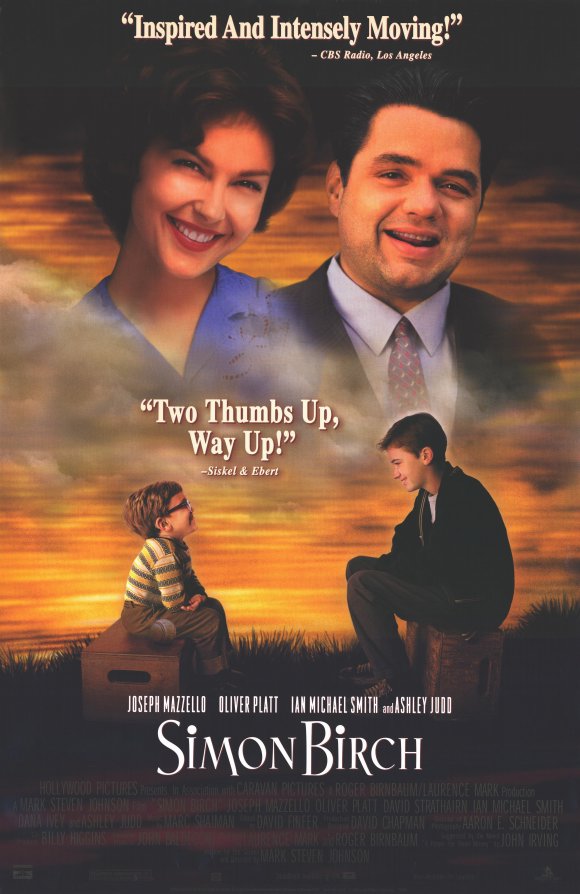
YesterMovies Rewind: Simon Birch

rewind

Five years ago this month, Yesterday’s Movies officially began. To celebrate half a decade of movie reviews, I’m rewatching some of the highlights and giving them second-look reviews. I’m closing out this series with the very first movie reviewed here, Simon Birch.

I know I originally chose this one because I’d just read the book it was based on, A Prayer for Owen Meany, and I recall it ended up not having much to do with the book.

I also think I remember Christmas being a major part of the movie, being a major episode somewhere in the middle of a story told over about a year or so. I’m not sure if I said something about it in the original review, but I’m recalling a feeling very similar to The Best Christmas Pageant Ever. oddly. That and the bus scene are all I really remember.

Continue reading