From the first time I heard about this movie, I was vaguely interested in the reality-hopping concept, but I wasn’t into martial arts movies and so I wasn’t all that attracted to it. What I know about the movie hasn’t really changed, I’m mostly just warmer to Kung fu films in general, and also I’m a little more aware of Jet Li’s work.
Apparently the movie was originally meant for Dwayne Johnson, who would’ve been very different, but I also would’ve been less familiar with 20 years ago.
I remember this being framed in the commercials like the invisible guy was the villain of a horror story, which I suppose could be from his slide into monstrous behavior without human consequences for his actions. I vaguely remember the movie coming up in an early explanation of Six Degrees of Kevin Bacon, though that’s probably more because it was recent than because it’s a particularly significant hub in Bacon’s connections with other actors.
I also remember it putting CGI effects that seemed completely novel front and center to do a more visually engaging telling of The Invisible Man than had been seen before. The League of Extraordinary Gentlemen came out not long after, but I don’t think they put as much effort into the Invisible Man effects because he was part of the ensemble, but also it wasn’t as new anymore.
This might be the first entry in this series from my time in college. It’s not quite from after the inception of this blog, but getting very close to it. It wasn’t long after when I saw this movie when I got my first opportunity to go back and catch up on movies I’d missed. But that wasn’t the way I saw this one.
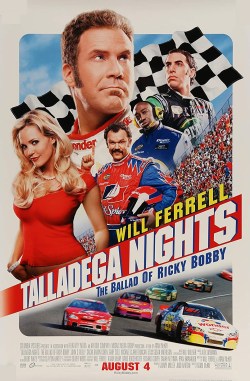
I first saw Talladega Nights because it belonged to my my freshman roommate, who set up his TV, small movie collection, and mini fridge, told me I was welcome to use all of them, and then found friends outside the dorm to spend all his days and nights with, leaving me alone with the whole room pretty much all the time. I can’t recall whether this movie got played in one of the rare times he was there or if I put it on myself in a bolder move in using his stuff, as using somebody else’s movies without their direct permission still seems like a breach to me even if blanket permission has been given (it occurs to me that I don’t feel this way about the massive movie and game collection of another roommate I had in the early days of the blog, which was probably represented multiple times on here). I’m pretty sure that was the only time I saw it until now.
Talladega Nights: The Ballad of Ricky Bobby. Mosaic Media Group 2006.
Born in the back of a speeding Chevelle, Ricky Bobby grew up not knowing his father, who left to race cars and do more shady things, which may have imparted his obsession with speed to him. Ricky only saw his father once in his childhood, making an unexpected and ignominious appearance at his class’s Career Day, but he left him with the dictum that “if you’re not first, you’re last”, a phrase Ricky went on to model his life on. Without many career prospects, Ricky found his way into the pit crew for Dennit Racing, finally getting his opportunity to enter a NASCAR race as a replacement for the driver who walked out in the middle of a race while in last place, and Ricky proves himself by finishing third, becoming a racing star. Backed up by his best friend Cal driving Dennit’s second car, who always gives him the assist to get to first, Ricky quickly achieves a life of fame and fortune, living in a mansion with Carley, the smoking hot fangirl he married, their two disgracefully disrespectful sons, and Carley’s father who impotently disapproves of how his grandkids are being raised. Ricky’s maverick driving style makes him a fan favorite, but costs him with the sponsors and the tournament judges, and therefore does him no favors with the new head of Dennit racing, Larry Jr., who hires openly gay Frenchman Jean Girard from the Formula One circuit to be his new, dependable lead driver with European precision. Ricky’s jealousy overwhelms him, causing him to crash and have a psychological breakdown that endangers his ability to ever be able to get behind the wheel of a car again.
This felt really raunchy at the time, but while it’s still kind of raunchy, it doesn’t feel like that’s an exceptional thing. I think the raunchiness largely comes from how it’s both a parody of the contemporary machismo but also kind of an earnest celebration of it. It feels entirely a product of its time, but no moreso than in the jokes about Girard being gay. This is tempered by Girard being revealed to be an honorable guy looking for an equal on the track and definitely a much more rational person than Ricky, but the jokes still significantly Other him. It occurs to me now that by being gay and European, Girard is specifically designed to be the antithesis of the NASCAR stereotype and the American nationalist cultural moment that NASCAR was a significant component of at the time. His being French is probably targeted at the specific distaste for the French after the country refused to support the US in doing some post-9/11 lashing out.
While the extreme farce style can easily get out of hand in a bad way, there were still plenty of laugh out loud moments. Its extremely contemporary nature probably keeps it from being as timeless as Anchorman, but it’s still a lot of fun. It’s not something I would come back to a lot, but I can see occasionally revisiting it to get my expectations exceeded again.
I vaguely recall the publicity for this movie at the time, and it didn’t particularly interest me then. The concept of extraterrestrials reacting to an astronaut from Earth as an alien invasion plot turned inside out was moderately intriguing, but it didn’t particularly call out to me at the time. Animation outside of Disney and Pixar (and sometimes them as well) at the time struck a tone that didn’t really connect with me, and still doesn’t. But as that tone was almost obligatory for the market of the day, it was probably exaggerated in the advertisements and this has the potential to be more in line with what does appeal to me.
I didn’t even know that the astronaut is played by Dwayne Johnson. The character design even looks a little bit like a redheaded reimagining of Johnson, how his appearance (and race) would have to change to fit the classic image of space race NASA astronauts. Or I may just be very bad with faces.
Under the Same Moon (la Misma Luna). Creando Films 2007.
Before watching the movie:
I didn’t know this movie existed before I watched it, so all I had to go on was that a lot of it is in Spanish, it’s about border crossing for family and Eugenio Derbez is in it. And I seriously can’t come up with more to say about it.
I was always a little intrigued by this movie, so I’m not sure why I never got around to it. Maybe it was because I was only a little intrigued. A married couple get turned against each other by the realization that they’re assassins for rival organizations, not a hundred percent my thing. Spy comedies are fun, but I’m not sure how much this is spy or how much it’s comedy. The actors don’t especially grab me either. I never had strong feelings either way about Pitt or Jolie, and I’ve got no idea who else is in it. I guess the most lasting cultural impact of this movie wasn’t the movie itself but the debut of Pitt and Jolie’s real-world tabloid relationship, and I could not care in the slightest about celebrity relationships.
It sure looks like an expensive house they end up shooting to pieces though. That’s something nice to look at.
I think the main reason I was never especially drawn to this movie was because I’m not that into fashion, but then movies can be themed around anything without requiring intimate knowledge of them. And maybe it was also something that didn’t appeal to me because it’s a women-oriented movie and I wasn’t as interested in those in 2006.
I do vaguely recall it being among the movies that I first got a real glimpse of what’s interesting about it at the Academy Awards that year, but like most other movies that I never really considered until the Oscars showed me more than any trailer did, I never really followed up.
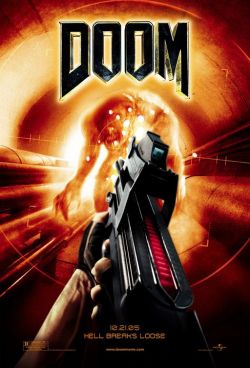
I’m not versed on the lore of Doom, but I think it’s pretty simple. There’s some kind of complex infested by demons, and one guy with a lot of guns takes them out. This movie is about a team fighting aliens. So already not the most faithful.
Later games probably built up the story, but I’m pretty sure it’s always essentially a lone guy fighting demons. But lone guys are hard to write movies for. I’m sure the change to aliens was something like embarrassment, but I completely get making it a team, even if it was probably not the best possible decision.
(Attempting to restore regularly scheduled programming, which is more than I can say for the plumbing here.)
Before watching the movie:
So I guess the joke is Kevin James is a fat, self-important security guard? And probably most of the comedy is going to come from Blart being fat or overstepping his station? I never expected this to be a great movie, or all that interesting. But it’s available, and it’s probably got some actually funny parts.
I just don’t know how they can make a feature length movie out of that concept.
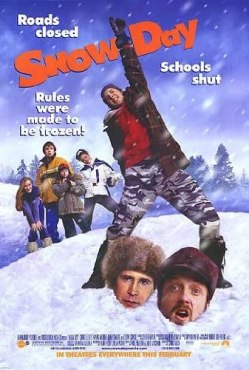
I saw this movie in a theater, but it wasn’t one I chose. A friend had a movie party for his birthday, and I don’t think I knew what we were going to see until we got to the theater. It seems like the kind of movie that was selected more based on what was playing on the date they wanted to have a party than because it was anyone’s first choice, but I remember it was fun in a very late 90s/early 00s Nickelodeon way. I must have recognized Chevy Chase at the time but I completely do not remember him. Actually, the main thing I remember about this day aside from some shots of kids and adults in snow is that it was the first time I heard of Superman ice cream.
Snow Day. Nickelodeon Movies 2000.
In a small neighborhood in upstate New York, an unseasonably warm winter suddenly gets a massive snowfall, and to the delight of all the kids in town, a snow day is declared. Hal and Natalie Brandston’s father Tom Brandston, the third-rated meteorologist in a three-station town, is hoping that having been the first to predict and report on the storm will be his ticket to pulling ratings over showboat weatherman Chad Symmonz and escaping the demeaning costume stunts his producer keeps forcing on him. Natalie’s friends Wayne and Chet make it their mission to stymie the Snowplowman, and maybe for once get a second snow day in a row. Hal spends all day trying to get the attention of Claire, the most popular girl in school, seeing it as destiny that he found her bracelet on the day that Claire broke up with her bully boyfriend Chuck, and drags his friend Lane along in his stunts even as she tries to get him to see how delusional he is.
In rewatching this movie, I didn’t come up with any concrete memories of how I felt at the time, but all the same, the sinking realization that the younger kids’ vendetta with the Snowplowman was relegated to the B-plot behind the high school boy’s quest for unrequited love that doesn’t at all need a snow day to take place on felt very, very familiar. In 2000, I was about the age of the younger kids in the movie, and while I never had the magical adventures this movie invokes of snow days with rose-tinted screenwriter glasses (as an indoorsy kid who lived on unwalkable roads nowhere near any friends, snow days were spent in our house probably watching TV under a blanket and meant relaxation), I think I was very disappointed that the whole concept of “kids having a snow day” got sidelined for a romance plot. They say kids are most interested in the next step up as a preview of what they can expect, but in this case, why would you have a movie called “snow day” and not center actual snow day adventures? It’s hard to push past that fault plus how tired the “guy can’t see the girl right next to him because he’s only got eyes for the unobtainable girl” plot is and get too objective on whether Hal is as lacking in relatability as it seems.
While the movie makes a point of saying how close Hal and Natalie usually are, and how they would usually be playing together on a snow day but he ditched her to go chase his dream girl, I really wish we’d gotten to see that somehow, so it means more to us to see them separate. When they’re together they speak warmly to each other, aside from Natalie being kind of resentful of how obsessed Hal has gotten, but the most significant interaction they have is Hal telling Natalie not to play with his collection of action figures that he wants to keep in pristine condition so he can sell them as a set. Oddly, Natalie acts like they’ve previously played with them before since she identifies him with a specific member of the group of figures.
Natalie’s friends are another missed opportunity. Wayne is marked by being the fat, wimpy kid who’s good for getting damseled and letting the filmmakers substitute farts for jokes, while Chet is… also there. Apparently Wayne and Chet made a snow cave that they were going to hang out with Natalie and Hal in that they brought a video game console out to, but it’s only used in one scene and destroyed by the Snowplowman to make him an extra-personal villain. The snow cave is the kind of thing one would expect to make up the main focus of the movie.
I think I need to come to the conclusion that the best part of this movie, at least as an adult, is Chevy Chase’s subplot, because it’s exactly what it’s supposed to be/ought to be. I think he won the crowd a bit too easily in the end, but this is a movie for middle schoolers and there isn’t really time for something more realistic.
While this is fun, especially for kids, it’s definitely an unbalanced script and isn’t primarily interested in what it claims to be interested in. It’s really hard to put aside all the small ways it disappoints and enjoy it for what it is when it isn’t even concerned with being what it says it is. There are some good seeds of movies in here, but the execution was almost entirely lacking.








 Yesterday's Movies