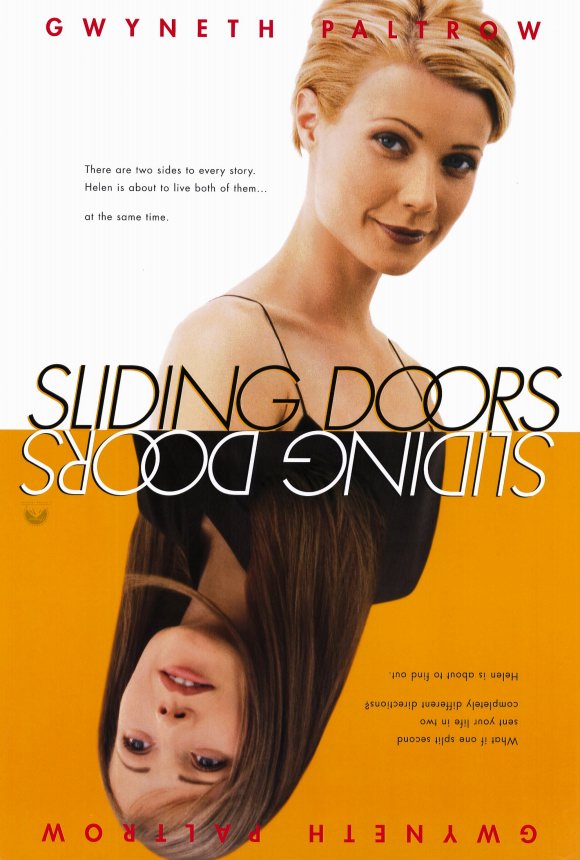
Sliding Doors

Sliding Doors. Paramount Pictures 1998.
Sliding Doors. Mirage Enterprises 1998.

Before watching the movie:

Exploring parallel outcomes of a small change in one’s life is hardly a unique source of plot, especially since Many Worlds Theory entered popular consciousness. Malcolm in the Middle did an episode on what would happen depending on which parent chaperoned an outing, one of Community‘s most popular episodes traces seven different continuities, Mister Nobody follows a mind-bending number of possibilities, and Constellations recently began a Broadway engagement, just to name a few, and completely ignoring the countless examples involving time travel. However, there are two films that are always held up as the chief examples of the concept: the German film Run Lola Run, and Sliding Doors, both of which, interestingly, released in the same year. Perhaps that’s a part of why they both resonate so strongly.

I encountered Run Lola Run first, so I’ve always seen this as the English-language derivative. I expect it to be less experimental in technique and so more accessible, but that’s dangerously close to snobbishness. This is still an experiment in stepping outside traditional linear story, and highly regarded as such, for reasons I’ll now get to experience.
Continue reading

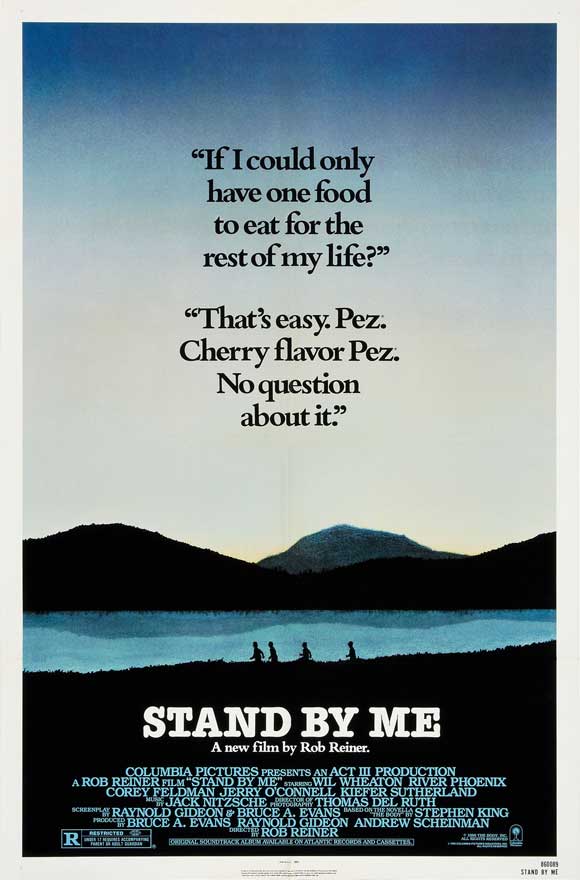
Stand By Me

Stand By Me. Act III Productions 1986.

Before watching the movie:

I mainly know of this movie because it was apparently the biggest thing in Wil Wheaton’s child acting career besides Star Trek, and as I keep up with his internet presence, it comes up a lot. I only know the broadest strokes of the plot, that there’s a group of boys who have some kind of adventure that leaves them all changed, like The Goonies, though more mundane. Everything else I think I know comes from the Simpsons episode that I think is based on this.

I’m not normally drawn to coming of age films, as I’m neither young enough to appreciate them as a child nor old enough to absorb the nostalgia of childhood adventure. Indeed, I’m from after the era where children commonly wandered freely outside of school to make lasting friends and life-changing discoveries, so this kind of film is somewhat foreign to me. But I have the impression that it’s a classic from the mid-80s, even if it doesn’t have as strong or visible a cult following as many others.

Continue reading

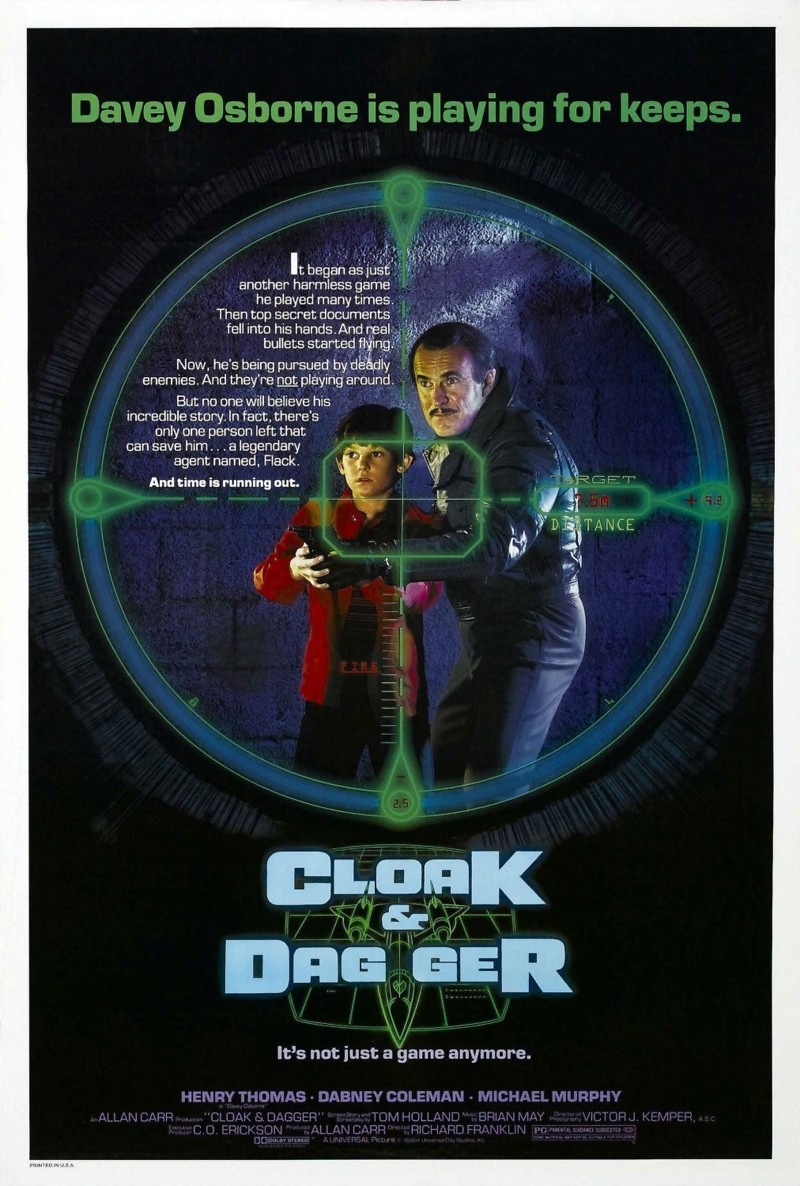
Cloak and Dagger

Cloak and Dagger. Universal Pictures 1984.

Before watching the movie:

I came across this in a 10-movie collection of cheap “family favorites” I bought with a Christmas gift, and I’m a little confused by the plot summary. The neglected kid’s video game hobby and superspy imaginary friend both figure prominently in the description, but I don’t see how video games enter into where the twist takes them, other than providing a setup for how to get there. This might just be the kind of weird concept that’s surprising to think it got made.

Dabney Coleman wouldn’t be the first person I’d think of to play a superspy, but he does seem quite appropriate now that I see him here. It’s not exactly the type I know him best in, but I can picture the role as something similar that he’d be quite capable at, or he could surprise me.

Continue reading

YesterMovies Rewind: Simon Birch

rewind

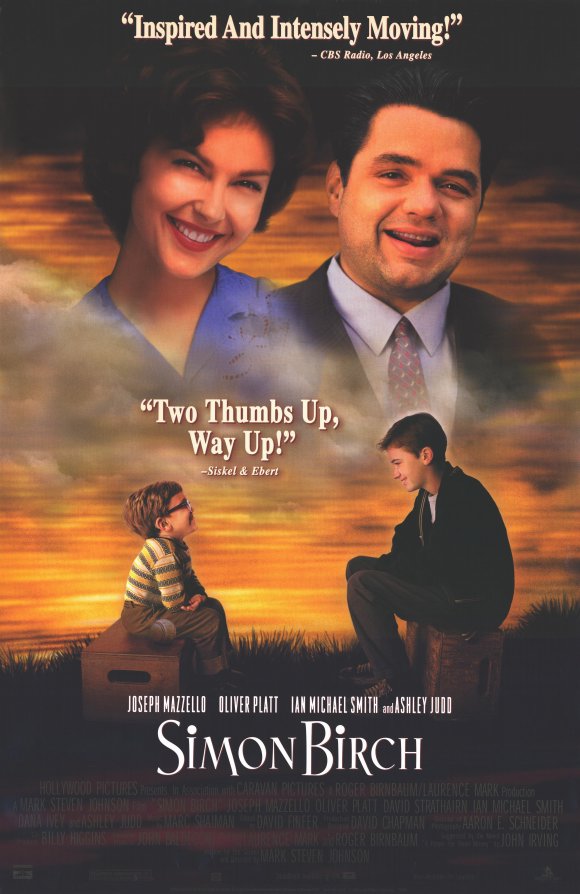
Five years ago this month, Yesterday’s Movies officially began. To celebrate half a decade of movie reviews, I’m rewatching some of the highlights and giving them second-look reviews. I’m closing out this series with the very first movie reviewed here, Simon Birch.

I know I originally chose this one because I’d just read the book it was based on, A Prayer for Owen Meany, and I recall it ended up not having much to do with the book.

I also think I remember Christmas being a major part of the movie, being a major episode somewhere in the middle of a story told over about a year or so. I’m not sure if I said something about it in the original review, but I’m recalling a feeling very similar to The Best Christmas Pageant Ever. oddly. That and the bus scene are all I really remember.

Continue reading

YesterMovies Rewind: Family Plot

rewind

Family Plot. Universal Pictures 1976.

Five years ago this month, Yesterday’s Movies officially began. To celebrate half a decade of movie reviews, I’m rewatching some of the highlights and giving them second-look reviews. This week, I’m giving the unfairly forgotten Family Plot another try.

In May of 2011, I was preparing to leave for an extended stay in another state, and I’d decided that my last review the night before leaving would be a family copy of Family Plot. However, shortly after I began watching the movie, I received word canceling the lodgings I thought I’d secured for my trip. I spent the next few hours frantically trying to make other arrangements, and while I managed to get a review posted, I probably hadn’t had enough attention to give it. Therefore, I always wanted to find an opportunity to give it another attempt, since it’s probably the film on this blog most deserving of a second look.

That story is pretty much all of what I remember about the movie. It’s some kind of comedy about murder, but I think that much is stated on the box.

Continue reading

Random Hearts

Random Hearts. Rastar Pictures 1999.

Before watching the movie:

I first heard of this movie in In The Can, a book about Hollywood missteps. When I selected it, I didn’t remember what the book had to say about it (I may have confused it with another entry), but I was fairly certain it had been in the book. I have a particular interest in movies that had potential but made a critical error, and in this case it sounds like a minor problem rippling outward: according to the book, Harrison Ford’s fame took too much focus that could have been spent on more interesting characters. Now I can decide for myself if that’s the case.

Continue reading

The Lodger

The Lodger. Gainsborough Pictures 1927.

Before watching the movie:

I got this in a box set of early Alfred Hitchcock films, which indicated it was Hitchcock’s first thriller. I’ve seen it described elsewhere as when Hitchcock came into his own. But I don’t know much about it beyond that it’s about a serial murderer and it’s silent.

I haven’t covered many silent films. I don’t dislike them, but they don’t usually attract me unless it’s something historically significant like The Birth of a Nation. Lack of color often enhances the tension in a movie, but I’m not sure if lack of sound will do the same or be a barrier to connecting with it. I’m expecting it to help though.

I have a hard time picturing a Hitchcock film without sound though. He does a lot of advanced camera and narrative techniques, and when I think of technique in the silent era, I think more about pioneering the basics than doing anything that can impress in its own right. I recognize this is patronizing, and I’m hoping this film will defy that notion.

Continue reading

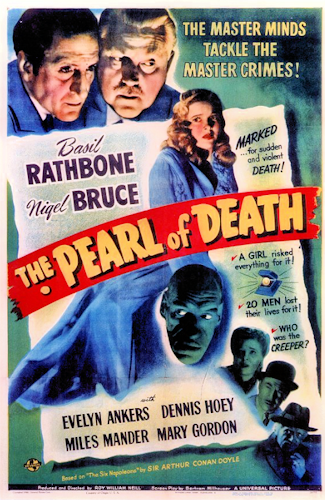
The Pearl of Death

The Pearl of Death. Universal Pictures 1944.

Before watching the movie:

Sherlock Holmes pops up so often here that he has his own genre category. So it was fairly inevitable that I’d get to the series starring Basil Rathbone eventually, even though I haven’t been very up on that version in the past. This is mostly by reputation at this point. Rathbone is considered definitive by some, and by others a poor portrayal that damages subsequent attempts. I have seen one installment before, but not much of it held my attention and my own opinions have changed since then.

At the time, I found the idea of setting the stories contemporary to their WWII production was lazy. The BBC’s current hit, Sherlock, however, has since demonstrated to me how much brilliance can be involved in making that kind of leap, and I should be judging it on the quality of the shift, not on the presence of it. Additionally, I was annoyed that they apparently tied Moriarty to everything, but most other adaptations do that too, and I should be judging it on how much they made that make sense, starting from the basis that a Napoleon of Crime would in fact have his fingers in a lot of crime. Finally, at the time I wasn’t aware that this series has been accused of practically lobotomizing Watson next to Doyle’s character, influencing many subsequent takes.

There’s a delicate balance in reviewing an installment from a film series. I try to avoid sequels that build on events from their predecessors, but this is more of the franchise type, with each individual film standing alone. In fact, it’s practically a television series before the popularization of television, due to the sheer number of films, the turnaround time between each, and the length of each (this one is only 69 minutes, and seems fairly typical). So how did I select which one? I have access to the third volume of the collection and this was the most interesting one in it. It’s based somewhat on The Adventure of the Six Napoleons.

Continue reading

The Cable Guy

The Cable Guy Columbia Pictures 1996.
The Cable Guy. Columbia Pictures 1996.

Before watching the movie:

The poster shown here is overwhelmingly the image associated with this movie, but for the longest time I took it at face value, as if it was telling me Carrey’s character is really a sinister, murderous psycho. However, in light of the descriptions usually attached, I think this is a joke that’s lost its context. From the descriptions, I think I see a story about a needy character who has more of an exasperating effect than a worrying one. Less Fatal Attraction, more What About Bob? But then looking at IMDB just now I’m thinking I’ve underestimated the darkness again.

I expect good things from Matthew Broderick in a beleaguered straight man role, and Jim Carrey’s proved himself in pretty much any kind of role.

Continue reading

Red Dawn

Red Dawn. Valkyrie Films 1984.

Before watching the movie:

Even in the 80s, as the cold war thawed, open warfare between the US and Soviet Union seemed likely. However, apparently it seemed plausible that a Soviet invasion could be resisted by guerrilla teens, so fear of the red menace was probably eroding.

I’m finding it interesting to track depictions of the Enemy over the decades. I know the 90s had trouble giving up the Soviets as stock villains, but I haven’t previously noticed a shift in how Russia was treated before the breakup. It’s often just a looming shadow of calamity, like an anvil held over one’s head with a fraying rope. Here, however, is a take on what happens when the rope snaps.

Continue reading