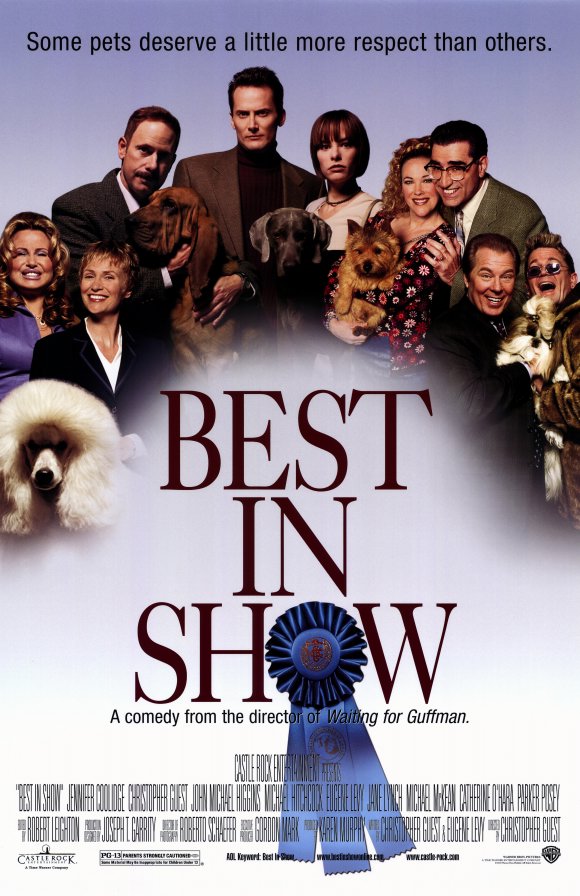
I’ve probably been aware of this movie since shortly after it came out. I remember for years seeing it on the shelf at the library, picking it up, and putting it down again. It always looked like something I should be interested in, but it never grabbed me. It’s about a dog show. It’s a mockumentary. It’s by Christopher Guest. And none of that ever really put it over the edge for me, until now.
For an improvisational mockumentary with a huge cast, the only thing I know to expect is that I can’t predict anything.
I’ve been looking for this for years. It’s easy to find the sequel, it’s much harder to come across this one. I’m not sure why that is.
The marketing looks like it’s positioning this as “Mr. Bean is James Bond”, but I’m hoping Atkinson will be doing something closer to Blackadder. Some of that hope may be fueled by the idea that if it’s the case, it might find a place as a missing link in my silly theory that Atkinson’s Doctor in The Curse of Fatal Death is a continuation of the Blackadder line, which tends through history to get smarter (though usually of lower station).
For years, Terry Gilliam has wanted to make a Don Quixote movie. And for decades, it’s been in development hell. Except once, it actually went into production. And never came out. This is the story of Terry Gilliam’s impossible dream.
I always thought Gilliam made this documentary himself when production fell apart, but it’s attributed to a couple of other directors. Makes sense, I guess. He’s too busy making weird movies (or at least trying) to make a documentary.
Apparently the title for Gilliam’s movie is The Man Who Killed Don Quixote. I always thought it was going to just be Cervantes’s story with a Gilliam bent, but that title sounds like he intended to at least tell a new frame story. I am unfortunately not familiar enough with Quixote to know how the original story ends, but I expect it’s a classical tragedy. So it might yet not be an original story on Gilliam’s part.
This hinges around a digital heist, but the summaries focus on the persuasion required to get the hacker to hack. Even Hollywood hacking can’t sustain a whole film (even The Net is mostly real-world action), so I expect very little of the excitement actually comes from a guy sitting at a laptop typing until the money is stolen.
I have the impression of the mastermind of the heist as a figure not directly involved in the plot aside from hiring people, coercing people, and hiring people to coerce, but there’s one more headliner than I would expect in that notion, so maybe he’s in the middle of it all, giving orders. I know far too little of use for comment beforehand.
I do recall seeing pieces of this on TV in college, but never more than a moment here and there because I only caught it at the beginning once and I didn’t have the time to watch it then.
I think this involves saving Hanukkah. I’m not entirely sure about that right now, but I thought I’d do a Hanukkah movie, and how many Hanukkah movies are there anyway? I wouldn’t know, as it’s not actually my tradition. I can only think of one definite one I’d really rather not see.
But anyway, what this definitely is is a Jewish parody of Blaxploitation films. Kind of like Shaft if he was Chosen instead of black. Well, more like the remake of Shaft maybe.
I’m not sure how long ago this movie came to my attention. I think it might have been when this comic was published, which was roughly six years ago, but I’m not sure but that it hadn’t come up before then. It seems to have the reputation of being the densest time travel movie ever, but then it seems a vast majority of the audience couldn’t understand Back to the Future Part 2.
The most specific thing I know about the plot is that it concerns a time machine with rules often cited as probable for potential real time machines, but rarely used in fiction because it limits the kinds of stories that can be told. The title always makes me think of a textbook, but I think it’s more likely to be about priming the machine due to those operational restrictions.
Between the highly cerebral reputation, the independent production, and a synopsis I saw that is likely to just be describing the first scene in a zero-tolerance approach to spoilers, it seems entirely likely that this could be an hour and a half of two guys in a room talking about what they’re going to do with the machine and only at the end revealing the actual result. I have seen duller “people just talking” movies about mindbending concepts. (See Mindwalk, which adapted a nonfiction book about physics by having a few characters meander through an art gallery talking. Or maybe don’t.)
The Prize Winner of Defiance, Ohio. Revolution Erie Productions, 2005.
Before watching the movie: When I ask someone new for a movie recommendation, there’s a high likelihood they’ll suggest something I’ve already seen. There’s a very slim chance they’ll recommend something I’ve never even heard of. Not every movie I’ve ever reviewed is obviously to my taste, but the ones that aren’t are pretty much the cinematic canon. And now there’s this. Possibly the first small drama I’ve seen outside of a film festival. I might have passed it by without the strong recommendation of a new friend. The closest reference point I have is something like What’s Eating Gilbert Grape? for reasons that become less clear as I explore what they might be (for one thing, I remembered that one as a period story and it’s actually contemporary). This seems to essentially be a story about a housewife supporting her children by writing for prizes. So it’s more like October Sky (intellectual skills lifting people out of bad situations), only probably not at all. Continue reading →
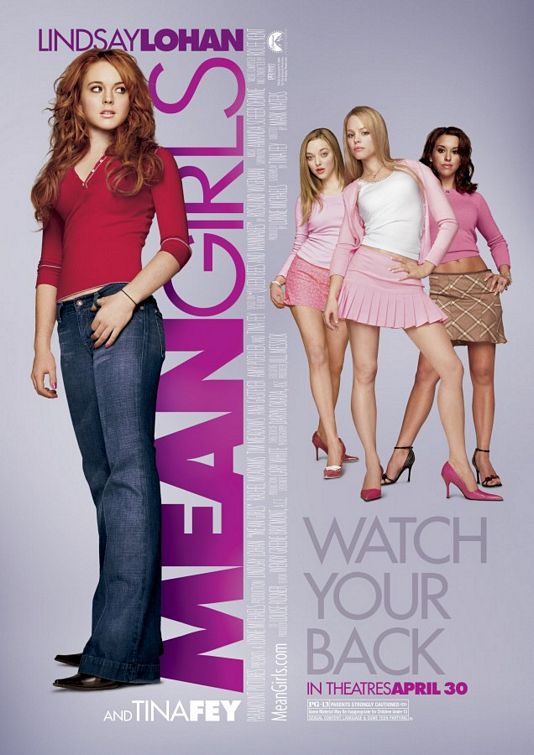
I’m fairly certain there were girls’ clique stories before Mean Girls, and of course many more after and because of it. So my impression is that this is extremely generic. But that’s probably unfair. Especially because of the influence this has had on the ten years since. And there’s always room for the writing to rise above a generic story type. I know there are a handful of lines that have become memetic.
This is also likely the most in-depth look at the girls’ clique trope. I seem to recall an idea that this is nearly anthropological in its study of catty high school girls, but that may be an argument beyond the depth of this blog.
Lost in Translation. American Zoetrope/Elemental Films 2003.
Before watching the movie:
I’m struggling a bit to describe my understanding of this movie in a way that doesn’t sound like it came straight from the blurb. Two Americans played by big stars find each other in Tokyo in an independent movie, and those and still other reasons, form a difficult-to-classify relationship.
Much beyond this description has been drowned out by Bill Murray’s presence in what’s definitely not a comedy, even though by now it should be easier to accept that he’s pretty much sworn off comedy and this is his thing now (or at least until he gets an award for it).
Eternal Sunshine of the Spotless Mind. Anonymous Content 2004.
Before watching the movie:
The basic plot seems attractive enough, as I’ve always been fascinated by explorations of mind and memory. I was even more interested when I learned about the dream imagery included. And I’m interested in Jim Carrey, even though I’m pretty sure he’s in a purely dramatic role here.
The reason I’ve never gotten to this is because it seems entirely concerned with the emotional drama, which is something I’m rarely in the mood for, especially at a feature-length scale. And so it’s now eligible to be among the movies this blog has given me a kick into seeing. Continue reading →








 Yesterday's Movies