I’m decently acquainted with the plot of the book, but somehow more through osmosis than from actually having watched the 1998 movie in class. I also recall attempting to read the book, but when I picked up the distressingly large tome with shockingly small text I was already having second thoughts, and then when this supposed English translation began with five pages in Latin, I put the book down and gave up.
I’ve wanted to experience the musical for a long time, and it’s always been a disappointment to me that the 1998 version was not based on the musical and that the musical was never properly filmed on stage (though there was an “original cast in concert” film just lined up on the stage performing the music, which I saw some of possibly in the same class that watched the other movie). When I decided to include Les Mis in this run of musicals, I was hoping there would’ve been another version because I’ve heard mostly bad things about Tom Hooper’s directorial decisions. But somehow this monumentally popular show has only been done on film the one time.
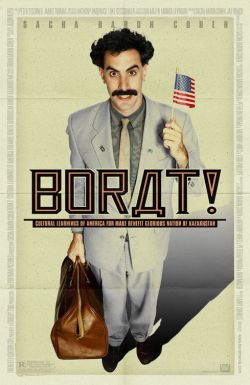
Borat: Cultural Learnings of America for Make Benefit Glorious Nation of Kazakhstan. One America Productions 2006.
Before watching the movie:
I remember this movie as something widely loved when I was in college, even though it came out a little before I began. There was also some kind of controversy about the real people in the movie being upset at being fooled into looking ridiculous.
A few years ago there was a streaming movie comedy where the scripted plot was written around setting up hidden camera pranks on bystanders called Bad Trip, and I thought it was the first scripted fiction/prank hybrid movie, but it seems that at the time I forgot about Borat. However, the mockumentary format of this movie makes it a bit closer to reality even if the plot is pre-written at least in the broad strokes, so it’s more conventional.
This might be the first entry in this series from my time in college. It’s not quite from after the inception of this blog, but getting very close to it. It wasn’t long after when I saw this movie when I got my first opportunity to go back and catch up on movies I’d missed. But that wasn’t the way I saw this one.
I first saw Talladega Nights because it belonged to my my freshman roommate, who set up his TV, small movie collection, and mini fridge, told me I was welcome to use all of them, and then found friends outside the dorm to spend all his days and nights with, leaving me alone with the whole room pretty much all the time. I can’t recall whether this movie got played in one of the rare times he was there or if I put it on myself in a bolder move in using his stuff, as using somebody else’s movies without their direct permission still seems like a breach to me even if blanket permission has been given (it occurs to me that I don’t feel this way about the massive movie and game collection of another roommate I had in the early days of the blog, which was probably represented multiple times on here). I’m pretty sure that was the only time I saw it until now.
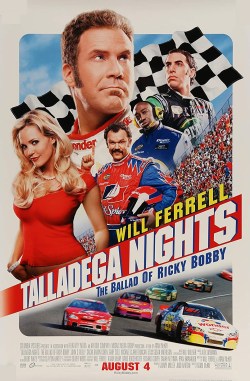
Talladega Nights: The Ballad of Ricky Bobby. Mosaic Media Group 2006.
Born in the back of a speeding Chevelle, Ricky Bobby grew up not knowing his father, who left to race cars and do more shady things, which may have imparted his obsession with speed to him. Ricky only saw his father once in his childhood, making an unexpected and ignominious appearance at his class’s Career Day, but he left him with the dictum that “if you’re not first, you’re last”, a phrase Ricky went on to model his life on. Without many career prospects, Ricky found his way into the pit crew for Dennit Racing, finally getting his opportunity to enter a NASCAR race as a replacement for the driver who walked out in the middle of a race while in last place, and Ricky proves himself by finishing third, becoming a racing star. Backed up by his best friend Cal driving Dennit’s second car, who always gives him the assist to get to first, Ricky quickly achieves a life of fame and fortune, living in a mansion with Carley, the smoking hot fangirl he married, their two disgracefully disrespectful sons, and Carley’s father who impotently disapproves of how his grandkids are being raised. Ricky’s maverick driving style makes him a fan favorite, but costs him with the sponsors and the tournament judges, and therefore does him no favors with the new head of Dennit racing, Larry Jr., who hires openly gay Frenchman Jean Girard from the Formula One circuit to be his new, dependable lead driver with European precision. Ricky’s jealousy overwhelms him, causing him to crash and have a psychological breakdown that endangers his ability to ever be able to get behind the wheel of a car again.
This felt really raunchy at the time, but while it’s still kind of raunchy, it doesn’t feel like that’s an exceptional thing. I think the raunchiness largely comes from how it’s both a parody of the contemporary machismo but also kind of an earnest celebration of it. It feels entirely a product of its time, but no moreso than in the jokes about Girard being gay. This is tempered by Girard being revealed to be an honorable guy looking for an equal on the track and definitely a much more rational person than Ricky, but the jokes still significantly Other him. It occurs to me now that by being gay and European, Girard is specifically designed to be the antithesis of the NASCAR stereotype and the American nationalist cultural moment that NASCAR was a significant component of at the time. His being French is probably targeted at the specific distaste for the French after the country refused to support the US in doing some post-9/11 lashing out.
While the extreme farce style can easily get out of hand in a bad way, there were still plenty of laugh out loud moments. Its extremely contemporary nature probably keeps it from being as timeless as Anchorman, but it’s still a lot of fun. It’s not something I would come back to a lot, but I can see occasionally revisiting it to get my expectations exceeded again.



 Yesterday's Movies