I really have no concept of what this movie is about. I think Mame is an outrageous character and I think this has the reputation of being an overblown production heralding the collapse of the musical bubble like Hello Dolly was.
I don’t know if I’m more surprised to learn this is starring Lucille Ball (not someone I think of as a singer) or that there was a nonmusical stage play and nonmusical film before this show. Or that this version is just “Mame”, not “Auntie Mame”.
Maybe the only thing most people know about this movie is the big reveal. It’s probably more spoiled than Citizen Kane but less than Darth Vader’s true identity. So what else do I know about it? Well, there’s a lot of other colors Soylent comes in, and Green is the newest. I think before I saw the poster just now I could’ve said we’ve already passed the future date of the movie.
I do have to say that naming a real life nutrition company “Soylent” after the fictional megacorporation committing brain-breaking sins against humanity is one of the most direct examples of geniuses who missed the point of their favorite story deciding to build the Torment Nexus.
The Man Who Fell to Earth. British Lion Films 1976.
Before watching the movie:
Once again I’m realizing I know even less about this than I realized. I had some inkling of a story about an alien landing on earth played by David Bowie, but I think more of the details are from Ziggy Stardust. Turns out Bowie didn’t even end up contributing music to this movie. I believe I recall being told something about the story, but I can’t recall anything more than what’s told by the title. From the summary I’ve glanced at now, it looks like what I was told would’ve glossed over a lot to make it appropriate for the age I was when it was discussed.
So, this is George Lucas’s big debut feature, before his career became all about chasing/maintaining the success of Star Wars. Thanks to Lucasfilm naming their theater optimization standard after this film, it may have one of the highest ratios of name drops to proper discussion of the content in all of cinema. All I know is some vague idea of being dystopic.
I have seen a portion of this movie before. I think it was accidentally recorded off the air as the lead in to what was actually supposed to be on the tape. I try not to directly spoil the movies I review here so I will not describe the turn of the very very last scene that I saw, but it was so disturbing, especially without context, that I vividly remember it even now, decades later. Any readers who have seen this movie will understand what I’m referring to. The little I’ve learned since has only reaffirmed my understanding of it as a very melancholy, very 70s movie.
However, my striking personal memory only made me more determined after starting this blog that it had to be one to review here eventually. I came to that ending without context and it was distressing but also very confusing, and much like the less spoiler-averse people in my life, even knowing where it ends, I want to see how it gets there.
When I was deciding on the next theme, I discovered that among the many different “_____ Month” observances for May, it is, according to Humans Vs. Zombies, “Zombie Awareness Month”. So be aware, I guess. The events of the past few years have demonstrated that zombie apocalypse stories don’t really go far enough with the dumb things people will do to spread contagions like zombism.
I already covered Night of the Living Dead a while ago, so I figured it was long past time to take a look at the other classic zombie franchise. These kinds of movies I’ve stayed away from for a very long time, but I’m pretty aware of Bruce Campbell, chainsaw wielding badass, coming back every few years to play Ash in yet another Evil Dead thing. I’m always interested in the changes that happen as a successful one shot becomes a franchise.
I almost certainly wouldn’t have known about this movie if it wasn’t for Airplane!, which is nominally a parody of the sequel Airport ’77 (but supposedly more directly riffing on the plot of Zero Hour). What I never understood is how movies about airplane disasters get titled after the airport, so I don’t know if I really know what I’m in for (Airplane but without the farce) or not.
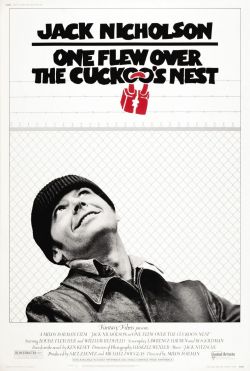
One Flew Over the Cuckoo’s Nest. Fantasy Films 1975.
Before watching the movie:
December is Oscar Bait season and on Yesterday’s Movies, this December is for those canonized movies that have become unquestionable in film culture.
I have seen mainly seen two opinions about this movie: glowing praise for Louise Fletcher, and faint repudiation of the depiction of mental health therapy techniques, particularly electroconvulsive therapy. I have this impression of a bleak slide into despair under the oppression of a corrupt and abusive mental health system. I also think this is one of the movies that made Jack Nicholson famous (or at least one of his earliest roles anybody talks about), so I’m curious to see if he’s got his recognizable style or if he’s more of a blank slate.
The Kentucky Fried Movie. Kentucky Fried Theater 1977.
Before watching the movie:
I’ve been a little intimidated by this movie for a while because trying to read a small amount of what it is doesn’t seem to actually provide any useful information. I’ve been interested because it’s by the writing team that made Airplane!, so it seems like something that would be fun, but with a 70s R rating, I don’t know how much it will keep to my sense of what’s appropriate for my blog.
The discourse around Zardoz typically begins and ends with Sean Connery’s outfit. Nobody has anything to say about Zardoz other than how bad it is, and at this point I wonder how many people saying that have actually seen it. On paper, there are a lot of cringeworthy elements, but I have to wonder how it manages as a cohesive whole. I have to know for myself what Zardoz is like.
After watching the movie:
In 2293, most humans live in a brutal, uncivilized state. A chosen few are selected by their god Zardoz, a flying stone head, to use weapons to exterminate the rest, in the belief that humans only destroy nature in their existence. Zed, one of the Brutals, hides inside the stone head to gain entrance into a Vortex, a utopic village of the elite Eternals who control the Brutals and force some of them to grow crops for them. Almost immediately, Zed shoots Arthur Frayn, the Eternal in control of the stone head and Zardoz identity, and Frayn falls to a death below. However, Eternals have developed a life without natural aging, where those who manage to die are immediately reconstructed in new, identical bodies. The scientist Consuella and her assistant May capture and pacify Zed with telepathy in order to study him and subject him to menial labor within the community. Another Eternal, Friend, plans to use Zed to overthrow the social order the Eternals have been imprisoned in for hundreds of years. But none of the Eternals suspect that Zed is not as mindless and savage as he seems.
At least in the British Isles, there was often a dreamy, new-age aspect to science fiction in the 70s. I feel like, by watching this movie, I’ve seen several episodes of “The Prisoner”. And I think I would have rather watched The Prisoner. This movie is full of trippy visuals that don’t make much sense, trying for something more artful and psychedelic than representative. Everything hinges on crystals, video projection is used to paint walls and people, and everything in the world of the Eternals that isn’t straight out of an 1800s Irish countryside feels so technologically advanced as to be indistinguishable from magic.
The other aspect that came to dominate 70s movies was an overindulgence in the evolution of social mores caused by the sexual revolution. This movie sets up a society of haves and have-nots where the haves are as repressed and oppressed by their lifestyle as the have-nots they distantly rule over, but rather than explore that very much, it would rather exult in explicit assault and meditate on the collision of raw sexual power with a world that has bred reproduction and desire out of itself. I don’t think there’s a single woman in the movie that doesn’t spend at least a third of her screen time topless. The result is both deeply uncomfortable to watch and dramatically disappointing.
There is also an incredibly frustrating mix of over-explanation and drawing out mysteries so long the viewer decides they aren’t important. I finally found something really interesting to watch in the third act, when Zed begins to really develop into his full potential and explain his intentions, but the mysteries and tensions that set that up are so buried by exploring the Vortex and the pretenses for nudity that it affords that I had thought that Zed’s origins were just unimportant.
There’s an interesting spin on the kind of social commentary that’s been a part of science fiction since The Time Machine here, but unfortunately, it’s held back by the extravagances and limitations of the 70s. Maybe a modern remake could salvage this, but I’m sure it would be so different that it would be rejected as a remake. I’ve seen Zardoz, and in that knowlege, in this form, I can’t recommend others do so.





 Yesterday's Movies