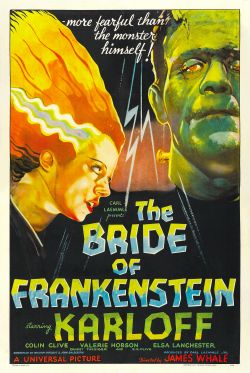
The Bride of Frankenstein

The Bride of Frankenstein. Universal Pictures 1935.

Before watching the movie:

I was never that interested in the Universal Monster Movie Universe until the last few years. They just always existed and I didn’t even learn until recently that basically every “canon” classic monster was owned by the same studio. I was particularly disinterested in the sequels and crossovers that were obviously naked cash grabs.

But much like slasher movies, I’ve come to recognize the cultural importance of these movies and feel like I have a gap without them. And not only does this one seem to have almost as much of a long shadow as the original Frankenstein movie, I’ve heard it described as when Universal’s monster movies reached a level of technical and artistic sophistication that can be said to be coming into their own. I still have a lot of gap, but I can see where the earliest movies are not quite what I think the platonic ideal of a Universal Monster Movie is.

I know there’s a new doctor making the Bride in this one. I think I read that the Monster forces him to make a partner for him, so I guess this new character is more reluctant than arrogant and maniacal.

Continue reading
Animal Crackers

Animal Crackers. Paramount Pictures 1930.

Before watching the movie:

Once again, this movie is not in the public domain yet, but thanks to being based on a stage musical, the score and song lyrics are. Though apparently not the script of that stage show, which I don’t know the legal mechanisms behind. Aside from Marx Brothers Vaudeville schtick, I don’t really know what to expect here.

When I think “Animal Crackers” and musical, I think of the song made famous by Shirley Temple, but it seems not even the song is here, let alone Temple, so I’m already going in a little disappointed.

Continue reading

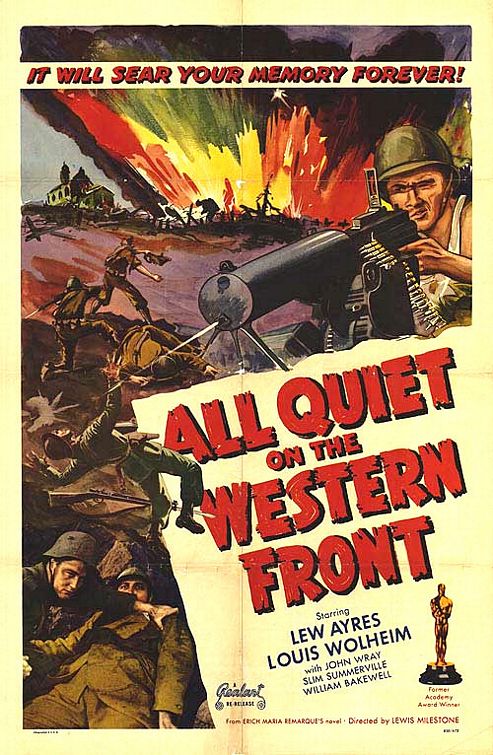
All Quiet on the Western Front (1930)

All Quiet on the Western Front. Universal Studios 1930.

Before watching the movie:

While this movie’s copyright has not expired, the book is as of this year in the public domain (and so is the original English translation, which I hadn’t realized came so quickly after). I’ve considered coming to this one a few times when an antiwar story would have topical currency, but I never made it all the way.

I mostly know only in vague terms how directly this story illustrates the hell and futility of war, aside from having heard of the scene where a protagonist kills an enemy soldier in a foxhole and, on examining the dead man’s pockets, realizes just how relatably human the “enemy” really is.

Continue reading

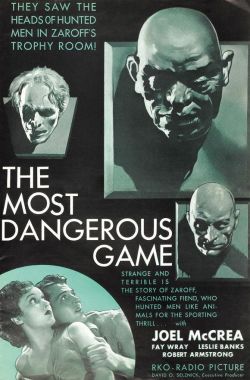
The Most Dangerous Game (1932)

The Most Dangerous Game. RKO Radio Pictures 1932.

Before watching the movie:

I recall reading the short story in high school, which is probably a very common curriculum element since it’s so widely referenced, parodied, and built upon. Short stories are often the perfect length to be adapted into movies without having to cut or add anything. But then they seem to have added a love interest because of course they wanted a love subplot. I suppose that it was more necessary because of how much of the story would’ve had the protagonist alone without someone to talk to than for time. But also a movie without a love story doesn’t seem to be allowable.

Continue reading

Nancy Drew, Reporter

Nancy Drew, Reporter. First National Pictures 1939.

Before watching the movie:

I’m not sure whether I’ve ever read a Nancy Drew story. I was probably more likely to have attempted the Hardy Boys, but neither interested me that much growing up. I was much more interested in Encyclopedia Brown.

I don’t recall a particular career or pastime being mentioned as what gets Nancy into sleuthing, and a quick skim of the Wikipedia page seems to show that she’s just a smart kid who happens to be in sleuthing distance of a lot of mysteries, like a teenaged Miss Marple. I was a little worried that by using “being a reporter” to justify her investigation into this mystery, the movie would be applying the name to a much older character, but it seems that she’s a school paper reporter, trying to win a journalism prize. Still seems like a lot of unnecessary scaffolding on “smart kid solves mysteries”.

Continue reading

It’s Love Again

It’s Love Again, Gaumont British 1936.

Before watching the movie:

While the first description I saw for this movie was just about a journalistic rivalry, the second source I saw had the more interesting information that the socialite one journalist invented to meet deadlines appears in real life impersonated by the other one. So this is much less of a His Girl Friday relative than I thought, and sounds about as wide open in terms of production as it can get.

Continue reading

The Ghoul

The Ghoul.
Gaumont British Pictures 1933.

Before watching the movie:

It never really seemed consistent to me what kind of supernatural entity a ghoul is. I kind of settled on a subtype of ghost that’s more corporeal than a spectre. I looked up the definition and it wasn’t very helpful. “A monstrous humanoid associated with graveyards and consuming human flesh” is broad enough to include zombies, only this is from pre-Islamic Arabia instead of from Haitian Vodou.

In this movie, Boris Karloff comes back from the dead to get revenge on those who wronged him, but I don’t think he eats flesh, just strangles or snaps necks or something. I expect a lot of overwrought tension that comes off as corny today.

Continue reading

Mr. Smith Goes to Washington

Mr. Smith Goes to Washington. Columbia Pictures 1939.

Before watching the movie:

So, the underdog political fable. The everyday guy who comes to Congress and fixes corruption with dogged determination and fillibustering. What’s sad is that it seemed plausible then, but not anymore, and the fillibuster it hinges on is now a tool of the kind of problems this movie wants to fix.

That’s the reputation, anyway. The changed political landscape is why I’m not sure I’ll get out of this movie what was intended. Continue reading

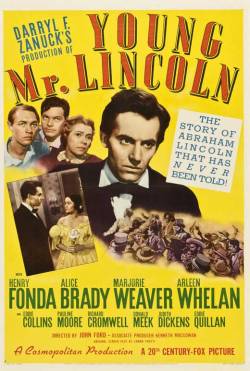
Young Mr. Lincoln

Young Mr. Lincoln. Twentieth Century Fox 1939.

Before watching the movie:

Okay, here’s one I’m completely unfamiliar with. It just came up in algorithmic suggestions, and I’m not really sure what to make of it. It occurs to me that in 1939, there were probably still people alive who had seen the Civil War, perhaps even usefully remember it.

I would not be surprised if this is a mostly fictional story suggested by Lincoln’s career as a lawyer. It looks on the surface more like a piece to venerate him than to explore a historical event worth exploring, but it’s going to be interesting to see how the late 30s remember one of our most notable presidents.

Continue reading

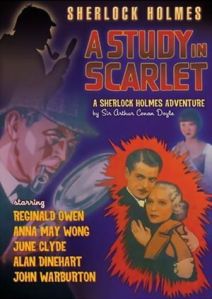
A Study in Scarlet (1933)

holmes

scarlet33
A Study in Scarlet. K.B.S. Productions 1933.

Before watching the movie:

A Study in Scarlet is, as the first Holmes story, important, but is also very unlike most other stories, in that half the book completely departs from Watson’s narrative and instead lays down motive. From another point of view, Holmes’s investigation sets up a half-novel romance on the American frontier. I’m interested in seeing how adaptations handle this oddity, though in most cases they handle it by ignoring the second part. On the one hand, it doesn’t have Holmes in it, which is the draw, but on the other, it’s the more cinematic part of the story. I have a sneaking suspicion this movie will dip into it more than most.

Continue reading