When I planned this month of the greats that I kept considering and putting off, I wasn’t thinking of the timing, I just happened to have multiple films that I kept considering as springboards to political thoughts at various times of political import. But I completely failed to consider that this November could turn out to be a month of much political spilling of ink of its own accord. That said, this specific one was not in the plan, I just remembered it when I realized there were themes among some of the selections.
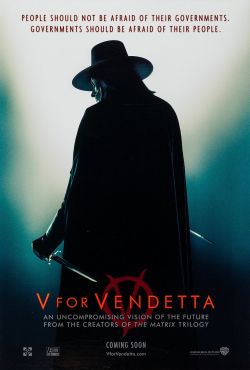
I suppose I know more than for a lot of movies going in. There’s a terrorist revolutionary in a mask instigating a revolution against a tyrannical government, there’s a woman brought into his world as a viewpoint character, a lot of people end up putting on the mask. And it’s based on a graphic novel.
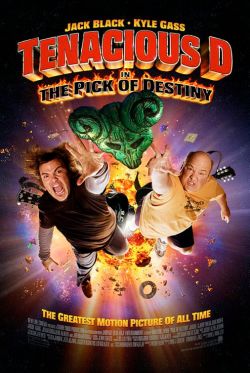
Tenacious D in The Pick of Destiny. Red Hour Films 2006.
Before watching the movie:
I’ve appreciated Jack Black’s work for a while, and while I haven’t really gotten much into his work in Tenacious D, I have heard some of their bigger singles. But rock culture, even affectionate parody of it, has not been much of a draw for me. So I really don’t have much of an idea of what to expect except rock comedy and they’re probably losers in over their heads somehow.
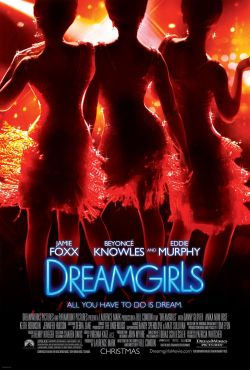
A large part of why I’ve avoided this movie is because I have always confused it with Showgirls. I don’t know much about that movie either, but I realized I was confused whenI went looking for the movie poster for Dreamgirls and didn’t see the weird leg women, a design that told me enough to stay away.
What I do know is that Eddie Murphy is in it somehow. I always imagined him as the Emcee in front of a cabaret show, but that’s because of the confusion with the other movie.
After watching the movie:
In the early 60s, the Dreamettes, a trio of Black girls trying to get a singing act off the ground, enter an R&B talent contest at the Detroit Theater. While they don’t win, they do attract the attention of Curtis Taylor jr, a Cadillac salesman angling to enter the music business. Curtis offers to try to get them the gig as the backup singers behind Jimmy Thunder Early on his tour, acting as their manager and agent. Deena and Lorrell are eager to accept, but their lead Effie is hesitant to do backup, afraid that as backup singers they’ll have a hard time stepping out from behind the star, but ultimately accepts for the benefit of her friends and her brother C.C., their songwriter. Curtis soon worms his way in as Jimmy’s manager too, supplanting his longtime agent Marty, and they have modest local success with their first single until a white artist steals the song and makes a national hit. Curtis liquidates his dealership to fund a payola campaign to get their next song on the charts while pursuing a relationship with Effie and promising her own record soon. When Jimmy’s act fails to appeal to white crowds the way he hoped, Curtis separates him from the trio, now renamed the Dreams, and plans a national music domination campaign with them, but with Deena in front as a younger, lighter, more broadly appealing face and pop-friendly voice. Cheated of her stardom and feeling physically ill, Effie is disillusioned and increasingly belligerent with the group, until Curtis hires a replacement. Having just learned that she’s pregnant, Effie leaves Rainbow Records on her own, and Deena, Curtis’s new girlfriend, is on the way up.
Apparently the best way to go into a movie cold is to mistake it for a completely different one. I have to say I was rather relieved to realize that I was thinking of the wrong movie as I watched. An exploration of the Detroit sound music industry through the 60s and 70s is much more attractive to me than what turns out on looking it up to be an even more explicit portrayal of stripper life than I realized. I have no idea why Showgirls came into my awareness about the same time as Dreamgirls. I always thought that they came out at about the same time, but they’re almost exactly a decade apart.
I thought the setting was going to be a mainly aesthetic backdrop at first. It wasn’t until “Cadillac Car” got stolen by a white singer that I started to get the sense that this was going to be a history lesson about the business. I had to read after the fact that this is directly inspired by the story of Motown Records and the Supremes, but I probably could’ve gotten a clue from the obvious Jackson Five pastiche we see a few times as an example of a Rainbow Records act not directly involved in the plot.
I wasn’t sure how well Eddie Murphy was going to fit, especially with the setting, but he can take a turn for the dramatic so well it’s a surprise he doesn’t do it more often. He turns out to play a manchild in a serious world perfectly, and sings so well you wouldn’t know his earnest solo discography is often called forgettable at best (though he does do a lot of singing in comedy, come to think of it). I also don’t really think of Jennifer Hudson as a singer, and so I was surprised her credit here was “introducing”, but apparently she’s considered a singer before being an actor. And then on the other end of the spectrum, I was blindsided to realize that Deena was played by Beyonce. She disappeared completely into the role. However, even among all these luminaries, my eyes were always on Jamie Foxx when he was in the scene, quietly becoming the villain. I was also pleasantly surprised to see Jaleel White in what turned out to be a smaller role than I thought right at the beginning. I’m sure he’s been doing things since playing Urkel on Family Matters and Sonic on the 90s Sonic the Hedgehog cartoon (something I only learned a few years ago), but he hasn’t been nearly as visible, so it’s nice to see him getting to have something like a normal career after the national fame/infamy.
One thing that’s always interesting with musicals about show business is how they balance the songs that are happening because a character is actually singing and songs that are happening because it’s a musical and characters get to sing. The first song that isn’t initiated by someone being on a stage, behind a piano, or in front of a microphone happens about 30 minutes in, by the point I’d assumed there weren’t going to be any non-diegetic songs. Even so, almost every in-world number is thematic to the moment it takes place in, though they can get taken out of context and re-arranged for plot reasons too. C.C. is actually increasingly frustrated with Curtis ruining his songs by changing the soulful tune he had in mind into something poppier, but every one that Curtis changes is mostly just “yeah, that’s a different way to do that song and I can kind of tell it’s more dazzle and less heart”. The two changes that are calculated to hurt the most are “One Night Only”, which, while it’s an arrangement that takes it into a different mood, the real turn is how the meaning is turned on its head just by flipping a pronoun from “you’ve got one night only” to “I’ve got one night only”; and the theft of “Cadillac Car”, which manages to ruin the song entirely, as if drowned in mayonnaise.
I’m coming to notice how much I appreciate stories told across decades so we can see how people change in the long term. I’m not sure the characters change so much as the historical environment they’re in, but that’s also fascinating to watch unfold in over ten years. The songs and intrigue are a lot of fun, but it’s also just fascinating to see the world they live in evolving and how they adapt to fit in it. The songs, while really well done, are already kind of fading from my memory, but the trek through music history is what’s sticking with me from this movie.
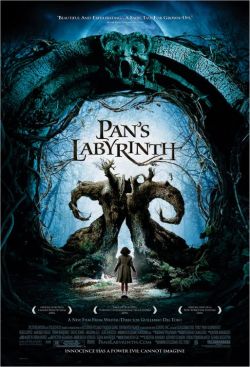
I never really had much interest in this movie when it came out. It looked like a horror movie thanks to the prominence of the Pale Man and I did not do horror movies even in 2006. This is the movie that made me aware of Guillermo del Toro as a filmmaker and probably most others, especially in this country. But mainly what I could say about it is that it appeared to be fantastical and dark story with a lot of fantasy production design and monsters.
I have a dim recollection of there being some buzz that this big budget tentpole movie is entirely in Spanish but I couldn’t have named it as a thing I knew about it until I was reminded very recently. In the past few weeks I’ve been watching a Latin American TV show and I’ve been impressed with how well I can follow it at this point in my learning of Spanish and I thought it would be an interesting exercise to do a month of non-English language movies.
After watching the movie:
Once upon a time, it is said that Princess Moanna was so consumed with curiosity about the human world that she went to see it for herself, was struck blind and amnesiac by the sunlight, and died, but her father, the King of the Underworld, believing she would return, built labyrinthine portals around the world for her and swore to wait until the end of time if necessary. In 1944 Francoist Spain, Captain Vidal of the Francoist forces mopping up the last republican rebels, summons Ofelia and her pregnant mother to his post so that he can see his son as soon after birth as possible. Ofelia detests Vidal and refuses to call him her father, and tells the fairy tales she’s obsessed with to her unborn brother to calm him through the difficult pregnancy. Along the road, Ofelia sees a large stickbug and believes it to be a fairy, which is confirmed to her when it comes to her room that night and transforms into a humanoid leading her into the nearby labyrinth to meet a faun that tells her she is the reincarnation of Princess Moanna, and if she completes the three tasks a magic book will only reveal to her when she’s alone, she will regain her immortality and return to her throne. The rebels Captain Vidal viciously persecutes seem to have unusually good help in the region, and it transpires that the captain’s housekeeper Mercedes and the doctor Vidal brought to save his son and if possible also his wife are secretly supplying them with food, medicine, and information. Ofelia becomes aware of this but doesn’t report them, as she can see that Vidal is cruel and not on the side of right, but also she’s more focused on her escape from this life into the world of the fae.
The duality of this movie feels like more of a hindrance than a strength. On the one hand, there’s the fairy tale story that’s very expertly rendered on screen but which I didn’t find very compelling because it’s a (graphic and gory) fairy tale with pretty standard tropes, and on the other hand, there’s the story of the dictatorship’s rebel-hunting captain and his hypocrisy and hubris against the desperation and risk-taking of the rebels under his nose, which I was much more taken with because of the more grounded humanity vs. fascism plot. Captain Vidal is a despicable villain you really want to see get defeated (which I suppose is the modern fairy tale), but the fairy side of the story is a few episodes of monsters and tricks and I found the only real tension to be how the human world plot that’s too big for Ofelia to affect but only respond to and escape from would interfere with her fantastical hero’s journey.
Del Toro’s insistence on producing this movie in Spanish means its cast is full of actors that are completely unfamiliar to English-speaking audiences. I wish I knew more of López, Verdú, and Angulo’s work. However, I simply don’t have enough to be able to really speak to their performances, other than that I was always watching López and Angulo whenever they were on the screen and as I came to realize the importance of Mercedes I watched Verdú closely too. The actor I do know is Doug Jones. In a movie otherwise filled with Spanish actors, Del Toro selected one of the best big-creature workers in Hollywood. As a very tall and flexible performer, his career has been almost entirely buried under latex and it seems more often than not dubbed over by other actors with bigger names. An alum of my school, he came back to star in a student film as a regular guy and when I learned who he was, I was very happy for him to have the chance to play just a regular guy, even if outside of Muncie, IN it’s one of his least known films (he does appear to have had other work without prosthetics, but also lower profile than his creature work). He learned Spanish to play the Faun, but was dubbed here too, though his work made the dub work better than if he had learned the lines phonetically. I’m glad to see him getting the recognition now that he was only beginning to receive when I first learned his name.
The greatest strength of this movie is the lush visual design. The mid-2000s were a great time for sci-fi/fantasy movies because CGI was expensive enough that they only used it where they needed it, limited enough that they put in the work to play to its strengths, and new enough that they gave it enough time to get it absolutely right, while practical work was also at a high state of maturity that truly impossible things could be absolutely convincing. It was a time when they made movies perfectly suited for behind the scenes featurettes rather than filler for streaming services. I believe the Faun is almost entirely practical, but between the prosthetics, the performance, and the lighting/color grading, he is a completely believable creature you’ve never seen before. Everything in the fantastical episodes looks like a page from a lovingly illustrated storybook, and the civil war story is one of the best-looking war movies I’ve ever seen.
I wish I knew more about the Spanish Civil War, the Republicans and the Nationalists. In history as taught in this country, Spain falls out of the narrative after the English defeat of the Spanish Armada, and their contribution to 20th century history is mainly from being the only country that was documenting the 1918 pandemic. I wish I cared more about the fairy tale. There is no Pan’s Labyrinth without its fairy tale, and it’s certainly one of the most beautiful and terrible fairy tales I have ever seen, but I just never felt the tension in that side of the movie. As much as this is very likely Del Toro’s masterpiece, I think I’d rather see Hellboy or The Shape of Water again.
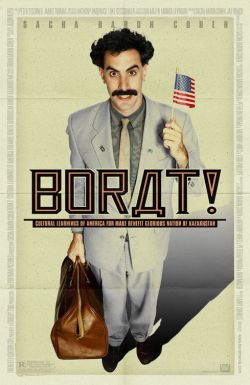
Borat: Cultural Learnings of America for Make Benefit Glorious Nation of Kazakhstan. One America Productions 2006.
Before watching the movie:
I remember this movie as something widely loved when I was in college, even though it came out a little before I began. There was also some kind of controversy about the real people in the movie being upset at being fooled into looking ridiculous.
A few years ago there was a streaming movie comedy where the scripted plot was written around setting up hidden camera pranks on bystanders called Bad Trip, and I thought it was the first scripted fiction/prank hybrid movie, but it seems that at the time I forgot about Borat. However, the mockumentary format of this movie makes it a bit closer to reality even if the plot is pre-written at least in the broad strokes, so it’s more conventional.
This might be the first entry in this series from my time in college. It’s not quite from after the inception of this blog, but getting very close to it. It wasn’t long after when I saw this movie when I got my first opportunity to go back and catch up on movies I’d missed. But that wasn’t the way I saw this one.
I first saw Talladega Nights because it belonged to my my freshman roommate, who set up his TV, small movie collection, and mini fridge, told me I was welcome to use all of them, and then found friends outside the dorm to spend all his days and nights with, leaving me alone with the whole room pretty much all the time. I can’t recall whether this movie got played in one of the rare times he was there or if I put it on myself in a bolder move in using his stuff, as using somebody else’s movies without their direct permission still seems like a breach to me even if blanket permission has been given (it occurs to me that I don’t feel this way about the massive movie and game collection of another roommate I had in the early days of the blog, which was probably represented multiple times on here). I’m pretty sure that was the only time I saw it until now.
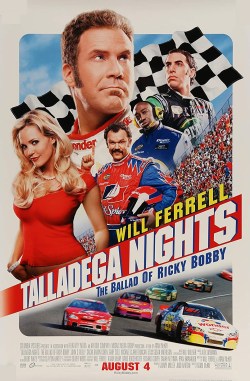
Talladega Nights: The Ballad of Ricky Bobby. Mosaic Media Group 2006.
Born in the back of a speeding Chevelle, Ricky Bobby grew up not knowing his father, who left to race cars and do more shady things, which may have imparted his obsession with speed to him. Ricky only saw his father once in his childhood, making an unexpected and ignominious appearance at his class’s Career Day, but he left him with the dictum that “if you’re not first, you’re last”, a phrase Ricky went on to model his life on. Without many career prospects, Ricky found his way into the pit crew for Dennit Racing, finally getting his opportunity to enter a NASCAR race as a replacement for the driver who walked out in the middle of a race while in last place, and Ricky proves himself by finishing third, becoming a racing star. Backed up by his best friend Cal driving Dennit’s second car, who always gives him the assist to get to first, Ricky quickly achieves a life of fame and fortune, living in a mansion with Carley, the smoking hot fangirl he married, their two disgracefully disrespectful sons, and Carley’s father who impotently disapproves of how his grandkids are being raised. Ricky’s maverick driving style makes him a fan favorite, but costs him with the sponsors and the tournament judges, and therefore does him no favors with the new head of Dennit racing, Larry Jr., who hires openly gay Frenchman Jean Girard from the Formula One circuit to be his new, dependable lead driver with European precision. Ricky’s jealousy overwhelms him, causing him to crash and have a psychological breakdown that endangers his ability to ever be able to get behind the wheel of a car again.
This felt really raunchy at the time, but while it’s still kind of raunchy, it doesn’t feel like that’s an exceptional thing. I think the raunchiness largely comes from how it’s both a parody of the contemporary machismo but also kind of an earnest celebration of it. It feels entirely a product of its time, but no moreso than in the jokes about Girard being gay. This is tempered by Girard being revealed to be an honorable guy looking for an equal on the track and definitely a much more rational person than Ricky, but the jokes still significantly Other him. It occurs to me now that by being gay and European, Girard is specifically designed to be the antithesis of the NASCAR stereotype and the American nationalist cultural moment that NASCAR was a significant component of at the time. His being French is probably targeted at the specific distaste for the French after the country refused to support the US in doing some post-9/11 lashing out.
While the extreme farce style can easily get out of hand in a bad way, there were still plenty of laugh out loud moments. Its extremely contemporary nature probably keeps it from being as timeless as Anchorman, but it’s still a lot of fun. It’s not something I would come back to a lot, but I can see occasionally revisiting it to get my expectations exceeded again.
I think the main reason I was never especially drawn to this movie was because I’m not that into fashion, but then movies can be themed around anything without requiring intimate knowledge of them. And maybe it was also something that didn’t appeal to me because it’s a women-oriented movie and I wasn’t as interested in those in 2006.
I do vaguely recall it being among the movies that I first got a real glimpse of what’s interesting about it at the Academy Awards that year, but like most other movies that I never really considered until the Oscars showed me more than any trailer did, I never really followed up.
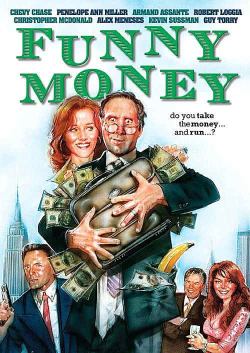
I had an impression that Chevy Chase completely disappeared from whenever he left the Vacation movies in the 90s until the late 00s, when he suddenly resurfaced in Zoom, a Tim Allen vehicle about a retired superhero, and on Community. Apparently what he was actually doing at the time was starring in German/Romanian adaptations of British plays. An American company was also involved, but I sure don’t recall any significant American release.
Part of the original concept for this blog was revisiting movies that I missed when they came around. I definitely remember Monster House being around in 2006. I think I even went to a theater for a different movie while this one was being screened there. I think it looked like more horror than I wanted in a movie at the time, but I can see more clearly now that it’s a children’s scary adventure movie.
I also have vague memories of it coming up in connection with the entertainment news show I worked with all through college, but I would have only started there over a year after it was released.
This seems like a strange pairing for a movie that seems to want to be known as a pensive romance. Reeves and Bullock headlined Speed as well, but that was an action blockbuster, which they’re both better known for.
Similarly to how I was wondering how the original source of You’ve Got Mail got things going without the weird social construct of anonymous chat rooms, it’s my understanding that the central concept here is that they send letters to each other, but they’re in the same place a few years apart. I’m again curious to see how that gets started, but also how it can be sustained.





 Yesterday's Movies