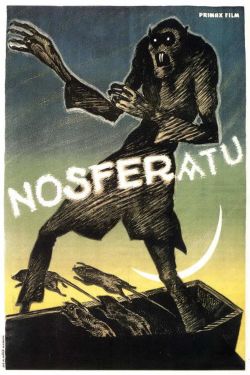
I’ve long known that this was the Dracula movie before Dracula, and managed to get some acclaim here even if it was in German (although or perhaps because it’s silent and therefore easier to translate). I don’t know offhand how much the extreme looseness of the adaptation was for copyright reasons (which, internationally, was still extremely loose at the time anyway) and how much was localization and the contemporary constraints of how stories were told on the silent screen.
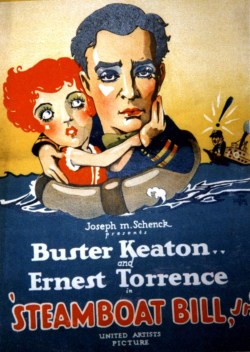
I didn’t really have any interest in this movie until very recently, though I had been aware of the title. It always seemed a little odd to me that Buster Keaton had at least two movies with “Junior” tacked on to them, and as I was disappointed that Sherlock Jr. didn’t have any connection to the Great Detective other than the protagonist being a detective enthusiast and dreaming himself into a detective adventure and didn’t even get the reference being made to “Steamboat Bill”, I never bothered. Until I learned about its connection to “Steamboat Willie”.
This is a particularly momentous year for the Public Domain as, after buying an extension of copyright law multiple times to prevent it, “Steamboat Willie” and therefore at least the early form of Mickey Mouse has lapsed in copyright and now belongs to everybody. What I didn’t know was that the title of that short was a reference to the song “Steamboat Bill”, and there is debate whether Keaton’s movie was an inspiration for the short, as they were released the same year. Apparently the copyright of this movie was not renewed and so expired in 1956, but the connection certainly got my attention.
It seems strange that works entering the public domain is now an annual thing, as it’s been frozen for most of the part of my life I was aware of such matters. Is this really the sixth year of welcoming new works into common ownership? It seems like only the third, but I distinctly remember being inspired to cover Safety Last! because its copyright was expiring and that was indeed 2019. I’m going to be exploring the Public Domain Class of 2024 this month. Not every movie will itself be owned by the commons, but there will be a connection in every case.
I remember enjoying Modern Times, The Great Dictator, and to a lesser extent, City Lights (which I remember more as good cinema than good comedy), but I’m not sure I’ve ever really considered Charlie Chaplin a favorite, aside from the speech at the end of “Dictator”. As he’s one of the early film personalities that were bigger than their films, all of his works seem to blur together for me, and I’m not as motivated to see a Chaplin film as some others, so I didn’t even know this existed before it came up as among the most celebrated works whose copyright expires this year. I don’t even know what to expect other than “probably Tramp antics.”
The machinery of the Public Domain has shuddered back to life and as with last year, new works are transferring ownership to the people. Perhaps most notably, the copyright on the final Conan Doyle Sherlock Holmes stories finally expired, so it will be entertaining to see what shaky legal argument the Doyle Estate will come up with to try to continue to get money out of Holmes now. Also joining the Public Domain is The Jazz Singer, which has an enduring technical legacy and, I hear, little else to recommend it.
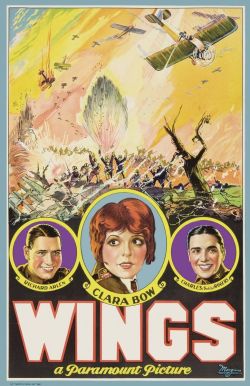
But the member of the PD class of 2023 that I’ve heard the most praise for is Wings. While I don’t recall hearing of it before now, it has not only a good reputation in story but also very impressive aerial cinematography for its time. I’m strongly reminded of Those Magnificent Men in their Flying Machines, so much as I remember anything about it. While that movie was set in the first world war but made in the 1960s, it will be interesting to see how the 1920s retold WWI.
While this is Soviet propaganda, it’s also considered a highly influential piece of cinematography. It got mentioned in my film studies class and we saw a clip of some metaphor-driven editing, but the main thing I remember is that it was briefly mentioned that this movie doesn’t have a traditional protagonist, but is focused on the collective actions of the crew, and because of how steeped I am in individualist Western hero narratives, and especially American big damn hero narratives, I have a hard time imagining how such storytelling can work. But after a lot of “one man in the wrong place at the right time” action movies lately, I’ve developed an interest in seeing what a movie that refuses to put any one person in the spotlight looks like.
For the first time in 20 years, works copyrighted in the United States are entering the public domain, after being put in a freeze by the Copyright Term Extension Act, because who cares if everyone who participated in creating these works are probably dead by now when there’s still profit to be had? Well, as of the beginning of the month (January 2019), works published in 1923 have finally had their copyrights expire, and among them is this iconic film that nobody seems much interested in the plot of.
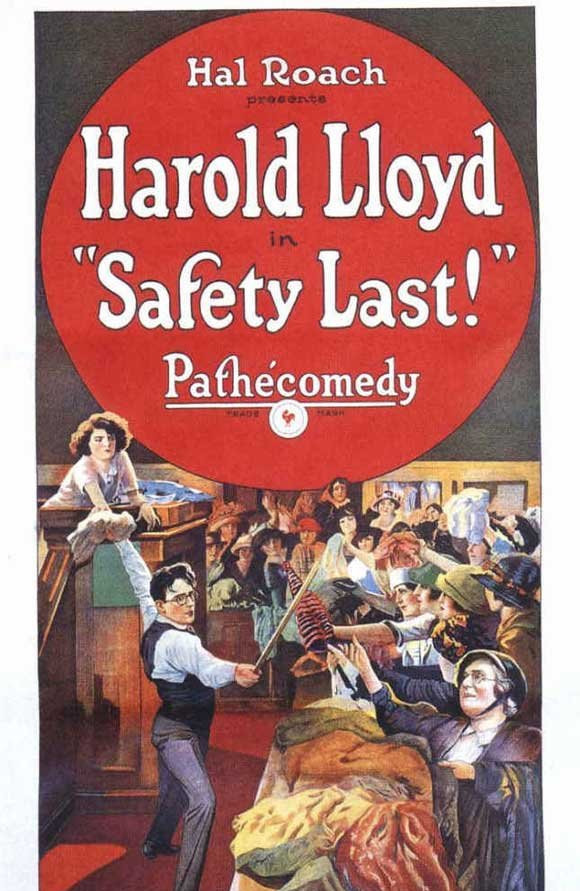
To be fair, the stunts and slapstick routines are likely more the point of the movie than the story they’re hung upon, but as far as I can tell without reading too far ahead, this is the story of a young man’s misadventures in becoming respectable enough for his girlfriend to marry him. The reason everyone talks about it though, is because of the iconic, very real, and dangerous scene where Lloyd hangs from a clock, which has been homaged endlessly. To me, and probably others, “a man dangles from a clock hand” is a Back to the Future reference, but when Christopher Lloyd did it, the filmmakers were referencing Harold Lloyd. But there’s still a lot of story to get to that point.
After watching the movie:
Young Harold gets on the train from his small town to go to the big city and make his fortune, promising to send for his girl to come and marry him when he’s done so. Big city living is hard, and money is scarce, especially since Harold is buying expensive jewelry to send home for the purpose of keeping up a narrative that he’s doing better than he really is, working as a harried sales clerk at De Vore’s department store living paycheck to paycheck. One day, Harold runs into an old friend from back home who’s now working as a policeman, and tries to show off to his roommate Bill that he can get away with messing with policemen. Unfortunately, Harold and Bill then proceed to prank the wrong policeman, who chases Bill up the side of a building and swears to arrest him if he ever sees his face again. Meanwhile, Harold’s mother suggests to his girl that if he’s got enough money to be buying her jewelry, it’s not safe to leave him alone in the city. Trying to keep up the charade in person now, Harold needs something big to secure his fortune in a hurry. Perhaps a daredevil scaling the 12-story building, sponsored by De Vore’s?
Though the plot is thin and mostly moves from setup to setup while laying the foundation for the climb that makes the final act of the movie, it’s fairly cute in execution. Aside from the climb, the physical comedy isn’t of the remarkable spectacle that I’m used to from Keaton and Chaplin, but it’s entertaining, and often clever.
From the legend of the clock-hanging moment, I was a little let down by its significance in the moment. It’s just one more gag in the climbing sequence, and one or two other moments seemed more precarious. The drama of the moment has been rendered obsolete by iteration. Harold Lloyd dangling from the hand of a clock six or seven stories above a city street doesn’t thrill me because every homage since has been made more dire through increasingly modern techniques.
The rest of the movie is, while not a monumental work of cinema, as suggested by how much people remember the plot leading up to the climb, a charming romp that does what it sets out to do, and is a perfectly good way to pass 70-odd minutes. But the moment it’s remembered for doesn’t live up to the hype anymore. It stands out only in relation to what came before it, but most of what I know is what’s come after it. The legend is bigger than the film.
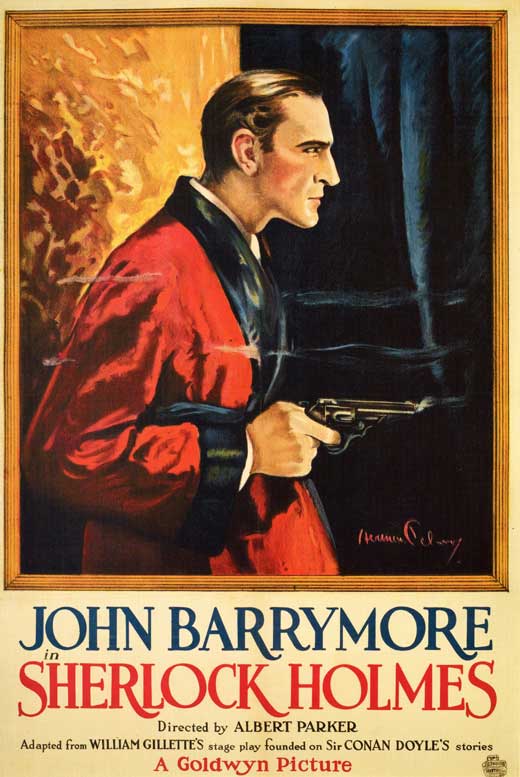
Sherlock Holmes (/Moriarty). Goldwyn Pictures Corporation 1922.
Before watching the movie:
I was somewhat concerned to see that this movie is also silent and based on the Gillette play, but a glance at the first paragraph of the synopsis tells me this is definitely a different adaptation. Not being familiar with the text of the play I can’t say if the differences were added to this production or subtracted from the other one. This looks hopefully more engaging.
When I first attached a disambiguating year to a title, I never expected to do two movies with the same title back to back. I can’t say it’s just because there were fewer movies to get confused with back then, since even the past decade has seen multiple productions simply titled “Sherlock Holmes”. So it’s worth noting that in Britain it was titled Moriarty.
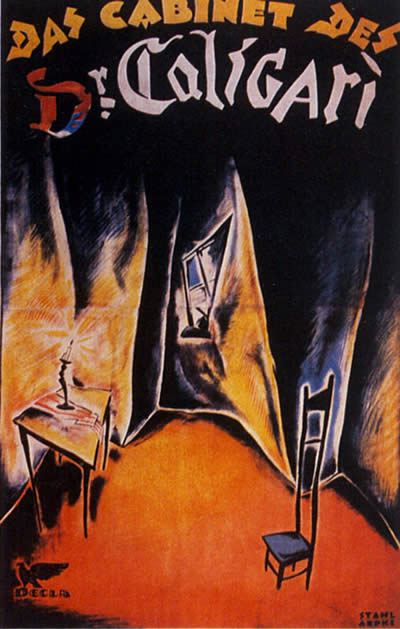
The Cabinet of Dr. Caligari (Das Cabinet Des Dr. Caligari). Decla Film 1920.
Before watching the movie:
I find it a fascinating idea to tell a psychological horror story, framed as a man telling his story of how his life was ruined, in a silent medium. There seems to be so much language wrapped up in that concept, and yet a silent film will necessarily tell the story visually and use cards only sparingly. It has the potential to go very wrong, yet from its legendary status I know that’s probably not the case.
It also looks like it’s doing some tremendous innovating in stylized cinematography. I couldn’t imagine trying to communicate exotic psychological events with what was available in 1920s technology, but the example frames look like they’re creating some very artistic effects.
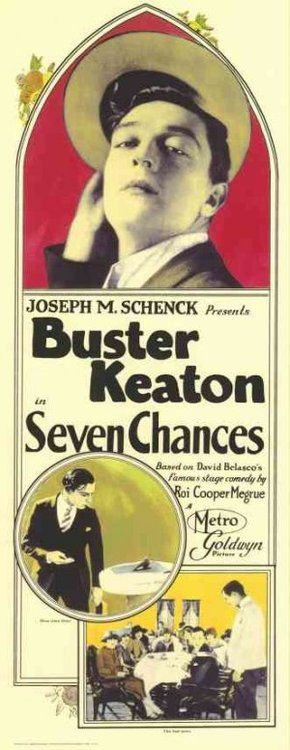
Buster Keaton is possibly the most enduring silent film personality, next to Charlie Chaplin. Few have made and starred in so many silent films that still get counted as great entertainment now.
This one is probably one of them. Unlike The General and Sherlock Jr, I think I’ve only encountered this as a heavily represented modern release of Keaton’s body of work. So it’s well known on the silent film shelf, but I don’t know of any buzz outside it.
The basic story appears to be an heir who must get married to receive his fortune getting mobbed by gold-digging suitors. Which would provide plenty of fodder for slapstick, and I’m not sure if there will be time for much else, though it’s apparently based upon a play. I wonder what the result will be in the translation from a dialogue-driven medium to a purely visual one.
I got this in a box set of early Alfred Hitchcock films, which indicated it was Hitchcock’s first thriller. I’ve seen it described elsewhere as when Hitchcock came into his own. But I don’t know much about it beyond that it’s about a serial murderer and it’s silent.
I haven’t covered many silent films. I don’t dislike them, but they don’t usually attract me unless it’s something historically significant like The Birth of a Nation. Lack of color often enhances the tension in a movie, but I’m not sure if lack of sound will do the same or be a barrier to connecting with it. I’m expecting it to help though.
I have a hard time picturing a Hitchcock film without sound though. He does a lot of advanced camera and narrative techniques, and when I think of technique in the silent era, I think more about pioneering the basics than doing anything that can impress in its own right. I recognize this is patronizing, and I’m hoping this film will defy that notion.





 Yesterday's Movies