
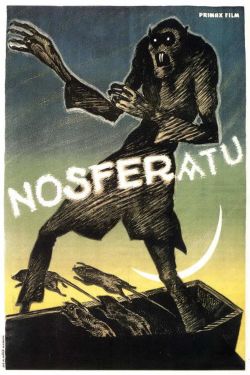
Before watching the movie:
I’ve long known that this was the Dracula movie before Dracula, and managed to get some acclaim here even if it was in German (although or perhaps because it’s silent and therefore easier to translate). I don’t know offhand how much the extreme looseness of the adaptation was for copyright reasons (which, internationally, was still extremely loose at the time anyway) and how much was localization and the contemporary constraints of how stories were told on the silent screen.
What I do know is how silly Count Orlock looks.
After watching the movie:
Young estate agent Hutter lives in the town of Wisburg with his young wife Ellen. His employer, the devious Herr Knock, receives a demonic letter from an Eastern aristocrat named Count Orlock who wishes to buy a house in Wisburg, and Knock sends Hutter “far away to the land of ghosts” to offer him the house opposite Hutter’s own. Undeterred by all the inhabitants of a small town inn near Orlock’s castle falling fearfully silent at the mention of his name, Hutter reaches Orlock and presents the offer. After a night’s sleep where Hutter wakes up finding twin mosquito bites on his neck, Orlock signs the papers and spies Hutter’s pocket photograph of Ellen, commenting on her “lovely neck”. Back in Wisburg, Ellen begins sleepwalking, and has a vision of Hutter being menaced in his sleep by Orlock. The next day, Hutter explores the castle and is horrified to find the coffin Orlock sleeps in during the day, later witnessing Orlock loading many coffins full of dirt and concealing himself in the last one before they are shipped out, which spurs Hutter to escape the castle to go home and warn Wisburg. However, with Hutter traveling on foot and Orlock on a double masted schooner, an epidemic of “plague” soon befalls the fair town.
When I watched Dracula a few years ago I was not as familiar with the novel as I am now, so it was a very interesting exercise to see how an adaptation that feels no compulsion to present itself as faithful to the original takes elements and remixes them. I did feel like a lot of the best plot elements were removed, and in fact, where the movie ends is where I consider the book to be just reaching full steam. However, as much as I like the victory though cooperation, research, and tenacity of the novel, I can also respect the melancholy beauty of the solitary sacrifice this movie exchanges it for. There was certainly more room for working out a solution than just being handed the whole thing on the page of a book, but I can see how a person putting pieces of a plan together can be difficult to convey in silent film.
The whole movie seems to be built around slowly increasing the dread, to the extent that all of the excitement is in the moments of reveal of how things are getting worse. As a result it’s pretty low energy until the climax, but by the standard of its time, not that slow.
I can certainly see how Orlok’s design is meant to be terrifying, and probably was, a hundred years ago. But I just find the sum of his parts to be comical. His gigantic claw hands are cartoonish and his bug eyes and protruding teeth add up to a fixed expression of dull confusion. I could yet again chalk this up to the simpler time and less developed art, but I wonder in this case if the choices made wouldn’t work better on the stage, where they have to play broadly to come across to the back row. I’m not familiar with all of the design elements that are said to be antisemitic, but while I do think it’s possible that was just as accidental as a lot of villain-coding is today, I also can’t say that the director Murnau being homosexual is a compelling argument that he couldn’t be antisemitic, as there are unfortunately a great many individuals from oppressed groups whose response to being oppressed is not solidarity with other marginalized groups.
I only really dropped my reading of this film as an almost note for note Dracula adaptation when I realized it was almost over and most of the book was left. I think I’d have to see it again to better appreciate it for itself. I think this story could be told very effectively and less directly dependent on Bram Stoker today (which is good because the name has brand recognition and that’s all it takes to sell a project now), though for me this version is a little oversimplified. The disappointing thing about influential film history is that the thing that made it influential becomes part of the DNA of everything that comes later, and so going back to it, nothing feels original.

