
Before watching the movie:
Among this month’s selections I guess this isn’t the most widely watched. But I still consider it formative to my cohort. Everybody knew about the Gay Cowboy Movie. Many were not kind. But I think the fact that it existed, that it challenged masculine images, and came from a major studio with big name actors, affected our perspective, even if not all at once. The world was changing, and this was part of the background radiation in the course of that change. Almost two decades later, I don’t think anything about this premise seems nearly as controversial as it did back then. Is that representation in action? Is it the confirmation of culture warriors’ fears? Maybe it’s both, or maybe neither.
After watching the movie:
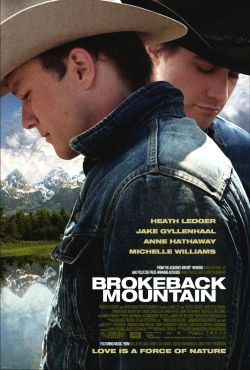
Itinerant ranch hands Ennis Del Mar and Jack Twist take a summer job for Joe Aguirre, a rancher who needs his sheep watched on Brokeback Mountain in Wyoming for the 1963 season. Aguirre wants one to stay in the shelter the Park Service apportioned for a ranch hand, but as the shelter is too far away from the sheep, he wants another hand staying with the sheep and dogs secretly. On the mountain for months with almost no other human contact, the taciturn Ennis slowly begins to befriend Jack, and in a night of drinking, Jack talks Ennis into having sex in the tent. Ennis insists the next day that it was a one time thing, but their relationship turns romantic and sexual for the rest of the summer, before they end the job in a fistfight and go their separate ways, expecting never to see each other again. Ennis marries his fianceé Alma, promptly has two children, and consistently fails to be there for them because he’s always working and broke. Jack returns to the rodeo circuit and marries a rider whose father is a wealthy ranch owner, but his marriage is empty. And then Ennis receives a letter from his old “fishing buddy” Jack asking if he should come for a visit. Soon Ennis and Jack are making multiple trips a year to Brokeback to “go fishing”, though Ennis refuses to take the risk of making a life together, and meanwhile their marriages wither from neglect.
I was always curious how the two “not queer” cowboys fell in love, and I still don’t feel like I fully understand the turning point of their relationship. The story is more concerned with the trouble they face trying to continue to live their lives in rural Cold War-era America while also unable to shake the fact that the closest, most fulfilling romantic relationship they’ve ever had was with another man. I pick up Jack’s homosexuality pretty clearly, but from what I can tell, Ennis was never interested in any man but Jack, and that’s a significant source of his conflict. I grant that others may see Ennis as being deeply in denial about himself due to his upbringing, but I don’t see it that way. His arc isn’t about accepting himself, it’s about accepting the people who love him into his life and allowing himself to have relationships at closer than arm’s reach.
I think I’ve now seen three Heath Ledger movies, and I wouldn’t be able to name any others. Certainly, his star was only just rising when he died, but this is the movie that brought him to my attention, The Dark Knight made him a legend, and then The Imaginarium of Doctor Parnassus was his unfinished last film, and I’m sure there’s more career there than that. I went into this wondering why he was forever marked by this movie in a way that Gyllenhaal wasn’t, and I think it’s just because Gyllenhaal was already a well known lead before this movie and continued to have a notable career long after. Maybe if Ledger had lived we wouldn’t remember him so much for his one. But also he’s much more the lead than Gyllenhaal is. This is Ennis’s story, Jack is more the problem Ennis has to deal with.
The understated way this story is told creates a richness for those who are invested. There are some story points that I didn’t fully pick up on, and others that I think I picked up on that didn’t seem to be important to the Wikipedia summary. I often complain that a movie is presenting a bunch of events without sufficiently connecting them or that it’s holding the audience’s hand too much and overexplaining everything, and I’m coming to suspect it’s a matter of direction, cinematography, and editing. This movie includes subtle details you might miss because they’re not in the dialogue, but the camera tells you what’s significant about what’s happening. I never thought much about how Ennis is always picking up his mail from the post office until the camera made me notice the last scene beginning with him setting up his mailbox by lingering on a closeup of sticking the numbers on. From that one choice, I picked up on a huge amount of characterization.
I was going to say this movie’s subject matter isn’t anything special anymore but I don’t think that’s quite true. Movies like it that came after have their special box they can get put in where they’re safely out of the way. Movies before it were either couched in subtext and metaphor or quietly buried. This burst out into the mainstream and everyone had to reckon with its existence, even if they refused to see it. It’s not a plea for tolerance, it’s a story about enduring what one cannot change. And in my opinion, the fact that it exists and refuses to hide is admirable, and moved the needle in its own way.
 Yesterday's Movies
I knew there had to be at least one I was forgetting! I just got a reminder that A Knight’s Tale had Heath Ledger as one of the leads. But I stand by this movie being the one that made me aware of his name and existence.