
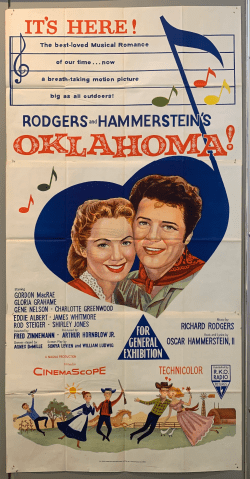
Before watching the movie:
I have no idea what this is about, other than that it’s set in Oklahoma in the 19th century and has a lot of songs that have become standards with lives of their own, maybe more than any other.
I guess it’s a love story on the prairie? I have nothing to go on but those famous songs. It’s almost certainly going to have a lot of scenes outside for the purpose of taking advantage of being a movie and no longer a stage play, but how much will that actually matter?
After watching the movie:
Cowboy Curly McLain has a prickly relationship with Laurey Williams, farm heiress. They both take quite a lot of sport out of knocking each other down a peg, and while neither of them would admit affection for each other, they are both secretly fond of one another, something that Laurey’s Aunt Eller, the widowed owner of their farm, can plainly see. Everyone in the region is excited about a box social being held in the evening, and Curly comes to suggest that Laurey go with him in a fancy wagon he will be renting, but Laurey already accepted the invitation from her hired hand Jud. Jud is a simple, brutish kind of man, but when Laurey starts to think about breaking off with him to go with Curley, Jud’s response suggests it would be dangerous to disappoint him. Meanwhile, Will Parker, another cowboy, has just returned from the fair in Kansas City and, having won a roping contest, now has the $50 his girlfriend Ado Annie’s father said he wouldn’t be allowed to marry her without. But while Will was away, Annie, a fun loving, variety seeking girl, has been taking up with the traveling peddler Ali Hakim, a man who is clearly in a habit of leading on girls with promises of marriage he doesn’t intend to keep. Annie’s father, especially keen to keep Will from marrying his daughter, pressures Ali to marry her instead, and Ali starts searching for any way out, like helping Will press his agreement with Annie’s father while trying to also keep his intentions from Annie, though Will has his reservations about marrying so flighty a girl. As Jud and Laurey drive to the box social, Jud tries to force a kiss on her, and she wrestles him away, whips the horses into a bolt, and takes off for the dance alone, with Jud swearing not to let her be rid of him so easily.
Early in the movie, I felt like none of the songs were really doing much to build the plot, but somehow I didn’t care as much about that as usual. Maybe it’s because the stakes were relatively low and the songs were familiar, but for a long stretch of the movie I was happy to let the story take a back seat to yet another song painting a picture of romanticized, whitewashed rural life in the Oklahoma territory. I only particularly felt they should be getting on with it during a couple of incredibly lengthy dance numbers. By the time we get to the box social the plot has finally fully engaged, and I was fully engaged with it. However it’s weird the lengths the movie went to to make sure everyone knows within Code decency how violent and perverted Jud is and then treat him as so minor a complication to Curly and Laurey’s romance that the fight that finishes him for good is pretty much over the minute it begins, and Curly has no figurative blood on his hands whatsoever.
I have tags for some of these actors so I must have seen them in other things (I particularly remember the name Gordon MacRae but I couldn’t tell you what I’ve seen him in). The one exception is that I knew the Persian peddler Ali instantly as Oliver Douglas of Green Acres, Eddie Albert. His accent is all over the place and I’m not sure it has any resemblance to a Persian accent, but then neither is his appearance, and that’s par for the course with productions from this era. But knowing him from a kooky TV sitcom made it especially weird to see him playing such a rake, even if a bit of a bumbling one.
At least three songs have gone on beyond this musical. Everyone knows “Oh What a Beautiful Morning”, which is a beautiful song about not very much, and “Surrey with the Fringe On Top” is just as much a chestnut (though I was surprised that the original lyric was “Isinglass curtains” and not “clear glass curtains”. I had to look up Isinglass, but it makes infinitely more sense to call that substance “curtains”), and I was surprised how late the title song, perhaps most famous in my generation for the Sesame Street skit where the muppet keeps getting the wrong opening vowel, comes in. It’s not nearly as prominent a song as the other two, which are major recurring themes.
The story is a bit unusual, but somehow I’ve never been more okay with letting the plot slide while the show takes more interest in its musical numbers. Almost all of them are worth the time, even if they aren’t about much of anything but a mood. I’m not sure what it means to romanticize a past where just about everyone is excited about impending modernization, but on the other hand, I miss being excited about the future too, so maybe I do understand it. This is just a portrait of an idyllic day in an idyllic time, and it’s nice to be in that space for a little while.


 Yesterday's Movies