

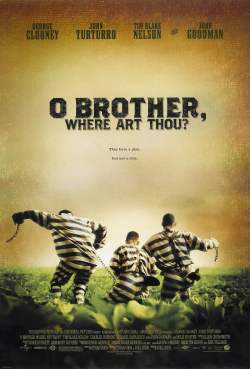
While I first watched this movie in high school, I think 9th grade English, it also has significance to me as the reason, or at least the excuse, to get Netflix. I had an assignment in a media class to analyze a scene and my group got O Brother Where Art Thou? and I used a free trial to get us a copy of the movie faster than the library could get it to us. That subscription back in the day made catching up on all the movies I’d never gotten around to possible, and while I was doing that and having opinions on them, I was looking for a creative project to put on the internet because I was also really getting into the heyday of webcomics. I didn’t think I was up to drawing a regular strip or making videos on a sustained basis at the time, but I could watch movies, have opinions, and share those opinions.
I’m glad to be able to say that in almost fifteen years, I’ve had something online every week, and I think I can still count on one hand the number that were just apologies for not even having old posts to recommend. I had a review online every week during a month where I had a full load of classes, a part time job, an assignment to write a novel in a month, and a weekly video series for my sketch comedy group’s blog. I got something up in weeks when I was moving all by myself and didn’t have internet service set up yet. I don’t remember what it was but I got something up the week I got married. I wanted to prove to myself I could stick to a posting schedule and it’s only in the last few months that I’ve had to evolve from staying up late on Thursday night to have something for Friday to writing over the weekend to have something by Monday. I’ve seen great movies I might not have gotten to without this push, and I’ve had a good excuse to rewatch movies I already loved and share why I love them.
Ulysses Everett McGill, a man with the gift of gab, leads his fellow convicts Pete and Delmar in an escape from their chain gang with the story of loot from a heist that he buried back home in a place that will be flooded to build a dam in just a few days. They go to Pete’s cousin for help, who immediately turns them in to Sheriff Cooley for the bounty, barely escaping the barn Cooley’s men try to burn them out of. Picking up hitchhiker Tommy Johnson, who says he sold his soul to the devil for guitar talent, they stop at a radio station where “a man will pay you to sing into a can” and record a song for some cash under the name “Soggy Bottom Boys”, then part ways with Tommy again. The gang is separated when some women at a river washing clothes drug them and when they wake up, they find Pete’s clothes laid out with nothing but a frog inside, and assume that they turned him into a frog, when really he’s been turned in for bounty, and confesses the location of the treasure under torture. Meanwhile, Everett and Pete arrive in Everett’s hometown and Everett meets up with the real reason he escaped from prison: his ex-wife is remarrying. All the while, the governor’s race is coming up, with the reform candidate Homer Stokes running a much more popular campaign than the incumbent, flour mill owner, and radio show host Pappy O’Daniel, and the people can’t get enough of that Soggy Bottom Boys record.
Even on this viewing, I can’t really tell how much was directly pulled from The Odyssey. There are the most obvious allusions, but they seem fairly superficial. Most of the misadventures along the way don’t seem to map to specific challenges faced by Odysseus, aside from the Sirens and the Cyclops, but especially the Cyclops is very surface level. It’s much easier to read the movie as a sketch of rural life in the Great Depression that draws some references from mythology to heighten the sense of being the little people in a world ruled by titans.
I’m surprised to learn that the central song of the piece, “Man of Constant Sorrow”, pre-existed the movie just as much as the other bluegrass and gospel music that is a persistent presence through the movie. I’d thought that it was written for the movie to specifically fit the mood they wanted for such a popular song and because “the man of constant sorrow” was one of Homer’s epithets for Odysseus. I see that the epithets include “much-enduring” and “man of pain”, but it seems that while “constant sorrow” could fit as other translations of those, it doesn’t seem to have been used in a popular enough translation to be significant. Regardless, it’s undeniable that the song was perfected for the movie.
I was always a bit confused as to the intended race of the characters. They’re played by three white men, but people keep calling them “Colored” or “miscegenated”, and while they do occasionally partner with Tommy Johnson, a Black man, they also have visibly darkened skin tones. For a while I thought that was some kind of aesthetic choice where they constantly have dirty faces because they’re working class in the Great Depression, but the thought crossed my mind this time around that they were meant to be mixed race, which would be a really bad look for a movie where a popular character gets run out on a rail the minute he outs himself as a white supremacist (a very 1990s moment). I’ve only come to realize now that they’re heavily tanned from working in the sun on the chain gang and the comments specifically from people who can see them are just about how they work with Tommy.
If anything, I’m more certain now that this movie is more about playing with historical and mythological elements more than taking them seriously. And that’s okay, remaking the old ideas in new ways is an important part of mythology and of storytelling. The story doesn’t feel as epic or meaningful as the way in which it’s presented seems to want it to be, but that just makes it more dreamlike, giving it the feeling of fantasy in a setting where everything has a natural explanation if you want it, but it’s not always the most compelling one.
 Yesterday's Movies