
Before watching the movie:
When I planned this month of the greats that I kept considering and putting off, I wasn’t thinking of the timing, I just happened to have multiple films that I kept considering as springboards to political thoughts at various times of political import. But I completely failed to consider that this November could turn out to be a month of much political spilling of ink of its own accord. That said, this specific one was not in the plan, I just remembered it when I realized there were themes among some of the selections.
I suppose I know more than for a lot of movies going in. There’s a terrorist revolutionary in a mask instigating a revolution against a tyrannical government, there’s a woman brought into his world as a viewpoint character, a lot of people end up putting on the mask. And it’s based on a graphic novel.
After watching the movie:
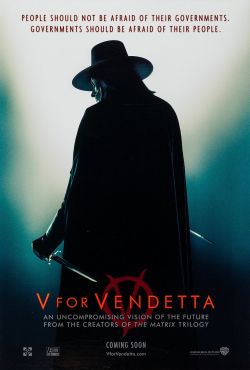
Not too far in the future, a generation in Great Britain has grown up under a fascist state that established itself in the wake of a biological weapon attack precipitated by an American war, run by High Chancellor Adam Sutler’s Norsefire party. Evey Hammond, whose parents brother died in a school attack and parents were arrested for participating in the ensuing protests, is accosted by corrupt secret police “Fingermen” on her way home on the night of November fifth, and rescued by V, an anarchist who dresses like Guy Fawkes and is never without his Fawkes mask. V invites her to a rooftop to watch his opening move: at the stroke of midnight, his bombs demolished the Old Bailey as the public address speakers fill the streets with the 1812 Overture. The next day, Evey returns to her job at the British Television offices and V hijacks a studio to broadcast his manifesto to all of Britain and invite anyone who feels the same to join him at the houses of Parliament in exactly one year. Police already at the studio nearly capture V, but Evey maces the officer, who knocks her unconscious before V incapacitates him. Recognizing the fate that awaits her if he leaves her, V takes Evey to his secret lair. For both their safety, V insists she can’t leave, but even while she’s coming to understand his ideology and character, Evey plots her escape.
One thing I really enjoy with comic book movies is when a stylized panel is clearly being replicated. The kinds of choices that get made for planning shots are different from those for comic book pages, and unusual visual elements can often give away that homage is being paid to work that came before. It doesn’t have to be as stark as movies like Sin City or The Spirit, and often the more direct framing and lighting elements have high payoffs. A sequence that particularly amused me was the decision in an otherwise relatively grounded movie to have V’s blades cast trails in a way that evokes a static medium trying to evoke motion.
The Nazi invocation is not as on the nose as it could have been, aside from the name “High Chancellor Adam Sutler”. His haircut is somewhat reminiscent of Hitler but he uses a goatee so it’s not immediately obvious. There’s not much depiction of racial discrimination but one gets a sense that if non-Anglican religions, nontraditional sexualities, immigrants, and even the non-English ethnicities of the countries of Britain are this devalued, it’s not surprising this country is so racially monolithic by now. I’m not sure but I hope “Fingermen” is a less ridiculous name in Britain. I assume the etymology is “the men who point the finger” but the result is at best silly.
The casting is solidly British. I think of only three of these actors as Hollywood people and the rest that I recognized I only know because I watch a lot of British TV (though to be fair, the UK industry never really had the divide between TV people and movie people that the US had for a few decades). Also one of those Hollywood actors never shows his face, and I was spending the whole movie going back and forth between “that’s Gary Oldman’s voice” and “it’s Liam Neeson” before the credits informed me that V was Hugo Weaving.
I had expected that either V would be perfectly heroic or a seriously questionable role model, but there’s really only one thing that V ever did that seems like going too far, and it’s not enough that he felt bad about it the whole time. The other thing that’s less than satisfying is how Sutler is dealt with. The point can be made that without his government apparatus behind him he’s just a pathetic, cowardly old man without making him feel like a footnote on the way to the big climactic fight to finish off his chief of security who only became that important because he was the key to getting to Sutler.
I waited far too long on this movie. It checked so many boxes for me and kept up the intrigue without feeling like it was slow-rolling the plot or worldbuilding. Perhaps it is a bit too black and white but it’s enjoyable to watch. Vonnegut said the power of protest art was equivalent to a custard pie dropped from a stepladder, but the most successful effect of subversive art is not to fight governments or change minds, it is to communicate that there are others, we are here. And if the We could come together to make themselves known, then maybe the governments they oppose really would know fear.
 Yesterday's Movies