
Before watching the movie:
It’s always surreal to me to be reviewing movies I was aware of and wanted to watch around the time I started doing this. As I limit the regular reviews to “10+ years old” and “first watch”, obviously not much I had a lot of interest in at the time makes it a decade before I get to it.
I’ve heard this is an apartheid story in the guise of an aliens on Earth story. It’s not exactly the most attractive idea to watch a dystopia story where the opressors are humans and the opressed are not. That’s probably why after the hype died down I didn’t make an effort to get back to it.
Anyway, I decided I should do some mockumentaries, and I was surprised to see this come up on a list of them, so I’m taking the opportunity.
After watching the movie:
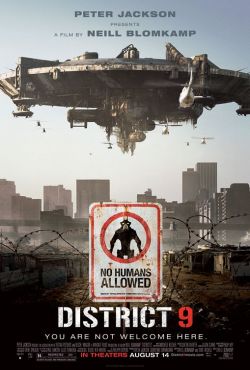
Twenty years ago, a colossal alien spacecraft drifted to a halt over Johannesburg, South Africa, and sat there motionless for months before humans managed to get inside and find over a million insectoid/reptillian aliens inside, badly malnourished. These refugees were relocated to a “temporary” shelter camp on the ground near Johannesburg designated District 9. After almost 30 years of friction between humans and aliens, the humans seeing the aliens as criminals, garbage scroungers, and wastes of resources, the government hires weapons manufacture/mercenary corporation Multinational United to evict every District 9 resident and relocate them to a new, even shabbier camp far enough from the city to forget about them. Aliens Christopher Johnson, his son CJ, and his friend Paul, have been scavenging alien trash for years, and have finally collected enough of the fluid inside them to use as fuel for their plan. Wikus van de Merwe is appointed to head the removal for reasons that have everything to do with the abilities he’s demonstrated as a middle manager at MNU and nothing to do with being the son in law of an executive. While searching Christopher’s hut, Wikus finds the canister of fluid and inadvertently sprays himself in the face with it, and Paul is killed by the mercenary leader Koobus for resistance. After injuring his arm and getting sent back for medical treatment, Wikus starts to experience nosebleeds, shed fingernails, and diarrhea, and after passing out and waking up in the hospital, Wikus discovers that his injured arm has mutated into an alien arm. MNU quickly spirits him away to their underground genetic research facility to determine that, now a hybrid, Wikus is the only human who can use the aliens’ genetically-locked guns, and they’re eager to cut him up and start studying his parts before he mutates to the point where they might as well be vivisecting any other alien in their lab.
The mockumentary angle is unfortunately only a frame. Once Wikus escapes, any pretense of being limited to found footage and what a documentary crew would have access to falls away and it becomes a traditional sci-fi action movie until it’s time for the epilogue. It’s honestly better without that limitation, but it’s disappointing for going in expecting a mockumentary.
Wikus starts as a completely unlikable nerdy bigot, kind of smug in his knowledge of how to manipulate the system to oppress the “prawns”, but a bit of a coward when his shield of bureaucracy seems to falter. It should absolutely not be necessary to have an experience where you or a loved one experiences bigotry or oppression in order to oppose oppression, but some people need that anvil dropped on their heads, and Wikus is certainly an example. But even after being forced to hide in the District among the alien refugees, he still allies with Christopher more because Christopher says he can help than because he sees that Christopher’s people are being treated unfairly, and only fully becomes a proper good guy near the end.
The creature design for the aliens is better than I always thought. Of course they’re pretty realistically drawn buglike exoskeletal bipeds, but until the movie wants you to, it’s easy to overlook their incredibly expressive faces with large, catlike eyes. That goes a long way to making them sympathetic even though they only ever speak in their own language of clicks over growls, perhaps unequipped for human speech. While gathering my thoughts for this review I found out that this movie is based on a short film the director made about the government opressing alien refugees, but the aliens in the short have kind of generic tentacle mouths and their eyes are obscured by privacy pixelation, no doubt in part to hide the shortcomings of the puppets they had to work with. District 9 has the full resources of the effects studio that made The Lord of the Rings creatures look amazing, and they clearly found an approach to make them seem fully foreign and fully relatable.
The human-alien apartheid of the movie creates a lavishly textured world for the movie to inhabit, but the exploration of it without development seems, at least to me as someone who was already familiar with the cycles of discrimination and poverty on display, seems a bit lacking. Perhaps however, the ending leaving it on the question of what happens next, refusing to break down the systems in place, asking the viewers if they can live with that, is the ultimate intent. Nothing changed except for the awareness of the one central character and the potential that the news of this situation will be shared more widely as the shred of hope that things will change. The events have already been shared with the audience, what are they going to do about it?
 Yesterday's Movies