
Before watching the movie:
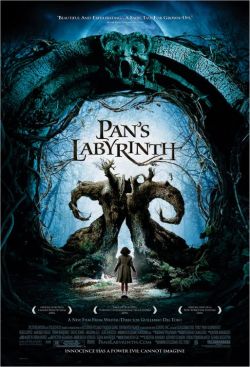
I never really had much interest in this movie when it came out. It looked like a horror movie thanks to the prominence of the Pale Man and I did not do horror movies even in 2006. This is the movie that made me aware of Guillermo del Toro as a filmmaker and probably most others, especially in this country. But mainly what I could say about it is that it appeared to be fantastical and dark story with a lot of fantasy production design and monsters.
I have a dim recollection of there being some buzz that this big budget tentpole movie is entirely in Spanish but I couldn’t have named it as a thing I knew about it until I was reminded very recently. In the past few weeks I’ve been watching a Latin American TV show and I’ve been impressed with how well I can follow it at this point in my learning of Spanish and I thought it would be an interesting exercise to do a month of non-English language movies.
After watching the movie:
Once upon a time, it is said that Princess Moanna was so consumed with curiosity about the human world that she went to see it for herself, was struck blind and amnesiac by the sunlight, and died, but her father, the King of the Underworld, believing she would return, built labyrinthine portals around the world for her and swore to wait until the end of time if necessary. In 1944 Francoist Spain, Captain Vidal of the Francoist forces mopping up the last republican rebels, summons Ofelia and her pregnant mother to his post so that he can see his son as soon after birth as possible. Ofelia detests Vidal and refuses to call him her father, and tells the fairy tales she’s obsessed with to her unborn brother to calm him through the difficult pregnancy. Along the road, Ofelia sees a large stickbug and believes it to be a fairy, which is confirmed to her when it comes to her room that night and transforms into a humanoid leading her into the nearby labyrinth to meet a faun that tells her she is the reincarnation of Princess Moanna, and if she completes the three tasks a magic book will only reveal to her when she’s alone, she will regain her immortality and return to her throne. The rebels Captain Vidal viciously persecutes seem to have unusually good help in the region, and it transpires that the captain’s housekeeper Mercedes and the doctor Vidal brought to save his son and if possible also his wife are secretly supplying them with food, medicine, and information. Ofelia becomes aware of this but doesn’t report them, as she can see that Vidal is cruel and not on the side of right, but also she’s more focused on her escape from this life into the world of the fae.
The duality of this movie feels like more of a hindrance than a strength. On the one hand, there’s the fairy tale story that’s very expertly rendered on screen but which I didn’t find very compelling because it’s a (graphic and gory) fairy tale with pretty standard tropes, and on the other hand, there’s the story of the dictatorship’s rebel-hunting captain and his hypocrisy and hubris against the desperation and risk-taking of the rebels under his nose, which I was much more taken with because of the more grounded humanity vs. fascism plot. Captain Vidal is a despicable villain you really want to see get defeated (which I suppose is the modern fairy tale), but the fairy side of the story is a few episodes of monsters and tricks and I found the only real tension to be how the human world plot that’s too big for Ofelia to affect but only respond to and escape from would interfere with her fantastical hero’s journey.
Del Toro’s insistence on producing this movie in Spanish means its cast is full of actors that are completely unfamiliar to English-speaking audiences. I wish I knew more of López, Verdú, and Angulo’s work. However, I simply don’t have enough to be able to really speak to their performances, other than that I was always watching López and Angulo whenever they were on the screen and as I came to realize the importance of Mercedes I watched Verdú closely too. The actor I do know is Doug Jones. In a movie otherwise filled with Spanish actors, Del Toro selected one of the best big-creature workers in Hollywood. As a very tall and flexible performer, his career has been almost entirely buried under latex and it seems more often than not dubbed over by other actors with bigger names. An alum of my school, he came back to star in a student film as a regular guy and when I learned who he was, I was very happy for him to have the chance to play just a regular guy, even if outside of Muncie, IN it’s one of his least known films (he does appear to have had other work without prosthetics, but also lower profile than his creature work). He learned Spanish to play the Faun, but was dubbed here too, though his work made the dub work better than if he had learned the lines phonetically. I’m glad to see him getting the recognition now that he was only beginning to receive when I first learned his name.
The greatest strength of this movie is the lush visual design. The mid-2000s were a great time for sci-fi/fantasy movies because CGI was expensive enough that they only used it where they needed it, limited enough that they put in the work to play to its strengths, and new enough that they gave it enough time to get it absolutely right, while practical work was also at a high state of maturity that truly impossible things could be absolutely convincing. It was a time when they made movies perfectly suited for behind the scenes featurettes rather than filler for streaming services. I believe the Faun is almost entirely practical, but between the prosthetics, the performance, and the lighting/color grading, he is a completely believable creature you’ve never seen before. Everything in the fantastical episodes looks like a page from a lovingly illustrated storybook, and the civil war story is one of the best-looking war movies I’ve ever seen.
I wish I knew more about the Spanish Civil War, the Republicans and the Nationalists. In history as taught in this country, Spain falls out of the narrative after the English defeat of the Spanish Armada, and their contribution to 20th century history is mainly from being the only country that was documenting the 1918 pandemic. I wish I cared more about the fairy tale. There is no Pan’s Labyrinth without its fairy tale, and it’s certainly one of the most beautiful and terrible fairy tales I have ever seen, but I just never felt the tension in that side of the movie. As much as this is very likely Del Toro’s masterpiece, I think I’d rather see Hellboy or The Shape of Water again.
 Yesterday's Movies