
Before watching the movie:
I have a dim memory spatially associating the existence of this movie with the existence of Amelie, but I wouldn’t have been in the space I’m thinking about seeing posters of them (elementary school restroom hallway) after Amelie came out, and I don’t believe they would have put, really either of them, in that place. Anyway, I remember very slowly learning of the existence of this show and some time later actually digging just deeply enough to know what the title meant.
I expect some degree of playing with gender roles if the core of the plot is a woman impersonating a man in order to get work, and that’s about all I can guess at. I’ve seen surprisingly little of Julie Andrews’ work for how much she is an institution in entertainment.
After watching the movie:
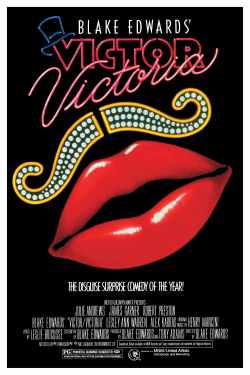
Over the hill lounge singer Carroll Todd (“Toddy), gets fired from his lounge act at Club Chez Lui when he acts too familiar with his closeted lover Richard and Richard’s straight friends and they start a brawl. English soprano Victoria Grant has been living in Paris failing to get work so long she’s not only getting evicted from her hotel room, she swoons at the mere thought of food. Victoria gets the idea to get herself a decent meal by capturing a cockroach from her room, going to a restaurant, and releasing the roach in her food after she’s had several plates. Toddy recognizes her from a failed audition at Chez Lui earlier that day and she invites him to join her on her bill, but the plan goes wrong and they barely escape the riot caused by the cockroach into Teddy’s flat. The next morning, Victoria finds that her clothes all shrank in the rain, and Toddy has her put on some of Richard’s old clothes. When Richard arrives to get his things, he mistakes Victoria for Toddy’s new boyfriend and Victoria decks him, giving Toddy the idea to get them both a new shot at success by having her pose as “Count Victor Grazinski”, a gay man from Poland come to Paris to perform as the best undiscovered female impersonator in the world. At one of “Victor’s” first shows, a Chicago “businessman” King Marchand and his moll Norma Cassidy are both impressed by the act, but King is struck by how attractive he finds the performer on stage and refuses to believe the “reveal” that the singer is a man, ready to go to any lengths to prove to himself that it’s not his own sexuality he’s questioning, much to the chagrin of Norma and of King’s long-suffering bodyguard “Squash”.
I’d been interested in looking into shows that started as a musical film rather than being a nonmusical film first and later adapted to the stage as a musical or starting on the stage and then being adapted to the screen, and I guess this might count. It’s an adaptation of a German film previously remade in several languages that’s called a musical, but I consider it a stretch to call this a musical film, even if it does seem to get classified that way. Every time there’s singing, it’s a real performance within the story, which is fine, but for a story about singers, there’s surprisingly few times we see them perform. Victoria has a bad audition, Toddy does a lounge act firmly establishing that he’s in the queer subculture of Paris, Victoria has her debut as the Count as “Victoria” which is the first song I would consider a proper showstopper, and then she has a second song that shows she’s having even more success, and that song gets two reprises as enveloped by the plot, Norma gets a forgettable number in a club to announce her return in the third act, and I think that’s all the songs (I found a list of numbers and apparently there’s two I forgot about). The stage show appears to thankfully fill it out better.
Of the 30s versions I read about, I see that the inciting incident seems to usually be the woman taking a man’s place on stage at the last minute and getting mistaken for a female impersonator rather than a sly mentor-type who knows the culture noticing she’s perfect for a bit of fraud, and I wonder if that’s one of those things like the jump from “The Shop Around the Corner” putting rivals into an anonymous relationship through a pen pal arrangement to You’ve Got Mail turning it into falling in love via internet chat where the concept was there but the culture wasn’t quite ready for it to fit into yet. From what I can tell, Blake Edwards makes a more modern exploration of gender, sexuality, and identity that I haven’t seen evidence of being in the previous, and (though none had to deal with the Hays Code), I’m sure not to the degree of candor this gets into. I do note that Victoria still has to mention a previous divorce in order to make her behavior more acceptable even for an early 80s release.
I’m not sure I’ve seen Robert Preston in anything else but The Music Man, but it’s nice to see his particular kind of rascal again, now playing a subdued and sympathetic but not tragic kind of camp. James Garner also gets his apparent type subverted as a manly man finding everything he understood about his identity and how others perceive him turned upside down. And Julie Andrews gets to show off her range in multiple ways, not least of which her vocal range, playing a classically trained coloratura turned into a lounge baritone.
My chief complaint is the sparse songs, which come so rarely they just feel like speed bumps in an engaging plot. Everything else was everything I waa hoping for, Blake Edwards wit and surprisingly deep musing on things that were taboo to acknowledge much earlier. Everyone’s at the top of their game, but the show isn’t quite itself yet.
 Yesterday's Movies