
Before watching the movie:
December is Oscar Bait season and on Yesterday’s Movies, this December is for those canonized movies that have become unquestionable in film culture.
I have seen mainly seen two opinions about this movie: glowing praise for Louise Fletcher, and faint repudiation of the depiction of mental health therapy techniques, particularly electroconvulsive therapy. I have this impression of a bleak slide into despair under the oppression of a corrupt and abusive mental health system. I also think this is one of the movies that made Jack Nicholson famous (or at least one of his earliest roles anybody talks about), so I’m curious to see if he’s got his recognizable style or if he’s more of a blank slate.
After watching the movie:
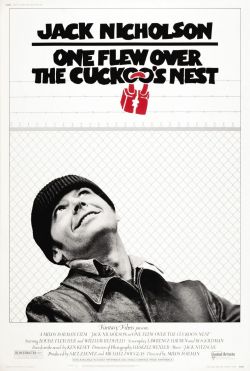
Rebel R.P. McMurphy is transferred from a hard labor prison farm to the Oregon State Hospital mental ward to evaluate whether he is actually mentally disturbed or merely faking to get out of work. Though the ward is nominally overseen by Dr. Spivey, the day to day running of the ward, including regular group therapy meetings, is Miss Ratched. McMurphy’s fellow inmates include shy, stuttering boy Billy Bibbit, gigantic deaf-mute Native American “Chief”, child-minded Martini, aggressive Taber, and others, many with chronic conditions that need intensive care. McMurphy immediately begins trying to get the gang to have more fun and believe in themselves, going so far as to steal a school bus to take the boys fishing. Ratched takes McMurphy’s flagrant disrespect as a personal challenge and enforces stricter rules for very sensible-sounding reasons. Then an orderly mentions to McMurphy that as a committed patient, his confinement isn’t the number of days he was sentenced to prison, but can last as long as the medical staff deem fit, with Miss Ratched having a lot of influence in that decision.
I feel like a lot of the reputation of the movie has been a bit overstated. I was expecting to see McMurphy beaten down psychologically through gaslighting and torture not much less disturbing than what A Clockwork Orange is supposed to be like, and in the end, McMurphy’s spirit really isn’t broken, more stolen. The electroshock therapy is overplayed in popular culture. I was expecting a lot of zapping and screaming, but we just see one pulse and McMurphy weathering the pain for several seconds after. And Miss Ratched (not Nurse Ratched, which is how I always hear her called) plays very subtly when her reputation is as a cartoon villain. Until the very end, it’s possible to read her as an antagonist more by circumstance than by anything like malice.
I wasn’t sure what kind of role this was going to be for Jack Nicholson, but then the first thing he does when the prison transfer guards take his handcuffs off is laugh maniacally in their faces as a taunt and I realized this is exactly the kind of role Nicholson is known for playing. There’s good reason to compare Louise Fletcher’s role here as Miss Ratched to her recurring role in Star Trek as a passive-aggressive politicized religious leader, but I think she’s even more subtle here. I was surprised by all the names and faces I recognized beyond the two leads that nobody tends to talk about Scatman Cruthers is briefly in this movie as the night guard. Christopher Lloyd is a ward inmate, as are Brad Dourif and Vincent Schiavelli. And somehow I didn’t even recognize Danny DeVito. I’m going to blame how young he is here, but also I think he wasn’t using his normal accent, or at least his childish affect made it less noticeable.
I was waiting for everything to go very, very wrong. And it does. But the shoe drops much later than I expected, arguably right after the climax rather than just before. And it’s more just tragic than horrifying. Most of the time we’re just hanging out with the boys of the ward, and most of them are pretty fun to be around. Not even the aggressive ones ever snap and lash out dangerously like I was expecting. The only danger in this institution is the institution itself, an indifferent system that allows power-trippers to stay in positions of power.
 Yesterday's Movies