
Before watching the movie:
This is one of the most enduring musicals of classic Hollywood (an era I’m sure some would argue I’m stretching). I always had the sense it was something of a modern fairy tale, a common woman swept into the royal court and falling in love. It didn’t seem that interesting except for how popular it is. I think I’ve come across before that she’s there to teach the king’s children, but I keep forgetting it. I also don’t always remember that the king is Siamese until I remember that another title in its orbit is “Anna and the King of Siam”, which explains why his fashion doesn’t look much like the Western perception of kings.
After watching the movie:
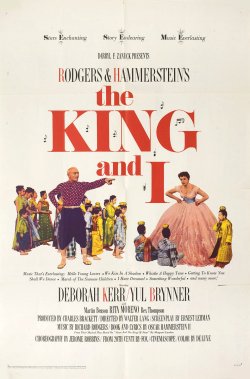
English widow Anna Leonowens arrives in Siam with her young, forgettable son to her new job as tutor and governess for the children of the King of Siam, as part of his plan to import the things that make the West so good. In the letter offering her employment, the King promised Anna a house outside the palace walls in addition to her generous salary, but on arrival, the prime minister Kralahome informs Anna that no house has been prepared, as the King often forgets his promises and it will be no good reminding him of them. Indignant, Anna demands an immediate audience, flying in the face of all protocol and of the King’s own whims, and demands what she has been promised. While the King denies having made this promise, once she has met his many, many children and his many wives whom the King deems good that Anna also teaches English to, Anna eventually agrees to begin teaching until she can have her house. The King’s newest concubine, Tuptim, was a gift from the Kingdom of Burma and is thoroughly unhappy in the palace, as she has fallen in love with her escort Lun Tha. Anna’s lessons for the dozens of children include as many references to houses and homes as possible in an attempt to annoy the King into submission, as well as many Western ideas that run dangerously counter to the King’s autocratic values, but when word reaches Siam that there is talk in the English court of disposing of the “barbaric” King and making Siam a Crown protectorate, no one is more suited to plan a party for the English ambassador to prove otherwise than Anna.
While the setup reminded me of The Sound of Music, the tone is much more in line with My Fair Lady. The King and Anna are always alternating between feisty arguments tinged with chauvinism calculated to not be too savage to make him unlikeable followed by tender moments of understanding, indicating a growing friendship that might verge into romance. I was surprised and impressed by how many little things that seem like throwaway pieces of conversation keep coming back and taking on new meaning.
Anna’s son Louis is very afterthought. I think he’s only in three scenes, or at least only has dialogue in that many. He seems more of a device to modify Anna’s status than a character, though I was surprised to learn after watching that the book that the play was based on was in turn based on memoirs of the real Anna Leonowens, so maybe he’s the equivalent of a vestigial organ in the narrative. The conception of Siamese worship of Buddha seems very Christian, but I can’t say I’m versed enough in Buddhism to be sure that this isn’t how it’s mutated somewhere. It’s more likely just an aspect of the very soft and mostly friendly orientalism the story is couched in.
The music doesn’t seem to get too much in the way, which makes it a better musical to me since I don’t care for a lot of show stopping numbers whose presence is poorly justified. The longest scene I count as a musical number is the Siamese ballet interpretation of Uncle Tom’s Cabin that Tuptim stages in order to make very clear how she feels about her own situation, but it’s directly integrated into the plot so I don’t mind too much how long it goes. I was highly amused by the royal children’s choir walking through the palace singing “Be it Ever So Humble There’s No Place Like Home”, but I immediately looked up whether it was originated by this show and it wasn’t. It would’ve been even more amusing if Anna had written it herself, but this way the show probably counts as a jukebox musical by Wikipedia’s standards.
I was surprised by the less than tidy ending. I assume it has something of a basis in the true story but it’s completely apart from how I expected a beloved classical musical to end. I looked over the summary of the animated version that came out in the 90s and it seems they “fixed” that then. Of course, a manchild king with dozens of wives could never renounce polygamy to marry his governess, but I was trying to figure out how that would work until it very emphatically didn’t happen.
For a movie that sets up South Asian culture as wrongheaded thinking in need of modernization, this is just too charming to not appreciate on something approaching its own terms. The King, who does have a name but is never addressed by it so it doesn’t matter, and Anna sparkle in every conflict and one can’t help but grin through every scene they have together. That relationship at the center of the movie is a delight to watch unfold, and most of the rest is set dressing. Maybe I didn’t want to like this, but its high status in cultural memory is well deserved.
 Yesterday's Movies