
Before watching the movie:
I remember this movie as something widely loved when I was in college, even though it came out a little before I began. There was also some kind of controversy about the real people in the movie being upset at being fooled into looking ridiculous.
A few years ago there was a streaming movie comedy where the scripted plot was written around setting up hidden camera pranks on bystanders called Bad Trip, and I thought it was the first scripted fiction/prank hybrid movie, but it seems that at the time I forgot about Borat. However, the mockumentary format of this movie makes it a bit closer to reality even if the plot is pre-written at least in the broad strokes, so it’s more conventional.
After watching the movie:
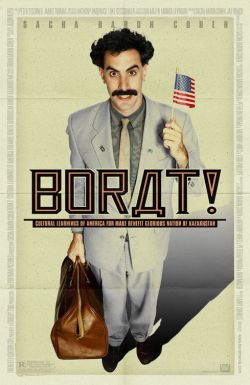
Borat Sagdiyev, a reporter for the Kazakh Ministry of Information, gets sent from his small town in Kazakhstan to go to New York City and talk to the people there to learn the things that make America great and bring those ideas back to improve Kazakhstan. To manage all the arrangements, his producer and friend Azamat comes with him. On the first or second night, while flipping channels on the hotel TV, Borat sees an episode of Baywatch and becomes obsessed with Pamela Anderson, finding out she lives in California. When Borat gets a message from home that his shrewish wife Oksana, who threatened bodily violence to him if he cheated on her, has died, he immediately tells Azamat the documentary needs to go to California “to see the real America”. Azamat agrees, but on the condition that they travel by road, and Azamat will book meetings and activities for the documentary along the way.
This is exactly the kind of intentionally offensive, edgy, line-crossing comedy that college students in the mid to late 2000s would have eaten up. Especially in the beginning when we see the town and culture that Borat comes from, which is gleefully and matter of factly chauvinist, ableist, anti-Semitic, and anti-Romani. As it moves on from the setup to the main action, it thankfully moves away from making fun of the fictional Kazakhstan and into two modes of comedy: making fun of Borat himself as a selfish, culturally misfit bigot, and using Borat as a lens to make fun of Americans.
The late 2000s were when mockumentary style comedy exploded on TV thanks to The Office, and while I think this movie came out too soon after (US Office in 2005, Borat in 2006), it still feels like this is part of where comedy was in the moment. The tone is actually very close to the spoof interviews the Jon Stewart version of the Daily Show was perfecting around the same time and the kind of “loveably reprehensible parody character” that Stephen Colbert spun off into The Colbert Report. I think another cultural artifact of its time is that its depiction of the fictional Kazakh culture is casually leaning into harmful stereotypes about a lot of the Middle East at a time when it was especially easy for Americans to forget there are real people there and not vile cartoon characters.
Supposedly there are only four people in the entire movie who are acting and the rest are real people who signed probably overly broad releases to record them and use them in the movie. I find it hard to believe that Oksana wasn’t a hired actor, but what’s more shocking is what some of the “real people” will say when they think Borat is an ally to their way of thinking. On the one hand, I don’t care for how much it leans into depicting the prejudices and insensitivity of Borat and his fictional community because it gets into the kind of comedy where if you’re against what’s being depicted the punchline is that this is obviously evil and if you’re in favor of it, the punchline is that “he’s saying what we’re not allowed to”. However, when other people who aren’t in on the joke believe they’re among friends and can speak openly, they expose themselves in a way they never would in mixed company, like the frat boys who suggest that women should be their slaves because they think that’s how it is in Borat’s country, and the rodeo manager who needs almost no prodding to mention that executing gay people is “what we’re trying to get done here”.
I’m eager to watch the 2020 sequel now and see if the shift in cultural mores altered the tone. Some of the comedy is simply about being distasteful for the sake of shock value, but underneath that there’s well-intentioned satire and skewering of the real bigots and arrogant hypocrites who offer themselves to the camera and probably regret it now.
 Yesterday's Movies