
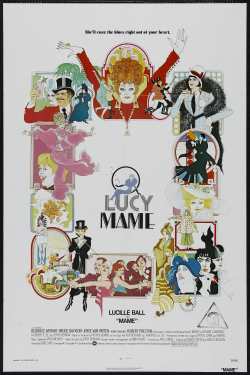
Before Watching the Movie:
I really have no concept of what this movie is about. I think Mame is an outrageous character and I think this has the reputation of being an overblown production heralding the collapse of the musical bubble like Hello Dolly was.
I don’t know if I’m more surprised to learn this is starring Lucille Ball (not someone I think of as a singer) or that there was a nonmusical stage play and nonmusical film before this show. Or that this version is just “Mame”, not “Auntie Mame”.
After watching the movie:
Upon the death of his father, Patrick Dennis’s last living relative is his aunt Mame Dennis, someone disapproved of by both Patrick’s late father, who leaves strict instructions as to how Patrick should be raised, and by the trustee of his father’s estate Mr. Babcock, who is determined to see them carried out. Escorted to New York City by his very Catholic nanny Agnes, they arrive at Mame’s home and find her in the middle of a wild party with all of the influencers and high society weirdos in town. Mame is immediately smitten with her nephew, and Patrick is very appreciative of her somewhat bohemian lifestyle, but Babcock is not, and forcibly removes Patrick from her care and into a more appropriate boarding school, just as Mame’s fortune disappears in the 1929 stock market crash. Mame swears that some way, she’ll get her little boy back, and the fabulous lifestyle would be good too.
I kept falling to anticipate the plot of this show, and in the end there wasn’t much of one. I thought it was going to be chaos having the wild socialite’s life crashed by a kid and a straight-laced nanny, but they all love each other right away. So then Patrick gets taken away from Mame and I thought that getting him back through reform and hard work was going to be the plot. No, he can just escape from the boarding school and come see her whenever he wants. Mame going from riches to rags to riches? No, after a few scenes of struggle she meets a wealthy Southern gentleman. Maybe it’s a romantic comedy now? No, she trips into charming his whole family by the end of act one, and by the end of the intermission she’s a war widow and his family is out of the picture but his wealth isn’t. I may have seen a musical where the first act and the second act are more like completely different movies, but this comes close.
It took me a while to place Mame’s actress friend because I’ve never seen Bea Arthur so young. Also she was credited as Beatrice so I wasn’t even looking out for her. I was also surprised to see Robert Preston so soon again. He’s playing the Southern gentleman archetype very straight and really one of the least memorable things in the movie, partly because he’s only in less than 20 minutes of it. Lucille Ball is not a singer. She also starts the movie at about the age she should be before the last time skip. This movie plays to none of her strengths as a performer. But her name above the title probably got some tickets sold, even if it wasn’t many. I enjoyed Jane Connell as Agnes, though the character doesn’t have enough development for how much plot focus she gets.
Beauregard’s family plantation in Georgia has aged very badly. It’s very uncomfortable now to see them painting antebellum opulence so rosily and not shying away from showing how many Black employees make their leisure lifestyle possible, complete with a song about how Mame makes cotton easy to pick and will inspire the South to rise again, and Mame just feels a little awkward because she’s not used to country life and Southern old money traditions. But I did my best to stomach it by remembering that the story is from a time when Lost Cause mythos was high in popularity. But then to go from that act one finale to a central conflict in the second act being that adult Patrick is going to marry into a snobby upstate New York family and the biggest tell that they’re not good people is that they call their Black housekeeper “one of the last good ones, not too haughty” behind her back and confide in Mame that they don’t want “the wrong kind of people” to buy the property next to theirs. Mame recoiling from that while having no qualms about Beauregard’s fortune is a level of narrative dissonance I can’t resolve.
This movie was just not much on giving any reason to watch it. The plot was mild and the songs weren’t even the kind where it seems like they needed a thread of a plot to hang their good songs on. It was interesting to learn the original context of “We Need A Little Christmas Now” (pulling out the decorations in early November because they’re desperate for cheer), but that’s the most memorable song and it’s mostly memorable because it’s played every hour from November to January. I’ve seen it, now I don’t have to see it again.
 Yesterday's Movies