
Before watching the movie:
I remember being unclear if this was ever on the stage when it came out or if it was original to the screen, just because I’d never heard of the musical before. Apparently it opened in the 70s, and what surprises me even more is that the musical was based on a play from 1926, so its origin wasn’t even a period piece.
After watching the movie:
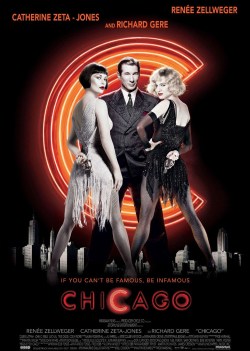
Velma Kelly was a successful cabaret singer with her sister, until the night she found her husband in bed with her sister and shot them both. Roxie Hart, a housewife who always dreamed of stardom on the stage, had an affair with Fred Casely, who claimed to have an in with Velma’s club just to get her into bed, and when he admits this to her, she shoots him. Roxie tells her husband Amos that the dead man is a burglar she shot in self defense and he should tell the police he did it because he was sure to get off, and he almost goes along with that until the detective identifies the body to him and he recognizes the name of their furniture salesman. Roxie gets sent to Cook County Jail’s Murderesses Row, overseen by “Mama” Morton, who can get you anything as long as you play by her rules. Mama connects Velma and Roxie with the best defense lawyer in Chicago, flim-flam artist Billy Flynn. Flynn can get anybody acquitted if they have $5000 and will go along with any yarn he spins to the press and jury, though he gives his full attention to the biggest star among his clients, which was Velma until Roxie’s story begins to outshine her. Amos continues to try to support his wife, but is increasingly ignored as Flynn plays up Roxie’s case to the press. Roxie starts to gain confidence in her own yarn spinning and wonders if she even needs Flynn, since no woman has ever been executed for murder before, until one is.
I generally appreciate musical adaptations that retain some of the stage aesthetic since they can be creative and stylized in ways that don’t work with filmic realism and incorporating that into the film allows the creative design work to be shared with the broader audience. This movie takes an interesting hybrid approach, swapping between a realistic setting and non-diegetic vaudeville/cabaret/Broadway style stage based performances in ways that sometimes make it a little difficult to understand what’s really happening and what’s just for the camp of it. As much as it’s nice to see the events happening in a realistic world, and intriguing to see them experiment with a hybrid, I think I would’ve preferred to stick with the stage device or come to more compromise than clash.
Richard Gere is kind of a strange choice for the razzle dazzle lawyer, but maybe I don’t know Richard Gere’s work very well. Part of why I was confused about Mama until I figured out how she was going to work in the plot was because I didn’t think Queen Latifah would play too dark an antagonist, but the first thing she made clear was that she doesn’t want to hear any complaints about mistreatment. The biggest surprise in casting however, was John C. Reilly as the not too bright blue collar husband, a role which seems very much in his wheelhouse until you add the “musical” and “Great Depression” layers. And yet he does shine here in this supporting role. He even has a solo and problems with his solo are not with him.
It’s hard to avoid thinking about The Shawshank Redemption when watching because the prison aesthetics are similar, but the tone is very different. When Mama was introduced I was expecting her to be a lot more abusive, but she’s mostly just about getting her palms greased and backing the right horses in her stable. None of the women in prison are ever much of a danger to each other than in terms of taking away the spotlight. These are all women who have been accused of murder awaiting trial and the only backstabbing among them is figurative.
There’s room to entertain discussion about the difference in these movies being between how men and women are affected in the prison system, or how the trial is the climax of Roxie’s story but only the prologue for Andy, but I think the real source of the dichotomy is merely the point being made. Where Shawshank is about the inhumanity inside the prison system, this story is about the inhumanity of the fickle crowd outside. Indeed, I had been preparing to write a bit about how it’s disappointing that the women get set up to compete against each other, but then in the end once they’re removed from that setting where they’re forced to be rivals, Roxie and Velma ultimately find their greatest success in working together.
I know the vaudeville aesthetic is a major component of this show’s charm, but a lot of the time it seemed like an excuse to fill the screen with an uncomfortable account of barely clothed women. There was plenty of fun to be had with the songs but I was always a little worried about someone popping up over my shoulder. Add to the mix the disorienting tension between the two worlds the movie is presented in and most of the best songs being already part of the trailer (though “We Both Reached For the Gun” is a highlight), and I was a little disappointed next to what I had been expecting. But then, what I’d been led to expect is once again probably not fair to the actual movie.
 Yesterday's Movies