
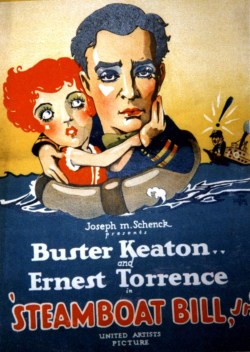
Before watching the movie:
I didn’t really have any interest in this movie until very recently, though I had been aware of the title. It always seemed a little odd to me that Buster Keaton had at least two movies with “Junior” tacked on to them, and as I was disappointed that Sherlock Jr. didn’t have any connection to the Great Detective other than the protagonist being a detective enthusiast and dreaming himself into a detective adventure and didn’t even get the reference being made to “Steamboat Bill”, I never bothered. Until I learned about its connection to “Steamboat Willie”.
This is a particularly momentous year for the Public Domain as, after buying an extension of copyright law multiple times to prevent it, “Steamboat Willie” and therefore at least the early form of Mickey Mouse has lapsed in copyright and now belongs to everybody. What I didn’t know was that the title of that short was a reference to the song “Steamboat Bill”, and there is debate whether Keaton’s movie was an inspiration for the short, as they were released the same year. Apparently the copyright of this movie was not renewed and so expired in 1956, but the connection certainly got my attention.
After watching the movie:
Steamboat Bill Canfield owns and captains the Stonewall Jackson, a paddleboat that has for decades done good business going up and down the river, but now J.J. King, the local robber baron owner of a bank and hotel and other businesses, has christened a state of the art steamer the King and is out to destroy Bill’s business. Bill gets a telegram informing him that his son William Junior has finished school in Boston and is coming to see him for the first time in years. Bill is delighted that he’s going to be reunited with his Willie until he connects with the disappointing beatnik who arrives. Willie happens to run into Kitty, a friend from college who turns out to be King’s daughter, and Bill buys a total makeover for Willie to make him into Steamboat Bill Jr, steamboat pilot he wants him to be, but young Bill Jr. is hopeless at the controls. Kitty sends Bill Jr. a message asking him to come see her on her father’s ship, but both fathers forbid them from seeing each other, and when Junior tries to sneak out, Bill Sr buys him a ticket back to Boston. Bill Sr’s boat is condemned as unsafe and he confronts King about it, believing him to be responsible. In the ensuing argument, Bill Sr gets arrested, and Junior decides to attempt to break his father out of jail, while a cyclone is brewing.
The plot is a little thin, but it’s mostly an excuse to carry Buster Keaton from one sequence of gags to another. The star-crossed lovers angle is a bit underplayed and the rivalry between steamboatmen doesn’t instigate as much as I would have thought. But what it makes up for in slapstick. Many of the gags still feel imaginative and unique today, and the ones that don’t are sold by Keaton’s famous deadpan, which always read to me more as confusion and stoic consternation than a truly blank expression.
Much is said of the expense of the moment in The General when a bridge collapses with a real steam locomotive on top of it, but what truly impresses me is the production value on display for the cyclone sequence. The cyclone sequence is the source of the famous shot where Keaton’s character is standing in exactly the right place for the facade of a house to fall down around him thanks to a second story window, but what I never realized is that it’s part of a longer sequence where that kind of near miss keeps happening and happening over and over again in ways that continue to be fresh and funny for much longer than one might expect, as the town is collapsing due to the strength of the windstorm, and except for two shots where an entire building is picked up leaving him behind and later dropped safely on top of him, it’s all apparently staged live in camera, and all but one shot seems to be at normal speed. Apparently the commercial disappointment of this movie was the final justification needed for his backer to dissolve Buster Keaton Productions, and considering how much the whole sequence must have cost, I can see why, even if it is funny all the way through.
To prepare to watch this movie, I listened to the song “Steamboat Bill” that it’s based on. It turns out that’s the opening tune in “Steamboat Willie”. It describes captain Steamboat Bill so obsessed with beating the speed record of the Robert E. Lee (set in a real race with the Natchez) with his ship the Whipporwill that he and the man who bet against him get killed in a boiler explosion. So when the movie right away presents a rivalry between the Stonewall Jackson and the King, I expected that the climax would be a race, but there is no race, rather a rescue mission, which puts Keaton’s character into an even more heroic position than piloting a steamboat to win a race. I’m not sure I’ve ever seen a character in a movie bite off a piece from a brick of chewing tobacco as Pete does in “Steamboat Willie”, but Bill Sr does this early in the movie.
A wound to the commons has been healing as the freeze on the public domain came to an end, and as the chief cause for that wound was Disney wanting to keep control of their most famous character, it was briefly cathartic to see people using the character in ways that would never have been allowed to stand by the Walt Disney Company, but that got old quickly. The reason it’s important that works and ideas be allowed to enter the common mythos is not so that anyone can sell copies of the original or pervert the original in “subversive” ways but so that we all have the right to build upon these ideas and characters that may be like old friends to us. So in the long run, I’m happier to see more wholesome remixes like this one or nuanced ones like the ongoing story of “Mousetrapped”. Steamboat Bill, Jr. has its own legacy in the numerous homages to the falling building gag, and owes much to the song it references and plays with, and although this movie may not have performed to expectations in theaters, sometimes the best sign of a work’s success is what later artists can do with it.
 Yesterday's Movies