
Before watching the movie:
I didn’t mean to put two westerns back to back, but I couldn’t finish a month of musicals without Paint Your Wagon and I didn’t realize this was a short month.
I know precious little about this movie other than that it has Western movie stars not known for singing bafflingly cast in a musical. And I also know about the Simpsons taking the mickey out of it, but it’s so ridiculous that it has to be completely unrelated to the actual movie, no matter how ridiculous the movie itself is.
After watching the movie:
Ben Rumson, a white-haired prospector who hasn’t found a speck of gold in decades of digging up and down the California hills, reluctantly intervenes at the site of a wagon crash. One man from the wagon is dead, his brother has a broken arm and leg. While burying the dead man, Ben notices that the moved earth has gold dust in it, and stakes his claim in the name of himself and his new pardner, the living brother from the wagon. Having struck gold dust, the prospectors of the region quickly put together No Name City out of tents around a general store, and all the the men live as bachelors from wild party to crippling loneliness until a Mormon family come through, a man, two women, and a baby. The miners persuade the husband that it’s not fair that they have no women and he has two, and convince him to auction one of his wives, to be “married” to the highest bidder through a mining claim. Barely aware of what’s happening, when Ben stumbles into town drunk and hears that a woman is being auctioned off, he yells that he’ll double whatever the current bid is and then collapses, and so takes Elizabeth as his wife. Ben’s violent jealousy makes him being married to the only woman in town untenable, and when the issue comes to a head, he convinces the miners that if they build a brothel and divert the six French prostitutes that will be passing by on their way to another town, not only will it solve their loneliness and his jealousy, but also it will be the start of building No Name City into a real city. But in the background, Ben’s Pardner, a kind, thoughtful man trying to be respectable in a bachelor’s town, has fallen in love with Elizabeth. And Elizabeth has fallen in love with Pardner. But Elizabeth also loves Ben, and Ben loves Elizabeth. And so, out here in the West, where Civilization hasn’t yet touched, the trio decide to try to make new rules that work for them. But as No Name City grows, Ben and Pardner hatch a scheme to tunnel under the town to catch all the gold dust everyone is spilling through the floorboards, while Elizabeth starts to get self-conscious with all the new people to have to reveal herself to as a polyandrist.
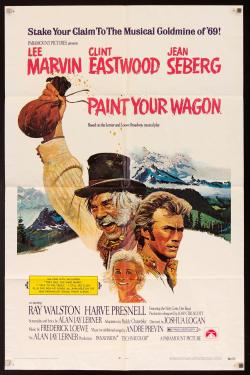
The title is so non-indicative of the plot that I don’t blame the Simpsons at all for imagining something completely different. The title song is about joining the wagon train out west, and is probably the least relevant song in the whole show. This is a movie about taking a shot at polyamory on a frontier where society’s expectations can barely reach (but it’s still the 60s, so everything works out into something more proper) that has a finale filled with cartoonish destruction that Buster Keaton could only dream of, and it’s got a title that sounds like it could be a reality show hosted by Bob Vila.
Lee Marvin is a joy to watch playing a lecherous curmudgeon, but his presence gets a little tiring as he starts to wrestle with married life civilizing him, the one thing he always swore he’d never be. His take on Ben’s main solo is intriguing, as he kind of mumbles and mutters it, but in a way that works for his voice and the character. Eastwood’s solo on the other hand, is a little less accommodating to his skill level, but at least the lyrics are a little corny so it doesn’t matter as much as if he were singing a momentous love ballad. I feel like I’ve seen Jean Seberg before, but it doesn’t seem to have been in something I reviewed here, at least in a role prominent enough to tag. The real star of the show, musically, is the faceless men’s choir.
I have to say I enjoyed the first half more than most of the second, but that’s mostly because the second half is where everything gets complicated and difficult. The tone is much more comic than most musicals that people know the names of, but that makes it more watchable. It’s more complex than corny, and I think its reputation as a failure wrought of puzzling decisions is unfair, but it comes from people reading the cast list and genre and getting angry at the movie they wrote in their own head.
 Yesterday's Movies