
Before watching the movie:
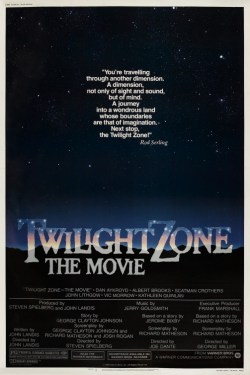
I first learned that there was a movie based on The Twilight Zone when I read that the first meeting between John Lithgow’s character and William Shatner’s guest character on “Third Rock From the Sun” had them comment that they had similar terrifying experiences on an airplane, and that was a reference to the fact that Shatner had starred in the Twilight Zone episode “Nightmare at 20,000 Feet”, and Lithgow had played the same role in the Twilight Zone: The Movie remake of that story. I thought it was odd that of all the iconic stories told on The Twilight Zone, they chose that one to make a movie out of, but simply titled it “Twilight Zone”, as if the one story summed up the entire show. I much more recently looked it up and discovered that multiple stories are told in the movie, which really makes a lot more sense.
After watching the movie:
A driver and a hitchhiker discuss their favorite Twilight Zone stories, but one has perhaps trusted the other too much. A bigot ready to loudly blame every other ethnicity for his problems gets put in their shoes. The new arrival at the senior rest home teaches the residents to reclaim the spirit of youth that they’ve lost. A young woman gets invited to the home of a boy whose family seems strangely afraid of him. And a man living through a turbulence-triggered panic attack couldn’t have seen what he saw out the window, could he? The familiar rules of reality have skewed in order to serve up dramatic irony in The Twilight Zone.
The prologue segment with the hitchhikers is just kind of there. It seems to mainly serve as a nod to the legacy of the show and to episodes they can’t include. It also provides a somewhat satisfying bookend to the movie later, which is probably important to the genre of “anthology movie”. Dan Aykroyd and Albert Brooks are here to demonstrate that some pretty big names have turned out, probably as much out of love for the classic series as for the greatly expanded budget.
“Time Out” is all ironic punishment but lacks much moral nuance I think. After complaining loudly to his friends in a bar that he got passed over for a promotion because the other guy was Jewish, nevermind that the other guy has been with the company longer or any other reasonable explanations, and turning to also verbally abuse Black people and Asians, Bill Connor steps outside and finds himself in Nazi Germany, hunted by German soldiers, then about to be lynched by the KKK in 50s Alabama, then fired at by American soldiers in Vietnam. I think it fails to demonstrate the real injustice because there’s never anything to teach Bill that these racial monoliths he hates are just people like him, just “wouldn’t it be messed up if you were the one being persecuted”? I see it’s a mashup of two different episodes, neither of which was about bigotry, so they were probably better than this. Perhaps the story would have been better with the scenes that were cut due to a helicopter crash, but from what I’ve seen, it would just be more in the vein of Bill learning his lesson simply because he’s experienced magical persecution.
I was relieved to transition to “Kick The Can”, which is a direct remake of an episode. While I have some reservations about everything being facilitated by an uninterrogated Magical Negro archetype, I enjoyed the overall concept of senior citizens who don’t believe they can do anything but sit around the home and watch TV learning how to enjoy life again. As they all turn back into children for a night, it’s a bit odd that one of them retains a smoker’s growl, but it’s also pretty funny.
“It’s a Good Life” really starts to show off what they can do having moved from 1960s TV resources to 1980s blockbuster movie resources. It’s mostly just a slow burn of creepiness as it’s incrementally revealed what Anthony can do and is doing to the people he keeps as his “family”, but once the true scope of what’s going on is revealed, it turns incredibly horrific and fantastical. I didn’t care for the attempt to bring cartoons into reality but I’m not sure if they were macabre on purpose or if it was a limitation of the technology. I did however really appreciate that what Anthony ultimately needed was someone who could kindly and gently guide him rather than simply appease him in terror of what he would do if they crossed him.
“Nightmare at 20,000 Feet” finishes on a true high note. I think this is the only episode I’d seen before and even before you get into the visual effects, it’s amazing how much more they can do with less time than they could in the original with the relatively static shots and inexpensive music tracking. We feel Mr. Valentine’s terror in a much more visceral and intimate way than we saw it before.
This is mostly a very worthy successor to the original run of The Twilight Zone. It’s regrettable that the weakest segment was also the most fraught part of the production. I really enjoyed two and a half out of four segments, so it’s overall a great experience, just really dragged down by the beginning. Just like an episode of the show, the end is always the best part.
 Yesterday's Movies