
Before watching the movie:
I’ve encountered George M. Cohan’s name around a lot, mostly around pretty much any patriotic, borderline jingoistic song from after the Civil War but before the 2000s glut of Country-Panderin’ songs. I may have seen a few times that this movie is based on his life, but uses his music (which I guess qualifies it as a Jukebox Musical), which probably means the music is largely diegetic, though it would be more fun if they found a way to incorporate the existing material into the telling of his life story directly.
After watching the movie:
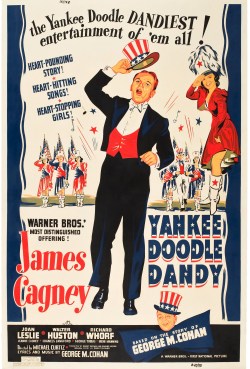
George M. Cohan, making a big return from retirement playing FDR in the controversial I’d Rather Be Right, gets word that he’s been summoned to the White House to meet with the actual President Roosevelt. Coming in expecting a scathing dressing down and being met instead by a friendly fan, Cohan starts telling his whole life story, from his birth on July 4th to a Vaudeville couple. Growing up on the stage, he quickly becomes a standout child actor, but his ego outgrows his talent and by the time he’s a young man, the Four Cohans struggle to find work because theater producers don’t want to work with him specifically. Striking out on his own, he tries to find a producer to sell his songs to, but can’t get any headway until he hustles his way into a Sam Harris’s floundering meeting with a producer, claiming to be the other half of the musical writing duo Cohan and Harris, and quickly selling their first Broadway musical “Yankee Doodle Dandy”, about an American jockey coming to London to take the English Derby cup for America, which is such a success that he’s able to invite the rest of his family to come star in his shows with him. But as hit after hit goes to his head and Cohan and Harris grows into a production company of its own with ownership of many theaters across the country, Cohan starts to want to prove he can contribute more than just flag-waving comedies, resulting in one of his biggest financial disasters, and when the US joins World War I, he’s disappointed to be told he’s too old to serve his country in the army.
I always knew of Cohan as a songwriter, and it’s not too much of a surprise to extend that to writing musicals, but I didn’t realize that his success in that allowed him to transition into not just producing musicals, but owning theaters to show them in. That side of his career is not elaborated on much except to signpost when it’s going well and when it isn’t, but there could have been more given on the balance between starring, writing, and managing ownership of theaters across the country that have to keep running when he’s not there to perform in them. In reading background, apparently he’s considered to have been the main force behind inventing modern “book musicals”.
I was about halfway through the movie before I realized the reason I liked George so much was because he’s portrayed as being unrealistically quippy. As I expected, most of the songs are in rehearsals and performances, though there is a lot of time given to performances. The show the title song comes from seems to be told completely if in a condensed form. It’s a bit of a departure from the plot to tell a completely different story, but it’s likely merited as it is shown as a major turning point in Cohan’s life. It’s hard to provide commentary on music that was already a throwback, and repurposed from existing songs when the movie came out, but it’s as enjoyable as any other classic showtunes.
It’s strange to think of this kind of movie as portraying as recent and well-remembered of history and celebrity figures as say, 1970s and 80s rock star biopics would be now. For me, this movie is a time capsule of who Cohan was when presented in the best light, but at the time, not only did everyone apparently remember who he was and his contribution to American culture (even if the movie does show him feeling forgotten in his retirement), but he was still around to consult on the movie, see it finished, and didn’t die until a few months after the premiere.
Cohan’s patriotic flagwaving informed the patriotism I grew up with. Wholesome cheerleading for a nation whose problems were buried under its staggering successes. I’m tired of harping on the problems I’m trying to see fixed in today’s world, but even though I can’t go back to the rose-colored view presented by Cohan and those like him, for which he was honored as basically a propagandist, it’s nice to take a moment to live in the positives and rah-rah with the best of them now and then, to remember what’s worth fixing.
 Yesterday's Movies